
South Africa's dilemma
(Baonghean) - The Sudanese President's return to his country immediately after the opening session of the African Union (AU) Summit held this week in South Africa, despite an arrest warrant issued by the International Criminal Court (ICC), has put the host country in an extremely difficult position.
Two years ago, on July 16, 2013, international media outlets repeatedly reported that "Sudan President Omar al-Bashir fled the AU summit." This was when al-Bashir successfully escaped arrest by Nigerian prosecutors by hastily leaving the country.
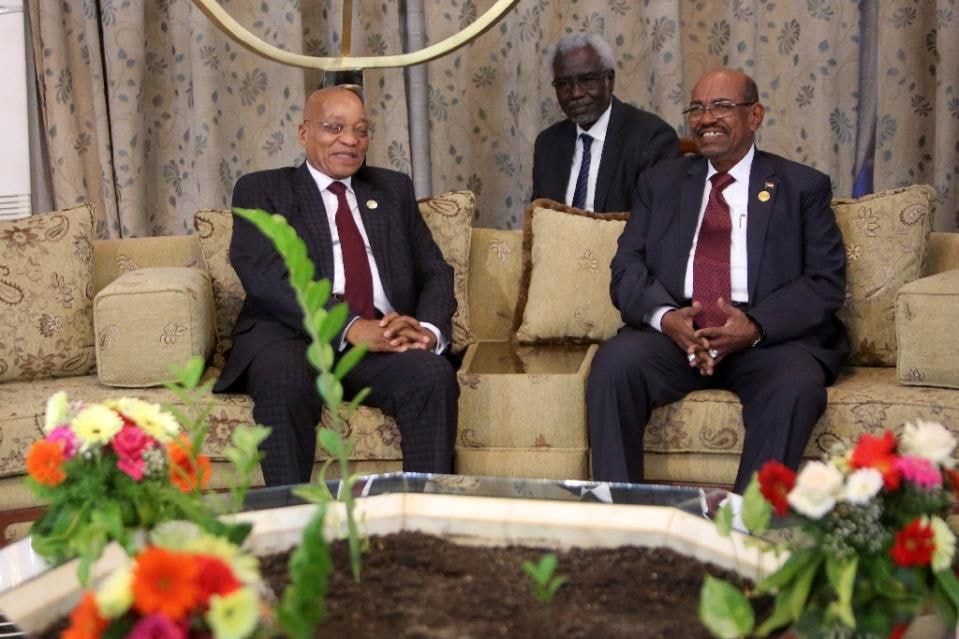 |
| Omar al-Bashir (right) meets with South African President Jacob Zuma in Khartoum on January 31. Photo: AFP |
At that time, many parts of Africa were engulfed in fierce protests, with the strongest criticism coming from the South African government. Bashir was wanted by the ICC to clarify allegations of war crimes, crimes against humanity, and genocide in the conflict in Darfur province in western Sudan, which claimed more than 300,000 lives. South Africa issued a statement promising to arrest the leader if he dared set foot on South African soil.
Yet al-Bashir actually dared to do it. He flew to the country to attend the 25th AU summit in Johannesburg. This time, just like before in Nigeria, local human rights groups in South Africa filed a request for his arrest. However, on June 15, despite an arrest warrant issued by a South African court, al-Bashir flew to Khartoum by helicopter from a military base near Pretoria with the support of the South African government.
Indeed, these two incidents are not surprising as the Sudanese president continues to discover new limits of solidarity in Africa. After all its empty rhetoric, the South African government has now been drawn into the al-Bashir debate. On June 19, the ICC demanded that the South African government explain to the judges within seven days why it failed to comply with the ICC's request to prohibit Sudanese President Omar al-Bashir from leaving South Africa. Prior to that, on June 5, the South African Foreign Minister guaranteed diplomatic immunity to all delegates attending the AU summit, and this decree will likely be invoked to justify the country's recent actions.
For the past two years, the South African government has been virtually absent from the international stage, yet this incident has thrust South Africa into the international spotlight this past week.
Some African leaders have quietly welcomed the attention surrounding Bashir, simply because it distracts from other pressing issues. Jacob Zuma, for example, has faced criticism for recent xenophobic attacks in his country. Furthermore, the lack of progress in addressing Europe's migration crisis at the AU summit—an issue that may preoccupy European government leaders but has failed to elicit any attention from African politicians who have already displaced hundreds of thousands of people—is a significant factor.
The events in Johannesburg carry an unwelcome message: that South Africa and Nigeria, two countries with significant economic and political influence in Africa, have openly defied the ICC—a court whose chief prosecutor is African—making it difficult to believe that she is pursuing neocolonial investigations against African leaders, as the continent's dictators often tell each other.
Despite the validity of the court order, this situation has drawn South Africa, the AU, and the ICC into a legal uproar as well as a political and diplomatic controversy. Most importantly, with the Sudanese president not being arrested and extradited to the Court, the ICC once again appeared as a powerless institution embroiled in a political dispute. It also diminished the international image of the court as an independent global body fighting for justice.
For South Africa, the country also found itself in a dilemma, forced to choose between two completely contradictory responsibilities: its obligation as an AU member state to assist another member, Sudan; or its role as a state entity participating in the ICC with the obligation to arrest and extradite Bashir. And the reality clearly shows that South Africa did not hesitate to reject the second option.
According to analysts, fulfilling its obligations to the ICC by arresting Bashir would mean a complete violation of the AU's repeated decisions not to cooperate with the ICC on any matters involving Kenyan and Sudanese leaders.
Therefore, South Africa chose to respect and abide by the AU's decision, which directly rejected its obligations to the ICC, to the international community, and even went against the ruling of its own supreme court.
In doing so, South Africa faces a dangerous "double-edged sword." Ideally, as a democratic nation with a constitution that respects the separation of powers, including the independence of the judiciary, it should implement and enforce any ruling issued by the Supreme Court.
But the difficulty lies in the fact that, if it doesn't do so, the South African government could be drawn deeper into an internal political controversy that could very well have enormous consequences for the independence of the judiciary and the overall stability of the country.
On the other hand, if South Africa complies with the ICC's wishes, it will avoid another international diplomatic crisis in the pan-African region following recent criticism of a series of attacks on African migrants in the continent.
In the political and cultural context of the AU, if South Africa cooperates with the ICC in the Bashir case, for some countries it would be seen as a betrayal of African solidarity, and the country risks being perceived as an enemy of the entire continent. This is because, in the eyes of African people, the ICC appears to be solely focused on prosecuting and accusing their leaders.
The South African president faced two options, both with the potential for equally undesirable outcomes. However, there was actually another option: he could have used presidential power, or a prior agreement with the AU or Sudan to grant full immunity to delegates attending the AU summit under the rules governing the summit, AU decisions on the ICC, and possibly based on international conventions on diplomatic immunity.
Although Zuma's controversial decision to allow Bashir to leave South Africa will not be limited to that country, the current predicament will instead exacerbate and complicate the relationship between the ICC and the AU, as well as the debate surrounding the ICC's position in Africa.
Thu Giang


