
More motivation for holistic development
(Baonghean) - Hong Son Ward (Vinh City) has a long-standing tradition of national history and culture. Within the ward are the national-level historical and cultural relics Hong Son Temple (also known as Ong Temple); and Vinh Confucian Temple (also known as Vinh Confucian Temple), whose restoration project has been approved and is considered a symbol of Nghe An's scholarly heritage. Now, the ward has added the relics of the Ancestor Trieu Co's Mausoleum and the Nguyen Viet Family Church, which have just been recognized as provincial-level historical relics according to Decision No. 4341/QD-UBND, dated September 6, 2014, of the People's Committee of Nghe An province. This is considered one of the conditions that will create momentum for the ward's increasingly civilized and progressive development.
Extensive historical documentation of the new site.
The Ancestral Tomb and Nguyen Viet Family Ancestral Temple complex includes the tombs of the two village tutelary deities, Nguyen Viet Nhung and Nguyen Viet Phu (currently located in Block 15, Cua Nam Ward), and the Nguyen Viet family ancestral temple (in Block 6, Hong Son Ward). According to the Nguyen Viet family genealogy and preserved stone steles, royal decrees, and documents, Nguyen Viet Nhung was born in the year Mau Dan (1578) in Trang Gia Mieu, Tong Son District, now Ha Long Commune, Ha Trung District, Thanh Hoa Province.
Nguyen Viet Nhung, also known as Dac Loc, was a 23rd-generation descendant of Nguyen Bac, a distinguished general and meritorious official who helped Dinh Bo Linh (Dinh Tien Hoang) quell the rebellion of the Twelve Warlords. Nguyen Viet Nhung was the grandson of Phuong Quan Cong Nguyen Dich Sam, who in turn was the grandson of Thai Bao Hoang Quoc Cong Nguyen Cong Duan, a renowned general and meritorious official of the early Le Dynasty. In 1593, as the Trinh-Mac conflict drew to a close, Nguyen Viet Nhung, now an adult, did not follow the official path of his ancestors. Instead, he chose to establish himself in a new land, settling in what is now Vinh City. He gathered people, established a village, and cultivated the land, a place associated with the Mai Am (later Mai Loc, in Dong Vinh ward) area, where the Voi Mep (Elephant kneeling) temple is still located to honor him.
When life in Mai Am settled down, Nguyen Viet Nhung continued to recruit and gather migrants, reclaim, improve, and expand rice and crop cultivation in Ma Han; he focused on developing roads to facilitate travel and communication with neighboring communities, creating strong connections within the village. This area became increasingly well-known, and families from many places came here to work and live. The villages became bustling and prosperous. Nguyen Viet Nhung named this new land Yen Truong – to always remember Yen Truong, the center of resistance against the Mac army of King Le and Lord Trinh in Thanh Hoa, his hometown. In the year Dinh Dau (1657), due to old age and weakness, Nguyen Viet Nhung passed away at the age of 80. His tomb was then located in Dam Ao Vang (now Hung Binh Ward, Vinh City).
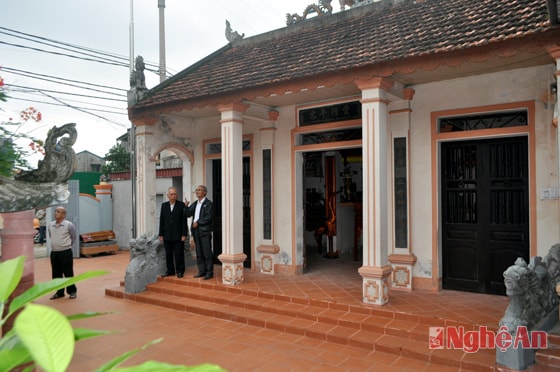 |
| Nguyen Viet Family Church - A provincial-level historical relic. |
Nguyen Viet Phu was one of five children of Nguyen Viet Nhung and his wife, Dau Thi Chuc. Born in 1603 (during the reign of Le Kinh Tong), in the Hoang Duc era, at the age of 20, he passed the Huong Cong examination. In the year Dinh Suu (1637) during the reign of King Le Than Tong, he participated in the Hoi examination and passed the Tam Truong (equivalent to Pho Bang in the Nguyen dynasty). Afterward, he was appointed by the court to an official position in Kinh Bac, holding the titles of Deputy Chief Justice and then Deputy Chief Justice, and was granted the title of Nam (Que Linh Nam). Throughout his official career, he devoted himself wholeheartedly to public service, without self-interest or causing trouble or harassment, earning the love of the people and the respect of his subordinates. In the 38th year of Thuan Duc (1675), during the reign of King Le Gia Tong, Nguyen Viet Phu retired at the age of 70 and returned to his hometown to continue his work of reclaiming and consolidating land, contributing to the prosperity of his homeland. On the one hand, he devoted himself to education, teaching the children of the local people classical literature until his death at the age of 85. At that time, his tomb was located in Ma Han.
At that time, people often said that Nguyen Viet Nhung and Nguyen Viet Phu founded five villages (Trung My, Dong An, Yen Vinh, Yen Thinh, Nam Khang) and two communes, Yen Truong and Vinh Yen (now belonging to the wards of Dong Vinh, Hung Dong, Le Loi, Doi Cung, Quan Bau, Hung Binh, Hung Phuc, Quang Trung, Le Mao, Hong Son, Vinh Tan, Truong Thi, Trung Do in Vinh City). To commemorate their contributions, after their deaths, the people erected temples and shrines to worship them, including Thinh Tien Temple (Truong Thi ward); Truong Ta Temple (also known as Tien Canh Temple, Hung Binh ward); Voi Mep Temple (Hung Dong commune); and Trung My village communal house (Vinh Tan ward). The Nguyen dynasty also issued many imperial decrees bestowing divine titles and tutelary deities upon them. In the inscription at Trung My village communal house, written by the second-class Doctor of Literature - Hong Lo, self-proclaimed Minister Nguyen Duc Ly in the year Ky Ty, the 4th year of Bao Dai (1929), there is a passage that reads: "...The two tutelary deities of our hamlet have contributed to the development and expansion of the village and commune. To this day, students are continuing to enjoy the blessings of the past, and farmers are inheriting the old legacy. Their kindness is still reserved for us and cannot be forgotten."
During the construction and development of Vinh city, the tombs of Mr. Nguyen Viet Nhung, buried in Ao Vang, and Mr. Nguyen Viet Phu, buried in Ma Han, were moved to Vang village, becoming the ancestral mausoleum of Trieu Co, now located in Block 15, Cua Nam Ward. The altars of the two men were also moved to be worshipped together at the Nguyen Viet family ancestral temple in Block 6, Hong Son Ward, as they are today. Their descendants, generation after generation, have developed into nine sub-families, continuing the traditions of their ancestors and making significant contributions to the construction and defense of the nation, helping to build Vinh City in general and Hong Son Ward in particular into an increasingly civilized and progressive city.
More impetus for development
In the honor of receiving the recognition of the Ancestral Tomb of Trieu Co and the Nguyen Viet family church as historical relics, the officials and people of Hong Son ward are even more aware of the task of building the ward into a comprehensively developed center for services and commerce within the economic map of Vinh City. Ms. Nguyen Thi Hoa – Secretary of the Hong Son Ward Party Committee – shared: Identifying culture as a driving force for economic development, harmonizing social relationships, and creating a healthy social environment, the Party Committee, government, and the entire political system of Hong Son ward have, over the years, focused on building a cultured and civilized lifestyle among the people of Hong Son, with a conscious effort to preserve and restore historical relics; and at the same time, preserving and promoting the traditional cultural values of the nation.
To date, Hong Son ward has two classified historical sites: Hong Son Temple, a National-level historical and cultural relic, and the Ancestral Tomb of Trieu Co and the Nguyen Viet Family Church, both provincial-level historical relics. This, combined with effective coordination and management of traditional cultural activities at Hong Son Temple, provides the ward with even more opportunities to implement Central Resolution 5, 8th Congress, on building and developing an advanced Vietnamese culture imbued with national identity, and Central Resolution 9, 11th Congress, on building and developing Vietnamese culture and people to meet the requirements of sustainable national development. In recent times, cultural and artistic activities have been promoted in residential areas, consistently ranking among the top performers in city-level art competitions and festivals…
In its economic development focus, the ward prioritizes the service and trade sector, boasting a diverse and abundant range of goods and services. Approximately 80% of households in the ward participate in service and trade activities under the private, family, and individual business model, with nearly 1,000 participating households (excluding the 2,445 businesses operating within Vinh Market); fulfilling their tax obligations fully to allow the State to reinvest in development. Annually, the ward consistently ranks first in the city in terms of budget revenue. In 2014 alone, estimated tax revenue reached 8.7 billion VND, and budget revenue reached nearly 6.3 billion VND, achieving 142% of the city's assigned target. The development of the private and family businesses has led to an increasing percentage of well-off and wealthy households each year, contributing to job creation, and reducing the poverty rate to 0.25% (only 4 households remaining in the ward).
Urban management, environmental sanitation, urban beautification, the construction of civilized streets and alleys, and the development of a civilized lifestyle, in accordance with Directive 05 and Resolution 06 of the Standing Committee of the Vinh City Party Committee, have been actively promoted, creating positive changes in cultural life. The education and training sector has received attention and made new strides. At all three levels of education – preschool, primary, and secondary – facilities have been increasingly improved; the quality of teaching and learning has steadily increased, with students achieving national, provincial, and city-level excellences. The preschool and secondary schools have achieved the title of advanced school at the city level; the primary school has achieved the title of advanced school at the provincial level. Primary healthcare for the people has been maintained, the quality of examination and treatment has improved, and the 10 national standards for healthcare in the 2011-2020 period have been successfully implemented. Security, politics, and social order remain stable. Party building and the political system have been strengthened and constantly innovated; the government and political and social organizations have consistently ranked among the top in the city for many years; the Party Committee of Ward 14 has maintained its title as a clean and strong Party Committee for 14 consecutive years.
To continue upholding historical and cultural traditions, while building upon the socio-economic achievements already attained, the Party Committee, government, and people of Hong Son ward are determined to make even greater efforts to build a faster and stronger developing ward. This includes enhancing the leadership capacity and fighting strength of the Party Committee, building a comprehensively strong political system, and promoting the strength of national unity to build a cultural life in residential areas. At the same time, they will continue to focus on cultural development as a foundation and driving force for comprehensive development, contributing to the achievement of the goals and targets set by the Party congresses at all levels.
Minh Chi


