
More information on the "Trinh-Nguyen conflict"
(Baonghean) - During our fieldwork in rural areas, we found some ancient documents related to the Trinh-Nguyen conflict in the Red River Delta. These include two royal decrees at the temple of Cuong Mach Hau Tran Hung Thi, Tien Hoa village, Thanh Xuan commune, Thanh Chuong district. Both decrees bear the Vinh Tho era name and, despite being over 350 years old, have been preserved intact…
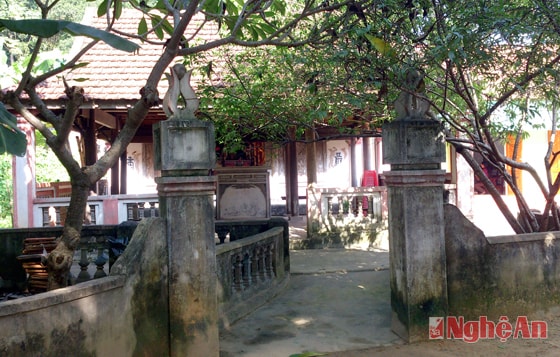 |
| The ancestral temple of Mr. Tran Hung Thi is located in Tien Hoa village, Thanh Xuan commune, Thanh Chuong district. |
Lord Tran Hung Thi, also known as Cuong Mach, was born into a family with a tradition of military commanders: His father was Tran Van Canh, who served as a member of the Imperial Guard under King Le Than Tong. His two older brothers, Duke Tran Hung Hoc and Tran Hung Nhuong, held many positions in the Le-Trinh army and made significant contributions to the restoration of the Le dynasty. The imperial decree, roughly translated, reads as follows: “A decree to General Kiet Trung, Chief Commander of the Cavalry Division, with the title of Hien Vinh Baron Tran Hung Thi: Following the orders of Grand Marshal Trinh Can and the Grand Marshal Trinh Tac, he is appointed as an attendant in the Vanguard Battalion of the Left Army Camp. He is a strong and righteous subject, participating in the suppression of the frenzied bandits in Thuan Quang province in many localities; he has fought many battles, ambushing the bandits and destroying their positions, thus achieving great merit. Now, the court officials have discussed and, in accordance with his merits, promoted him to the position of Commander-in-Chief, while retaining his previous title. He is hereby promoted to: General Kiet Trung, Commander of the Imperial Guard, assuming the position of Commander-in-Chief in the Command Office, with the title of Hien Vinh Baron.”
Based on the content and dates of the two royal decrees at the Cuong Mach Hau temple, it can be determined that the event recorded in the decrees was the 5th Great Trinh-Nguyen War (1655-1660), a struggle between two feudal factions in Nghe An province. This was the only time the Southern army proactively attacked the North, and the districts south of the Lam River, such as Ky Anh, Thach Ha, Can Loc, Nghi Xuan, Duc Tho, Huong Son, and Thanh Chuong, came under the control of the Nguyen lords. This was the longest and largest-scale war in the Trinh-Nguyen conflict, with the main battlefield taking place in Nghe An province.
After Lord Trịnh drove the Nguyễn army back to the South and recaptured seven districts on the left bank of the Lam River, he issued decrees bestowing titles upon meritorious officials, including Trần Hưng Thi. These decrees contained much important information about the history of that time. Firstly, the decrees specifically referred to the Southern army as: "The瘋狂 bandits of Thuận-Quảng," clearly demonstrating the Trịnh government's hostile and resentful attitude towards the Nguyễn dynasty. During their occupation, the Nguyễn army gradually imposed its will and consolidated its power in all aspects, including the economy.
Furthermore, the Nguyen army launched campaigns of forced evictions, causing great discontent among the people and encountering strong resistance from both the local community and the Le-Trinh government. Many individuals and families rose up against the Nguyen dynasty, with Tran Hung Thi and the Tran Hung family of Thanh Chuong being among them. Secondly, the imperial decree clearly states that Tran Hung Thi was a "loyal and steadfast subject," because although living in land controlled by the Nguyen army, he remained loyal to the Le-Trinh government, wholeheartedly cooperating with the court in fighting against the Nguyen army for five years in numerous battles. This demonstrates that Tran Hung Thi was a highly respected military general of the contemporary feudal state. This decree is a very valuable historical source that helps us better understand the people of Nghe An connected to a turbulent period in the nation's history in the 17th century.
Tu Quang


