
Human chess - a unique feature of the spring festival.
Human chess is a traditional folk game, an intellectual and engaging sport that is played during the Lunar New Year celebrations.
In the past, human chess games were popular throughout Vietnamese villages, most notably in Binh Dinh province. According to elderly locals, the human chess game in Binh Dinh dates back to the feudal era, originating in Phu Da village, Tan Dan hamlet, Nhon An commune, An Nhon district.
Through many historical ups and downs, like many other folk festivals, the human chess game had faded into obscurity. Recently, in line with the policy of preserving and reviving national culture, many festivals and forms of folk cultural activities have been restored, including the human chess game.
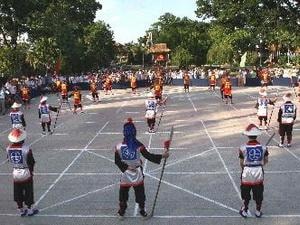
A game of human chess.
The 32 human chess pieces are usually selected from young men and women who are descendants of the village, or martial arts students from the village's martial arts school. The human chess pieces usually wear brightly colored robes embroidered with the symbol of the chess piece they represent on the front and back of their robes so that spectators can easily follow the progress of the game.
The chessboard was designed in a square shape in the middle of a large open space. Before the competition, outside the arena, spectators cheered on their team with continuous drumming and gong sounds, creating a lively atmosphere for the tournament.
The art of human chess clearly reflects the cultural identity of each region. In the North, the process of the human chess festival bears the strong imprint of folk performance through dances accompanied by characteristic verses.
In the South, when the drum signal is given, the chess pieces must advance and attack the opposing pieces using martial arts techniques such as stances, wielding swords, spears, or machetes, or performing a set of moves to knock the opponent down.
In Central Vietnam, most notably Binh Dinh, human chess festivals share many similarities with those in the South but are more vibrant. At Binh Dinh's human chess festivals, spectators can enjoy unique martial arts displays that resemble a real combat rather than just a performance.
Each move in chess is associated with a different corresponding move. For example, if a knight wants to attack any other piece of the opponent, it uses the "Monkey's Small Rooster" move – a circular turn followed by a sideways attack; if a rook attacks a cannon, it uses the "Surrounding the Pearl and Defending the Earth" move – a surprise attack from above; if a cannon attacks a knight, it uses the "Piercing the Cannon in Spring" move – an attack from below; and if a rook attacks a knight, it uses the "Ox's Horns" move – resembling a pair of ox horns striking back and forth...
To achieve this, martial arts practitioners need not only a thorough understanding of traditional martial arts but also mastery of each technique. Therefore, to be selected for the human chess competition team, martial arts practitioners undergo very rigorous and meticulous martial arts training for three to five years.
When a piece on either side is killed, the drums sound in rhythm with the killing drums. Similarly, when one of the players is in a difficult position and refuses to move a piece, the urging drums sound repeatedly. If the player is unable to move a piece, they will be declared the loser.
Each game of human chess typically lasts two hours. If a game is not finished after two hours, the organizers will draw lots to determine the winner. Teams compete in a round-robin format, usually with four teams participating. Because the competition is held as an exhibition and a way to exchange experiences, each team receives a prize at the end of the tournament to encourage the players.
According to VNA


