
Pilot program to innovate the operational mechanisms of public higher education institutions.
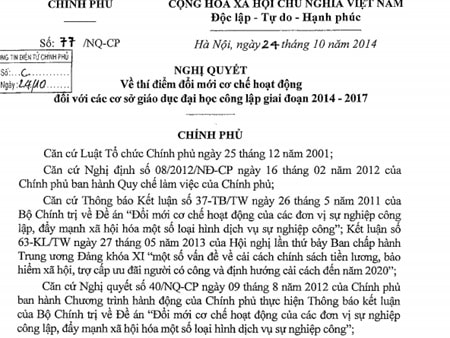
On October 24th, Prime Minister Nguyen Tan Dung signed Resolution No. 77 on piloting the reform of the operational mechanism for public higher education institutions during the period 2014-2017.
Encouraging public universities to take the initiative.
Accordingly, this pilot program aims to encourage public higher education institutions to proactively exploit and utilize resources rationally and effectively to improve the quality of university education and reduce expenditure from the state budget, while not reducing opportunities for poor students and students from disadvantaged backgrounds to access higher education.
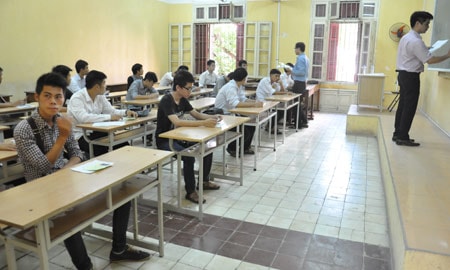 |
| Photo by Van Chung |
The government has decided that public higher education institutions that commit to fully self-financing their operating and investment expenditures will be granted full autonomy and accountability.
In terms of carrying out training and scientific research tasks, universities have the autonomy to decide on opening new majors and specializations according to social needs when they meet the conditions stipulated by law; determine enrollment quotas according to regulations and organize admissions ensuring transparency and openness.
Simultaneously, the institution decides on training activities (training programs; teaching methods; examination methods;...) to ensure learning outcomes and implement quality accreditation according to regulations; and decides on joint training programs with domestic and foreign training institutions based on accredited joint programs. The quota for joint training is included in the total training quota determined by the institution itself according to regulations.
Deciding on research directions; encouraging the commercialization of scientific research results; and providing public services commissioned by the state.
Tuition fees can be determined independently.
Regarding organizational structure and personnel, universities have the autonomy to decide on the establishment of new organizations, mergers, divisions, separations, and dissolutions; and to define the functions, tasks, and operating regulations of their affiliated organizations.
In addition, the responsibilities include deciding on the structure and number of employees; recruiting civil servants and contract staff after approval by the School Board; signing employment contracts and labor contracts, managing, utilizing, and terminating contracts in accordance with the law; and entering into labor contracts with foreign lecturers and scientists to ensure teaching and scientific research needs are met.
Public universities also have the autonomy to determine the average tuition fee (for mass programs), up to a maximum of the tuition fee ceiling set by the State plus the average recurrent expenditure from the state budget allocated to each public university student nationwide.
Determine specific tuition fees (higher or lower than the average tuition fee) for each major, profession, and training program based on student needs and training quality, ensuring that the average tuition fee within the school does not exceed the maximum average tuition fee limit mentioned above; publicly disclose tuition fees to students before enrollment.
Tuition fee waivers and reductions for underprivileged students.
According to the issued Resolution, autonomous universities must develop and implement policies to grant scholarships to outstanding and excellent students; students from disadvantaged backgrounds; provide tuition fee exemptions and reductions for poor students and students from disadvantaged backgrounds; and support the difference between the state's support level and the university's tuition fees.
Priority should be given to providing accommodation in dormitories for poor students and students from disadvantaged backgrounds, and dormitory fees should be waived or reduced, along with other policies depending on the conditions of each school.
The government is increasing preferential loan amounts for students of universities granted autonomy…
 |
In addition to fulfilling their commitment to ensuring the quality of education, public higher education institutions must establish internal spending regulations that guarantee transparency and accountability. They must also have mechanisms in place to allow staff, faculty, employees, students, and social organizations to participate in monitoring the institution's operations.
The Ministry of Education and Training will preside over the inspection and supervision of the implementation of the Resolution, and strictly handle cases of violations. In the fourth quarter of each year, it will compile and report to the Prime Minister on the progress of the pilot implementation...
According to VietNamNet


