
High school and university/college entrance exams in 2015: Convenient and beneficial for candidates.
(Baonghean) - The regulations for the 2015 national high school graduation exam and university and college admissions have been officially announced by the Ministry of Education and Training, with many changes compared to the initial draft. These adjustments have been widely welcomed by teachers and students, as they have created many more advantages for candidates…
(Baonghean) - The regulations for the 2015 national high school graduation exam and university and college admissions have been officially announced by the Ministry of Education and Training, with many changes compared to the initial draft. These adjustments have been widely welcomed by teachers and students, as they have created many more advantages for candidates…
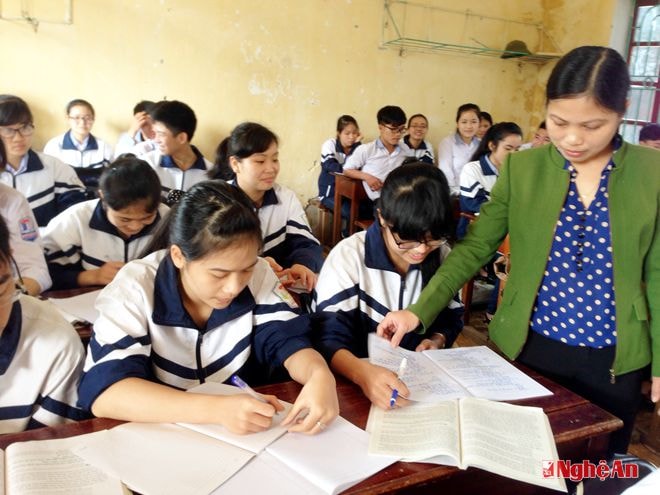 |
| Class time for 12th grade C1 students at Nguyen Truong To High School, Vinh City. |
A day after the regulations for the national high school graduation exam were announced (February 26, 2015), classes in class 12C1 at Nguyen Truong To High School (Vinh City) were much more relaxed. Even in History class, a subject not considered particularly engaging, the students were still very enthusiastic in participating when the teacher reviewed the content taught before Tet. This relaxed atmosphere likely only came about after the Ministry of Education and Training clarified that in the upcoming national high school graduation exam, students applying to universities and colleges and those only taking the exam for graduation certification would be tested separately in two different clusters.
As mentioned above, in class 12C1 of Nguyen Truong To High School, 35 out of 44 students only registered for the high school graduation exam. They felt relieved to have overcome a "barrier" as they no longer had to worry so much about travel, exam pressure, etc. Sharing her thoughts on this, student Nguyen Thi Thuy Dung said: "From the beginning of the 12th grade, I decided to pursue vocational training rather than university because my academic abilities are limited. Previously, I was very worried because I didn't understand if the exam would be harder if it was a combined 2-in-1 exam, and I didn't know if I could pass the graduation exam to pursue vocational training... Currently, I feel reassured because the Ministry's regulations state that as long as students have sufficient knowledge in 12th grade, average students still have many opportunities to pass the graduation exam. Besides Literature, Math, and English, most of us chose History as an elective subject, because it's a core subject we decided to focus on from the beginning of high school, as our class leans towards social science subjects..."
Because the students had clearly defined their career choices after graduation, Ms. Nguyen Thi Ngoc Hoan, homeroom teacher of class 12C1, said she felt quite comfortable organizing review sessions for them, and the school did not encounter many difficulties in assigning classes for exam preparation. “I think the fact that the students chose vocational training instead of university is a positive sign, because it shows they understand their true abilities and aspirations. This also helps them avoid putting too much pressure on themselves in a highly competitive exam like the university entrance exam, allowing them to focus on studying all subjects in class to achieve a relatively good GPA and have enough knowledge to participate in the high school graduation exam,” Ms. Hoan shared.
The official regulations for the 2014-2015 National High School Graduation Examination have undergone several adjustments compared to the draft published in mid-December 2014. These adjustments focus on several key points, including: The examination will be organized into clusters. Clusters for candidates taking the exam for high school graduation and university/college admission will be chaired by universities in coordination with the Department of Education and Training. Separate clusters for candidates taking the exam for high school graduation will be held at individual high schools or groups of high schools within the province, chaired by the Department of Education and Training in coordination with universities or colleges.
Regarding the exam scores, instead of the previously planned 20-point scale, the traditional 10-point scale will be reverted, with a failing grade of 1. The exam will emphasize practical application and will not require rote memorization: “The exam content is based on the high school curriculum, primarily the 12th grade curriculum. The exam ensures differentiation of candidates' abilities, meeting both basic requirements (for high school graduation) and advanced requirements (for university and college admissions). According to the Ministry of Education and Training, the use of open-ended questions aims to develop candidates' comprehensive abilities and reduce the tendency towards selective or rote learning.” According to the National High School Examination Regulations, the registration period for the exam is April 1st and ends on April 30th. To be considered for graduation, candidates must register for four subjects, including both compulsory and elective subjects. To apply for admission to universities and colleges, candidates need to choose their exam subjects based on the admission regulations of the school they wish to attend. Candidates can register for up to 8 subjects, but they must carefully consider the number of subjects to ensure the best possible results from their preparation.
Speaking about these changes, Mr. Hoang Van Thai, Principal of Nguyen Duy Trinh High School (Nghi Loc), said: "The Ministry of Education and Training's policy of change is completely in line with current trends. Of course, achieving optimal results is very difficult in the implementation process, but if we calculate specifically, the benefits are numerous. For example, at our school, we see many positive aspects after the exam reforms. The school has to pay more attention and concern, and teachers and parents must focus on the actual quality of teaching and learning, without the subjective mindset of before. That is, we can no longer think that just taking the exam guarantees a graduation rate of over 90% as before. The innovation in exam design will also impact teaching methods; how the exam is conducted will determine how we teach and learn, aiming to develop students' abilities…"
Nguyen Duy Trinh High School has a long tradition of teaching and learning and is one of the schools with the highest percentage of students admitted to universities and colleges in Nghi Loc district each year. This year, despite many changes in the national high school graduation exam, the percentage of students registering to participate in the 2-in-1 exam still reached over 80%. Currently, after successfully organizing the mock university entrance exam and the semester quality assessment exam for 12th-grade students, students are quite relaxed and confident, even though the school has prepared the exam questions based on a newly developed set of questions. Teachers, in anticipation of these changes, have made many adjustments to the content and methods of teaching to keep up with the Ministry of Education and Training's innovative exam trends, ensuring both comprehensive education and the quality of the exam.
As the main organizing unit for the national high school graduation exam in Nghe An and Ha Tinh provinces, Professor, Dr. Dinh Xuan Khoa, Rector of Vinh University, told us about the regulations for the national high school graduation exam and the regulations for university and college admissions in 2015, which have been officially announced by the Ministry of Education and Training: The changes in the national high school graduation exam are a significant step forward in the process of reforming our country's examination system. This is considered the most optimized exam, as it has been widely consulted with numerous administrators, parents, students, and those interested in education. The first purpose is to recognize high school graduation after 12 years of schooling, and the second purpose is to select students for admission to universities and colleges.
The innovation and application of the "2-in-1" results also achieve many other goals, such as reducing the burden on students, helping universities select truly high-quality human resources, and easily channeling students into appropriate educational paths. In addition, the two fundamental changes – using a 10-point grading scale and organizing separate examination clusters – have created a sense of security for students. Especially in remote districts, where a large number of students do not apply to universities or colleges, the Ministry of Education and Training's decision to allow schools to organize examination clusters at individual schools and inter-school locations under the supervision of the Department of Education and Training is a very appropriate modification, saving students from having to travel hundreds of kilometers and saving families money.
To date, more than 400 universities and colleges nationwide have registered and announced their admission plans, and most use the results of the national high school graduation exam. Some schools have their own plans, but these only supplement the aptitude and ability assessment, while the majority still use the results of the national high school graduation exam. With 13 consecutive years of successfully organizing the national high school graduation exam, the Rector of Vinh University added that: Candidates should not worry too much about the national high school graduation exam but should focus on studying to ensure they have the most complete and solid knowledge. The examination board will prepare to the best of its ability to ensure a fair, serious, objective, and compliant examination.
My Ha


