
The cooking oil market is booming.
With a market size of up to 30 trillion VND, the edible oil industry is attracting numerous confectionery, real estate, and supermarket companies to compete for market share.
The owner of a cooking oil shop in the Ong Lanh Bridge area (District 1), Ho Chi Minh City, said that he used to only sell 1-2 types of cooking oil, but now the number has increased to 6. Many small businesses have even offered to consign their goods, but he refused because he only accepts top-brand products.
"Recently, quite a few small cooking oil companies have approached me offering prices 30-40% cheaper than branded products, but I've declined, even though this product is in high demand among small eateries," the shop owner said.
Not only are cooking oil products widely available in markets, but they also occupy long shelves in most supermarkets, featuring numerous different brands. Notably, private-label products from supermarkets are also abundant, cleverly interspersed with branded items.
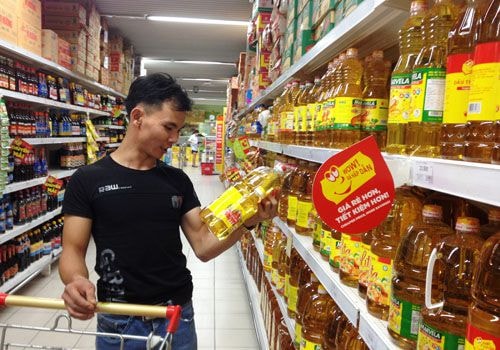 |
| Cooking oil at the supermarket is displayed in a prominent and well-ventilated location. |
For example, at the Big C supermarket chain, every other branded cooking oil product is offered with private label products in a variety of types. Notably, the supermarket's products are 50% cheaper than the branded products. This approach is also applied similarly at the Co.op Mart supermarket chain. As a major player in the confectionery industry, Kinh Do Group has also made a decisive move by selling off its branded product line, which has been around for over 20 years, to focus its efforts on the cooking oil business. The clearest example is after selling 80% of its confectionery shares to an American corporation, the company quickly invested heavily to increase its ownership stake in Vocarimex – a company that holds nearly 70% of the cooking oil market share. Kinh Do stated that after this transaction, they will quickly implement various strategies to develop the cooking oil market and provide distribution and technical support to Vocarimex.
At the company's previous general meeting, many shareholders argued that conquering this market was quite risky, given that 90% of production materials had to be imported and the company was being overshadowed by foreign products in terms of price. To prove that its strategy was on the right track, near the end of June, Kinh Do changed its name to Kido and officially declared its position "standing on the shoulders of giants" by signing a memorandum of understanding with one of the world's largest palm oil plantation and production corporations - Felda Global Ventures (FGV) - and a logistics company to establish a new joint venture in the edible oil sector. With this joint venture, Kido will not only supply products to the market but also distribute production materials to domestic and foreign businesses.
Besides Kido, in late 2014, the market for cooking oils also saw a surge in activity when Sao Mai An Giang Group, a company in the real estate and seafood sectors, launched its premium fish oil brand, Ranee. Mr. Hoang Xuan Quoc, the company's General Director, stated that despite entering the market later, the Group was determined to participate because no domestic or international company had yet produced cooking oil from pangasius fish oil. Previously, some companies had only processed fish oil into functional foods or baby food.
"Although marketing costs in this field are high because we're latecomers, we're not afraid to invest. Currently, in addition to expanding the domestic market, Sao Mai An Giang is promoting its products and boosting exports to Singapore, Malaysia, and China," Mr. Quoc said.
Previously, Quang Minh Vegetable Oil Joint Stock Company, a diversified enterprise, also entered the cooking oil market with the brands Mr Bean, Oilla, and Soon Soon.
Commenting on the booming edible oil market, Mr. Nguyen Hong Khanh, Head of Analysis Department at Saigon Thuong Tin Bank Securities Joint Stock Company (SBS), stated that it is no coincidence that many businesses are vying to enter this sector, as the profit margin in this industry is large.
Reports of business results for companies in the edible oil industry have consistently shown growth of 20-30% in recent years. Along with this growth, research reports on the edible oil industry also indicate that although market share in this sector has stabilized, there is still significant room for further development. Vietnam's per capita edible oil consumption is still low compared to the rest of the world. Currently, this rate in Vietnam is approximately 7-9 kg per person per year, while the World Health Organization recommends an average consumption of 14 kg for optimal health.
According to Nielsen Market Research, vegetable oil accounts for nearly 29% of the consumer food industry. This indicates that this market segment still has considerable potential.
However, SBS experts also cautioned that it would be quite difficult for a new business entering this field to gain market share from the big players. Marketing costs during this fiercely competitive period will increase, and it will take a long time to gain even a small market share.
"Products from foreign companies are very competitively priced, while some Vietnamese companies' newly launched cooking oil products are quite expensive. Consumers always prioritize quality and price. Therefore, any company that can offer an attractive price while maintaining quality will be prioritized," Mr. Khanh added.
Fierce competition has not only caused many large cooking oil businesses to experience declining sales, but has also eliminated quite a few ambitious brands. At the end of 2013, Vina Acecook ceased production of cooking oil under the brand name "Đệ Nhất". A representative from Vina Acecook explained that the reason was the volatile nature of the cooking oil industry due to intense competition, and the decrease in cooking oil consumption as consumers reduced their consumption of fried foods.
According to statistics from the Ministry of Industry and Trade, there are currently nearly 40 businesses producing and trading edible oils in the market. Of these, palm oil is the main vegetable oil product, accounting for 70% of the market share, soybean oil accounts for 23%, and other vegetable oils account for 7%.
According to VnExpress


