
Hoang Mai town develops its marine economy.
(Baonghean)Hoang Mai town is blessed with a prime location, boasting many beautiful coastlines and abundant seafood resources. Besides focusing on seafood exploitation and processing, Hoang Mai town also has promising prospects for developing an industrial port.
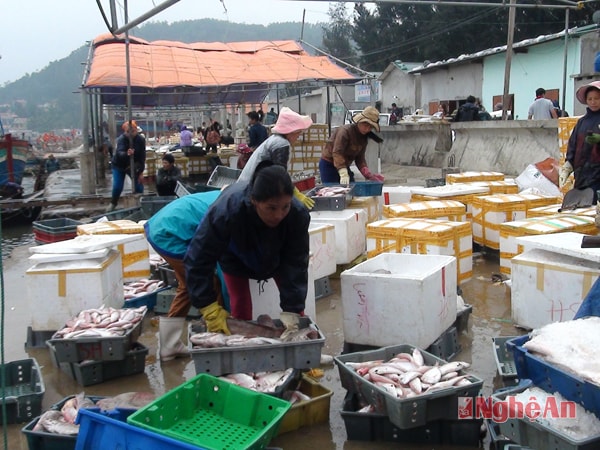 |
| A bountiful fishing season in Quynh Phuong - Hoang Mai town. Photo: Viet Hung |
Captain Nguyen Huu Thanh, from Dong Tien hamlet, Quynh Lap commune, Hoang Mai district, who recently returned from a long fishing trip, said: "To have the large 420 HP vessel we have today, it took nearly three decades of saving and hard work from two generations of my family. Starting with a 20 HP vessel given to me by my parents, I gradually upgraded to a 45 HP vessel, then a 90 HP vessel (in 2010). By 2011, realizing that fishing grounds were shrinking and that to do business on a larger scale and achieve higher efficiency, I needed a larger vessel, I mobilized four more shareholders, contributed assets, mortgaged them to borrow 1 billion VND from the Hoang Mai Agricultural Bank, and borrowed another 1 billion VND from relatives and friends to build the 420 HP vessel worth 3 billion VND. Offshore fishing has provided me with a stable livelihood, creating income for 13 crew members at 5-7 million VND per trip per person." From fishing with poles and catching squid and tuna, his family has now paid off their bank loans, built a house, and purchased equipment.
Mr. Le Ba Luu, from Dong Tam hamlet, Quynh Lap commune, Hoang Mai town, is also a skilled fisherman. Having accumulated assets and borrowed from relatives, Mr. Luu now owns a "billion-VND" fishing vessel with a 320CV engine. Thanks to this, each trip to sea brings him a considerable income for himself and his crew. According to Mr. Thanh, Mr. Duy (Rong hamlet), and Mr. Trieu (Hop Tien hamlet) in Quynh Lap commune, seafood harvesting is currently the highest-paying occupation in Quynh Lap. The Chairman of the People's Committee of Quynh Lap commune, Mr. Tran Dinh Chieu, happily stated: "Seafood exploitation in Quynh Lap is the leading industry of the commune, generating the highest income, accounting for nearly 60% of the commune's total income. Currently, the commune has 145 vessels with a capacity of 90 horsepower or more. The commune's catch in 2013 reached its highest level ever with over 25,000 tons. The commune has always facilitated loan procedures for fishermen and requested support from higher authorities for ICOM radios and sonar for large fishing vessels."
In Quynh Phuong, besides its tourism advantages, offshore fishing is also a traditional and thriving occupation. The ward currently has 580 fishing vessels with a total capacity of over 40,000 horsepower, including approximately 300 offshore fishing vessels, providing employment for over 3,000 workers. The fishing industry in Quynh Phuong is supported by the processing industry in Quynh Di, with its traditional craft villages and large-scale steaming, drying, and fish sauce processing facilities. The Phuong Mai enterprise in Quynh Di processes thousands of tons of steamed and dried fish annually, supplying products to fishermen in both Quynh Phuong and Quynh Di.
Hoang Mai town currently has 962 fishing vessels with a total capacity of 83,650 horsepower (CV) belonging to 3 wards/communes: Quynh Lap, Quynh Di, and Quynh Phuong (of which 358 vessels have a capacity greater than 90 CV, accounting for 37.2%; 180 vessels have a capacity from 20 to 90 CV); the 2013 fishing output reached 28,682 tons of seafood, an increase of 45% compared to the same period, equivalent to 137.9% of the annual plan. The people of Hoang Mai town... Hoang Mai has processed seafood with a variety of high-quality products such as: sun-dried squid, dried squid, barramundi, fermented fish sauce, steamed anchovies, and steamed fish, which have been exported to Laos and Thailand… The total annual processed seafood output reached 7,495 tons (including: 200 tons of frozen shrimp, 674 tons of frozen squid, 6,621 tons of fish and other products), and the annual fish sauce production was 3,750,000 liters.
Currently, there are 12 shipbuilding and repair facilities in the area (8 in Quynh Phuong and 4 in Quynh Lap), some of which can build ships over 90 horsepower, such as those owned by Mr. Ho Tho and Mr. Anh. Fishery logistics services are diverse and abundant. Hoang Mai town has 16 fuel stations with an average annual supply of over 12 million liters; and 15 ice-making machines with an average annual output of 20,000 tons. Fishermen in Hoang Mai town have formed a team of transporters and buyers at sea with 10 vessels ranging in capacity from 50 to 300 horsepower, mainly transporting goods to northern provinces, with an annual cargo volume of approximately 8,000 to 9,000 tons. Hoang Mai town has effectively put into operation the Lien Thanh fishing port in Quynh Lap commune. Currently under construction are investment projects to build the Lạch Cờn storm shelter and anchorage area, and projects to dredge and renovate the Nhà Lê canal (also known as Mai Giang river), Quỳnh Lập breakwater, and Quỳnh Phương breakwater.
Hoang Mai town is also famous for its beach tourism combined with spirituality. The Hoang Mai coastline boasts beautiful beaches with gentle depths, clear and clean water, calm waves, and suitable salinity for swimming and therapeutic purposes, such as Quynh Phuong and Quynh Lien beaches. In addition, there are historical and cultural spiritual sites such as Xuan Uc Temple (Quynh Lien) and Corn Temple (Quynh Phuong).
It is known that Hoang Mai town is striving to develop its marine economy at a rapid, comprehensive, and sustainable pace, while maintaining national defense and security at sea and protecting maritime sovereignty and islands, along with protecting the marine environment and addressing social issues such as job creation, poverty reduction, and improving the lives of people in coastal areas. The town is attracting resources to invest in the construction of coastal infrastructure, prioritizing investment in electricity, water, transportation, irrigation, ports, fishing harbors, storm shelters for boats, and dikes and breakwaters. Besides the planned Dong Hoi Port, which can accommodate ships with a tonnage of 50,000 tons to serve the power plants there, the town is calling for investment in upgrading beaches; improving the quality of restaurant and hotel services, and preserving historical sites such as the Corn Temple, Xuan Uc Temple, and traditional festivals to attract tourists. Review and adjust the town's overall tourism plan and attract investment to develop coastal tourism. Upgrade and expand coastal roads and the system of branch roads connecting National Highway 1A with these roads; Invest in expanding and upgrading the infrastructure of the Quỳnh Liên aquaculture area and concentrated aquaculture farming areas: Quỳnh Liên, Quỳnh Xuân, Mai Hùng, Quỳnh Dỵ, Quỳnh Lộc.
Quynh Lan


