
Providing practical support to domestic businesses, especially private enterprises.
Editor's Note: On June 25th, the Government's macroeconomic management team held its regular meeting to discuss the results of implementing socio-economic and state budget management tasks for the first six months of the year. According to the Ministry of Finance, in addition to the achievements, state budget management still has limitations that need to be overcome... After the meeting, Minister of Planning and Investment Bui Quang Vinh had an exchange with the press regarding the content of this important meeting. Nghe An Newspaper respectfully presents this to our readers.
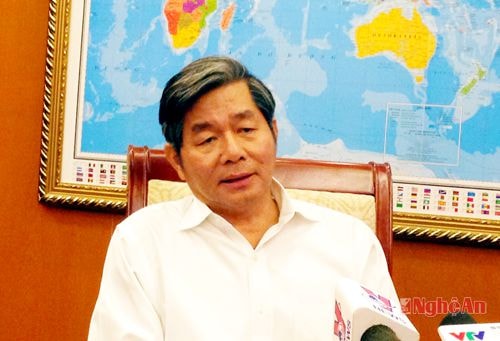 |
| Minister Bui Quang Vinh |
PV:Mr. Minister, what were the highlights of the regular meeting of the macroeconomic steering committee?
Minister Bui Quang Vinh:This meeting of the macroeconomic steering committee did not address any unexpected issues such as the sharp drop in oil prices or fluctuations in monetary policy, and its purpose was to discuss the economic situation in the first six months of the year. However, we must always be aware that 2015 is the final year of the 2011-2015 five-year plan, therefore, evaluating the first six months is very important. During these six months, we have had many positive developments as well as many new challenges, so discussions by experts are essential, especially the assessments of the four ministers from the Ministries of Finance, Planning and Investment, Industry and Trade, and the Governor of the State Bank of Vietnam, to determine what issues need to be addressed in the last six months of the year in order to maintain the 6.2% growth rate approved by the National Assembly. This meeting includes a lot of new data on growth forecasts, inflation forecasts, and predictions of favorable and unfavorable conditions.
In the first six months of the year, the Consumer Price Index (CPI) fell very low, almost to its lowest level in the past 10 years. This fact shows that even though electricity prices increased by 7.5% and gasoline prices were adjusted, they did not contribute to an increase in the CPI. Notably, the strength... (Continued from page 1)
Our production continues to grow, with GDP growth in the first six months reaching 6.28%, the highest in this term, if not in the last 10 years. While the CPI is low, there's no need to worry, as we remain stable with each quarter showing higher growth than the previous one. This growth is concentrated in two sectors: manufacturing, which has consistently experienced high growth for the past three years, potentially contributing up to 9% in the first six months; and the mining industry, specifically oil, gas, and coal. In the first six months, oil production reached 8.3 million tons – a significant increase compared to 7.4 million tons in the same period last year. These two sectors are making a substantial contribution.
PV:Mr. Minister, what are the most significant challenges currently facing our country's economy?
Minister Bui Quang Vinh:In this meeting, the macroeconomic steering committee assessed that our country's economy is in a crucial stage, as this is the year marking the end of the five-year plan. Therefore, our more than two hours of discussion today were dedicated to analyzing and evaluating economic growth and the challenges currently facing us. Based on our assessment, we believe that good growth while the CPI is decreasing is positive, but there are still three major challenges: firstly, the contribution of the agricultural sector has decreased sharply; in 2014, the agricultural sector contributed 3.44% to GDP, while in the first six months of this year it only contributed 2.17%, mainly due to drought in Central Vietnam. Secondly, the significant decrease is in the aquaculture sector, as shrimp and catfish exports have declined, leading to a decrease in domestic production. Finally, disease outbreaks have also had a significant impact on production and exports. The problem is that agriculture, which is the foundation of the economy, attracts a large workforce and is the focus of many social welfare policies, is now experiencing a sharp decline due to weather and market conditions. This should be considered a worrying issue that requires collective effort to resolve.
The second challenge is our large trade deficit. For three consecutive years, we had a trade surplus, resulting in a balance of payments surplus and increased foreign exchange reserves. However, in the first six months of this year, we started experiencing a trade deficit of 4.7% of import and export turnover. Although the target is 5%, this is still a challenge. If the trade deficit surges beyond 5%, it will disrupt the balance of payments, reduce the surplus, and, more significantly, put pressure on the exchange rate.
PV:Minister, credit has increased sharply by more than 5%, but credit to the real estate sector has doubled to 10%. Is this something to worry about?
Minister Bui Quang Vinh:Regarding this issue, the State Bank of Vietnam has explained that the real estate sector is thriving, with many projects continuing and new ones starting, leading to increased capital inflow, a warming market, and increased consumption of real estate products. Increased consumption naturally leads to increased capital attraction, and this capital is not solely from banks. Furthermore, this increase is concentrated in the segment where investors invest and sell directly to customers, bypassing intermediaries, allowing banks to monitor projects with products and real demand. This helps limit bubbles and the 발생 of bad debts. However, strict market control is still necessary. In my opinion, overall, although real estate contributed 2.2% to the 2014 growth, coupled with a warming real estate market, projects have resumed operations and investment has increased, leading to increased bank and other social capital flows… which is a positive sign. However, we must be wary of real estate bubbles with artificial demand. If we continue to pour money into this market, it will further exacerbate bad debts, making it more difficult to deal with bad debts later on. Therefore, the government requires stricter control to prevent bubbles and artificial markets. Caution is needed in this area.
PV:Minister, will the economy be negatively impacted, affecting government revenue, if oil prices fall further?
Minister Bui Quang Vinh:We've discussed this many times before. At the end of 2014, we held a meeting at the Ministry of Industry and Trade, clearly forecasting that Vietnam would both export and import petroleum products, but import more. This is because we export the oil we produce to the world, and when prices fall, government revenue decreases sharply (last year, the forecast was based on $100/barrel, but at times world prices fell to only $40-$50/barrel, and this year we are still affected, so government revenue is still short). However, since we are an importer of refined petroleum products, a decrease in the price of refined products benefits us, helping to reduce the prices of raw materials and inputs for manufacturing and service industries, thereby boosting production, increasing GDP, and increasing government revenue. This forecast has come true, and currently, government revenue has met and exceeded the target.
PV:According to the Minister, what are the key solutions to boost socio-economic development in the last six months of the year?
Minister Bui Quang Vinh:To address the issue of continued growth, I believe we must promote exports, especially agricultural exports. We must find ways to increase agricultural exports, aiming to reduce the import-to-export ratio, strictly control imports, and restrict the import of non-essential or excessively expensive goods. We must do everything possible to prioritize and promote domestic production.
Furthermore, I believe we must combat smuggling and counterfeit goods to effectively promote domestic production. This is crucial because while manufacturing contributes a large proportion to GDP, it is primarily driven by FDI, which is good, but we need our own economic sector. I think we need to invest directly in small and medium-sized enterprises (SMEs) and private businesses so that this sector can develop Vietnamese brands. Economic self-reliance is always better. To achieve this, we need to effectively implement Resolution 19 on creating a competitive environment and supporting domestic businesses, especially private enterprises. These are the things we must do to ensure this sector achieves strong growth in the future.
PV:Thank you, Minister!
Red River(Perform)


