
Lack of suitable housing for small and medium-sized enterprises.
(Baonghean) - The lack of land for factory investment to serve production and business is a prominent issue for small and medium-sized enterprises (SMEs) in urban areas. Of particular concern is that industrial clusters have not met the development needs of SMEs, while large industrial zones lack space for small businesses…
Established in 2009, ICEM Construction Materials Joint Stock Company had to rent 1,000 m2 from a unit in Nghi Lien (Vinh City) to build a factory and install production equipment, with a land lease term of one year. After that term, they had to move again to another location from a unit in Nghi Phu, and after two years, the land lease contract expired, they continued to search for another location and moved the equipment to Ngo Thi Nham Street, Trung Do Ward, to continue production. There, the company rented 1,000 m2 of factory space and 2,000 m2 of land for warehouses, and invested 700 million VND to renovate the factory and upgrade the warehouses to serve production and business... After these relocations, the company lost a lot of effort, incurred costs, and lacked operational stability... but because of the lack of available land, they had no choice but to rent land for short periods.
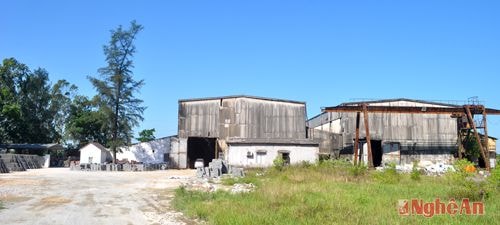 |
| Some small and medium-sized enterprises (SMEs) are renting factory space and premises from businesses that have relocated (on Ngo Thi Nham Street, Trung Do Ward, Vinh City) to continue production. |
Trung Do Ward is a location where several small and medium-sized enterprises (SMEs) rent land for the production and sale of construction materials such as bricks, tiles, white stone processing, wood processing, and carpentry. Some large factory buildings still exist here (due to the relocation of Vinh Concrete Factory, the leather factory, etc.), and are currently leased by four SMEs for production. Mr. Nguyen Tat Thao, Vice Chairman of the People's Committee of Trung Do Ward, stated: “This area is within the planned Quyet Mountain forest park, so businesses that invest in and operate in accordance with the plan will be granted long-term land leases (49 years). Businesses renting factory space for brick, tile, stone processing, and woodworking are only renting temporarily.” Thus, in the coming time, businesses renting land in this area will continue their “journey” to find new land for production. The practice of small businesses renting land from large businesses and state-owned enterprises is quite common.
In Vinh City, there are 1,144 businesses in the mining, processing, and construction sectors, most of which urgently need land for factory and production facilities. Vinh City has only planned and invested in 5 industrial clusters (Hung Loc, Nghi Phu, Dong Vinh, Hung Dong, Nghi Kim), of which 3 clusters – Nghi Phu, Hung Loc, and Dong Vinh – have reached 100% occupancy, while the remaining 2 are currently undergoing infrastructure development. However, not all businesses have the capacity to enter these smaller industrial parks, while most small and medium-sized enterprises (SMEs) in Vinh City are small in scale and have limited capital.
After expanding its administrative boundaries, Vinh City gained a significant amount of land, but most of this land has been planned for residential areas. The allocation of land for industrial clusters has not received adequate attention, making it increasingly difficult for businesses to find suitable land and confidently invest in developing their industries, especially in new, high-tech sectors.
In Thai Hoa town, small and medium-sized enterprises (SMEs) also face difficulties in finding land to build factories for production. Because the majority are small businesses with limited financial capacity, it is difficult for them to invest in the Nghia My industrial cluster (Thai Hoa town), which covers over 30 hectares, as businesses would need to invest a significant amount of capital to complete the technical infrastructure. Therefore, only 5 businesses have invested and started operations in this industrial cluster. The preferred option for these small businesses is to buy or lease land for production and business.
Mr. Le Nguyen Chat, Chairman of the Association of Small and Medium Enterprises of Thai Hoa Town, said: “Currently, there are more than 200 businesses in the area (including 70 businesses participating in the association), and many businesses have a great need for land to invest in factories for production and business. Currently, due to Thai Hoa Town's investment in developing many new roads such as DD5, DD6, N3, and N4, land resources in Long Son and Hoa Hieu wards have been developed, creating favorable conditions for businesses to establish projects to lease or purchase land for stable investment in building factories for production and business. To ensure businesses can invest and develop production with peace of mind, Thai Hoa Town needs to plan and invest in industrial clusters synchronously and have mechanisms and policies to support businesses, especially in providing land and clean land sources…”
Currently, many localities in our province have invested in developing industrial clusters such as Nam Dan, Do Luong, Quy Hop, Nghia Dan, Dien Chau, Anh Son… to create space to attract businesses. However, due to high investment capital (as most businesses have to invest in technical infrastructure) and cumbersome administrative procedures, many small and medium-sized enterprises are not yet enthusiastic. In Quynh Luu district, after the separation, an industrial cluster has only recently been planned. Mr. Ho Ngoc Dung, Vice Chairman of the District People's Committee, said: “The district has chosen to plan and invest in industrial clusters in the western part of the district (including Tan Thang, Quynh Chau, and Ngoc Son communes). This area is far from the district center, has the advantage of large land areas, suitable for manufacturing, processing, textiles, handicrafts, building materials… After completion, the industrial clusters will create space for many businesses to invest and develop production.”
Mr. Phan Thanh Mien, Chairman of the Nghe An Small and Medium-Sized Enterprise Association, stated: “Currently, there are more than 8,000 small and medium-sized enterprises in the province, but few of them have been allocated land or leased land long-term in industrial clusters to invest in building factories for production and business. The issue of creating land and clean land funds for businesses to invest in production development needs more attention and support from all levels and sectors. This is also a practical policy to support and alleviate difficulties for businesses in the current situation.”
Hoang Vinh
| Mr. Nguyen Chi Cong, Deputy Head of the Economic Department of the Vinh City People's Committee, said: “Businesses investing in the industrial cluster have invested over 388 billion VND and, after becoming operational, have made significant contributions to the socio-economic development of Vinh City, contributing nearly 37.6 billion VND to the national budget annually, and creating jobs for 1,433 workers… To continue attracting investment in Vinh City, in the coming time, the city will continue to review and reassess the production space needs of businesses to serve as a basis for planning the development of industrial clusters from now until 2020. Simultaneously, we will continue to invest in completing the Hung Dong and Nghi Kim industrial clusters to create space for businesses to invest in production and business.” |


