
Due to a shortage of raw materials, the sugar factory shut down its operations early.
(Baonghean) - Recently, sugar factories in the province have faced a severe shortage of raw materials, with some factories having to end their crushing season earlier than usual. Creating a stable raw material supply and developing a sustainable sugar cane industry is a pressing issue requiring responsibility from many parties.
There is a severe shortage of raw materials.
As in previous years, the Nghe An Sugar Company Limited is currently in the peak sugarcane crushing season, which usually lasts until mid-April or at least the end of March. However, this year, even though it's only the beginning of March, the company's workers have already started cleaning and maintaining the machinery as usual after a crushing season.
Mr. Anthony John Mape, General Director of Nghe An Sugar Company Limited, expressed his concern: “According to the plan, for the 2016-2017 crushing season, we will crush approximately 650,000 tons, however, we have only been able to purchase 534,000 tons of sugarcane. The shortage of raw materials is due to farmers converting some of their sugarcane fields to other crops, and over 100,000 tons in the raw material area have been sold to other factories in the province.”
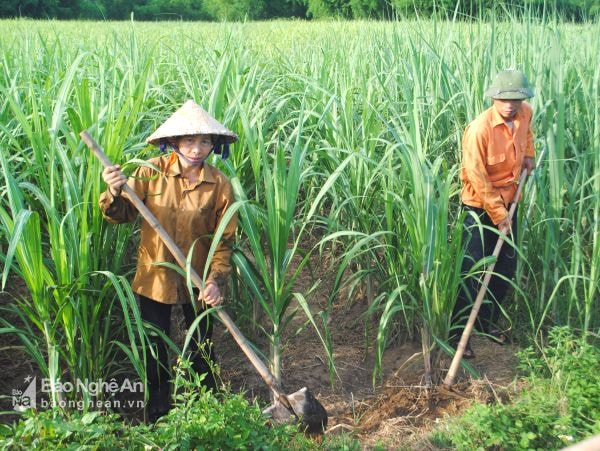 |
| Caring for sugarcane plants in Nghia Phu commune (Nghia Dan district). Photo: PH |
In Tan Ky, one of the province's key sugarcane growing areas, the district's sugarcane area decreased by nearly 1,000 hectares in 2016 alone, to almost 5,400 hectares. Ms. Dang Thi Van, Deputy Head of the District's Agriculture and Rural Development Department, shared: "The district's stance remains to maintain the planned area, but people are still independently converting to other crops."
| ||
| Loading sugarcane into the crushing machine at the Song Con sugar factory. (Archive photo) |
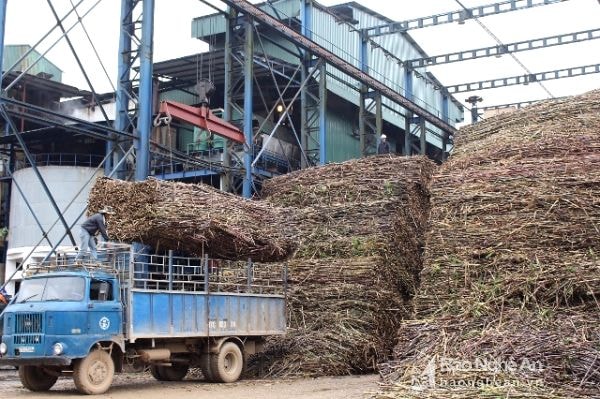
Nghe An currently has 3 sugar mills operating within its territory, with a total processing capacity of 13,300 tons of sugarcane per day. To ensure raw material supply, the province has planned over 30,000 hectares of land for sugarcane cultivation, involving approximately 42,000 farming households, providing 2 million tons of sugarcane annually. However, due to various reasons, the entire province now only has around 22,000 hectares of sugarcane plantations. Not only has the area decreased, but sugarcane yield and production have also not improved, remaining at only 50-55 tons/ha, while the mills all have plans to invest in increasing their crushing capacity.
Find solutions
While the planted area remains unchanged, investing in increased productivity and quality is the most effective solution and is currently being prioritized by many businesses and localities. According to Mr. Anthony John Mape, General Director of Nghe An Sugar Company Limited, the company is currently implementing a project to produce three-tiered sugarcane varieties, including a tier 1 sugarcane seed area in Yen Thanh, and tiers 2 and 3 seed areas in Nghia Dan, selecting and developing new sugarcane varieties with high yield and quality for production. Simultaneously, they are investing in machinery to help sugarcane growers mechanize planting, weeding, fertilizing, spraying pesticides, and irrigating the sugarcane. In particular, they will be experimenting with machine harvesting and loading to reduce costs, increase productivity, and improve sugarcane quality.
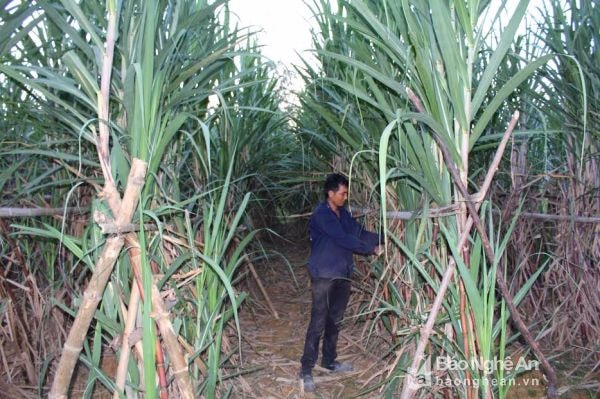 |
| Sugarcane raw material of Tan Ky Sugar Company. Photo: PH |
In Nghia Phu commune (Nghia Dan district), a large-scale sugarcane production area covering 15 hectares has been implemented for the past two years with 22 participating households. On this field, technical measures ranging from introducing new varieties and applying water-saving irrigation technology to intensive cultivation in favorable areas and promoting mechanization from land preparation, planting, caring for, and harvesting are all implemented synchronously and uniformly according to a single process. As a result, sugarcane yield has increased by nearly 30% compared to before.
Most recently, on March 16, 2016, the Provincial People's Committee issued a decision approving the adjustment and supplementation of the sugarcane production area plan. Accordingly, by 2020, the entire province will have a standing sugarcane area of 28,957 hectares.
According to Mr. Hoang Nghia Hieu, Director of the Department of Agriculture and Rural Development: Along with planning, specific solutions regarding science, technology, and mechanisms are also being developed. Accordingly, research, adoption, and application of advanced technologies will be undertaken to invest in sugarcane production development according to technological processes suitable to local production conditions, aiming for high and sustainable results. Given the decreasing land available for sugarcane raw material areas, sugar factories and localities need to prioritize the improvement of sugarcane varieties. Select varieties with high yield, high sugar content, drought tolerance, good regeneration ability, and slow or no flowering, such as ROC10, ROC16, ROC23VN 85-1859, My55-14... Approach and apply biotechnology to produce large quantities of uniform, disease-free seedlings in a short time, reducing costs. At the same time, we will continue to import, research, and test new varieties with high yield, quality, and adaptability to meet the requirements of production development.
Sugar companies need to establish seed production areas to gradually ensure that all newly planted sugarcane areas have high-quality seeds, replacing the current method of using raw sugarcane as seed. Furthermore, sugarcane harvesting is a labor-intensive industry, especially during the harvest season when cutting sugarcane must be done promptly to maintain sugar content. Therefore, promoting mechanization to free up farmers' labor is extremely necessary.
Construct reservoirs and dams to retain moisture for sugarcane irrigation, and continue investing in expanding drip irrigation technology. Strengthen the transfer and application of science and technology to the people, focusing on high-tech application processes, biosafety, and environmental protection, so that producers can gradually apply them to sugarcane production.
Phu Huong


