
Lacking and weak – needing investment – where to start?
One of the outstanding achievements of the sports movement in our province in the recent period is that many localities have paid attention to planning, allocating land, and constructing training grounds and purchasing additional training and competition equipment. Numerous modern sports facilities have been built… However, given the public's need for physical fitness and the demands of developing high-performance sports, the infrastructure of sports centers and arenas remains inadequate and requires significant investment.
(Baonghean)One of the outstanding achievements of the sports movement in our province in the recent period is that many localities have paid attention to planning, allocating land, and constructing training grounds and purchasing additional training and competition equipment. Numerous modern sports facilities have been built… However, given the public's need for physical fitness and the demands of developing high-performance sports, the infrastructure of sports centers and arenas remains inadequate and requires significant investment.
Along with the rest of the country, the physical education and sports movement in our province has flourished in recent years. Regarding mass sports, currently 30-35% of the province's population participates in regular physical exercise and sports training; 23-25% of families meet the standards for sports participation. One of the reasons for this achievement is that all levels, sectors, and localities have intensified investment in facilities for physical education and sports training and competition.
For example, Cua Lo Town currently has one stadium with a capacity of approximately 20,000 people, one golf course, one sports arena with modern equipment capable of hosting major provincial and national tournaments, one beach volleyball court, and one tennis court managed by the Sports Center. In addition, the town also has a system of playgrounds and training grounds located in residential areas and cultural and sports facilities in the centers of all seven wards.
Vinh City boasts two large stadiums (Vinh Stadium and Military Region 4 Stadium); numerous multi-functional sports halls at the provincial, city, Military Region 4, and university levels; swimming pools; training facilities; and volleyball and football courts in various wards. Over the past three years, the city has added nearly 80 artificial turf mini-football fields. Thai Hoa Town has 10 badminton halls, one large stadium, 20 smaller stadiums, and nearly 300 volleyball courts with lighting…
The figures regarding facilities for sports and physical training show the efforts of local authorities and sectors in mobilizing resources for construction and procurement. However, surveys reveal that facilities, centers, and stadiums in districts, cities, and towns still cannot meet the needs for physical training. Compared to the government's overall sports development plan, the technical infrastructure system in most districts, cities, and towns is lacking in many aspects. According to the plan, the construction of sports facilities in districts, cities, and towns requires three major projects: stadiums, gymnasiums, and swimming pools. However, in our province, very few units have met these stringent criteria.
Mr. Nguyen Kim Nam, Director of the Do Luong District Sports Center, said: “Currently, the district does not have a sports arena, only a badminton training facility that also serves as a cultural performance rehearsal space, built four years ago with a total cost of 1 billion VND. In addition, there is a district stadium that is open to the public, nearly 10 small badminton halls with corrugated iron roofs belonging to various agencies and units in the district, and hundreds of cement-paved volleyball courts with lighting. In general, the district still desperately needs a multi-functional sports arena. But we know this is not easy, because in today's economic climate, it would require tens of billions of VND in investment. The province and district are currently poor and cannot afford it yet…”
Unlike Do Luong district, Vinh City already has a large, multi-functional sports arena, with a total investment of approximately 2 billion VND, which has only been in use for two years. However, according to Mr. Nguyen Chien Thang, Director of the Vinh City Sports Center, it is "empty inside." He explained: "The interior lacks anything significant: a cement floor, and windbreak equipment. It's not yet suitable for competitions. Furthermore, according to regulations, the arena grounds must be 3 hectares, but this one is only 1 hectare. Significant investment is needed."
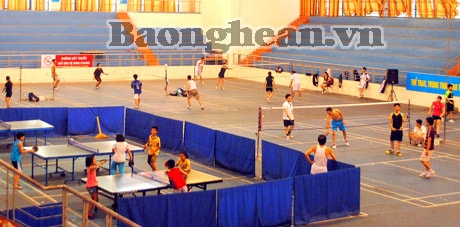
People are exercising at the Vinh City Sports Center gymnasium.
The facilities for grassroots sports are like this, and the facilities for high-performance sports are no better. According to Mr. Nguyen Nhu Tam, Director of the Sports Training Center, the Center's practical difficulties are truly "intractable." The entire Center currently consists of a dilapidated administrative building, a cramped and stuffy training room, and a row of severely deteriorated single-story buildings. Currently, the Center trains 16 sports with 250 athletes but only has one training room of less than 720 square meters. The training room only accommodates two sports; for the remaining 14 sports, the Center has to rent facilities elsewhere: the provincial competition center, utilizing empty rooms in grandstand A of the stadium, and the vacant land behind the training room…
Witnessing the training sessions of the martial arts instructors and their students in the training room reveals the full extent of the difficulties: Located beneath Stand A of Vinh Stadium, the room is damp, dark, enclosed, and hot. The training area is less than 64 square meters (while the standard requires over 100 square meters) to accommodate nearly 30 athletes across all three disciplines, forcing instructors and students to train in shifts. Due to insufficient space, the training platform used for practical exercises has to be located elsewhere; after learning theory and techniques, instructors and students move to the platform to practice.
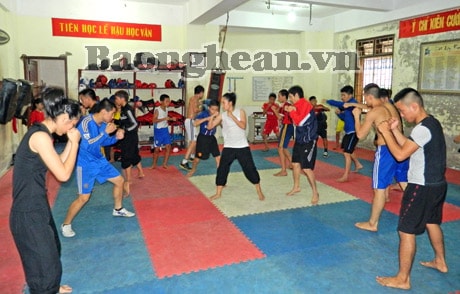
Traditional Martial Arts - Boxing Department of the Nghe An Sports Training Center
They train in a cramped room of about 40 square meters.
The training floor area does not meet the required standards, leading to numerous collisions and unfortunate injuries during training. Not only the training rooms themselves, but also essential training equipment for athletes, such as strength training equipment and specialized equipment, are lacking and inadequate. (This is not to mention the shortage of modern, expensive training equipment). Partly due to extremely limited funds, there isn't enough to purchase and replenish equipment annually, and partly because training facilities haven't been built, meaning even if purchased, there's no space to store them… Clearly, sports facilities and equipment, including centers and arenas serving both amateur and high-performance sports, need investment. However, the problem is that, in the context of economic recession, public investment cuts, and limited local budgets, construction and procurement must be considered from a different perspective.
In fact, the solution to the funding problem for sports centers and training facilities has existed for a long time. It is the Project to Promote the Socialization of Activities in the Fields of Culture and Sports in Nghe An Province until 2015, with consideration to 2020, which was approved by the Provincial People's Committee on October 27, 2009. This is a correct policy to serve the purpose of developing grassroots sports, improving health, and promoting community activities for the people. The issue lies in how localities and units apply and implement it.
In our province, there are localities with good practices, a prime example being Quynh Luu district. Mr. Ho Xuan Huong, an official from the District Sports Center, shared: "The district currently has a newly renovated and upgraded level 2 stadium costing 1.2 billion VND, a swimming pool in Quynh Doi commune, and a district sports arena with an area of over 1,300 square meters and 1,000 seats. Recently, we built and completed two tennis courts worth nearly 2 billion VND. All these resources were raised through social mobilization by the district, appealing to businesses in the area, expatriates, and the people for contributions. Recently, the district organized a youth football tournament, and dozens of businesses approached us to offer sponsorship."
Mr. To Son, Head of the Culture and Information Department and Director of the Thai Hoa Town Cultural and Sports Center, shared his approach to mobilizing resources for building sports facilities: First, the town has successfully fostered a spirit of enthusiastic participation in physical exercise and sports among its residents. Once people have developed a passion for it (over 40% of the town's population participates in training), a movement to build infrastructure and purchase equipment can be launched. At that point, there's no need to worry about people not donating land for fields and contributing money to create resources for construction. Often, the town only needs to stimulate demand through policy initiatives, and immediately, the people have enough funds to cover 100% of the costs.
However, that's not a problem in Thai Hoa. In Long Son and Hoa Hieu wards, the population density is high and land is insufficient, so some hamlets have to build sports fields separate from the community center…
Mr. Nguyen Chien Thang, Director of the Vinh City Sports Center, stated: To have a sports center or arena that meets requirements, long-term planning is essential; it's unacceptable to plan construction in one location today and then move it to another tomorrow. Once a stable construction plan is in place, diversify sports activities such as: organizing public services, bidding for ticket sales, advertising, sports lotteries, bidding for competition organization, joint ventures for exploitation, or bidding for the use of sports facilities. The provincial plan clearly outlines inviting units and businesses to invest and operate these facilities. In addition, sports training centers should diversify their training types, developing collaborative training programs and implementing training contracts to generate additional funding beyond the formal training methods.
In the national sports development strategy, Nghe An has been approved by the Government as one of the nine national sports centers. For Nghe An's sports to gain a stronger position and reach further, it needs more attention and investment from the province and the central government in building infrastructure, but it also requires the joint efforts of organizations and individuals, as well as the dynamism of all levels, sectors, and localities.
Zen Thanh


