
Tho Hop: A solid three-pronged foundation: Sugarcane - forest - crops
After years of organizing specialized production zones and restructuring crop patterns, the correct direction outlined by the Party Committee of Tho Hop commune (Quy Hop district) is leading the poor commune of Tho Hop to develop day by day. The agricultural and forestry sector is being shaped according to a three-pronged model: sugarcane – forest planting – cash crops.
(Baonghean)After years of organizing specialized production zones and restructuring crop patterns, the correct direction outlined by the Party Committee of Tho Hop commune (Quy Hop district) is leading the poor commune of Tho Hop to develop day by day. The agricultural and forestry sector is being shaped according to a three-pronged model: sugarcane – forest planting – cash crops.
Despite being a predominantly agricultural commune, no farmer in Tho Hop owns a rice paddy due to complex geological and topographical conditions, and the scarcity of water resources, making it impossible to build an irrigation system. Consequently, the Tho, Kinh, and Thai ethnic communities in the commune have been constantly struggling with poverty. As the saying goes, "fire tests gold, hardship tests strength," the cadres and Party members of Tho Hop are always deeply concerned, closely observing the reality, proactively seizing opportunities to formulate policies, plans, and projects that are appropriate to the local situation, and immediately implementing them in the local context.
The first story we want to tell is about introducing sugarcane cultivation to barren land, replacing areas previously used for low-yield crops. Under the August autumn sun, we followed the wide concrete road into the Sợi Dưới hamlet. The hamlet has 178 households with 765 inhabitants, mostly ethnic Thổ people. Looking at the spacious, airy houses lining both sides of the village road, one can truly understand the significance of the word "transformation" for this land. As Comrade Trương Hồng Lam – Party Secretary – said: "Before, our people suffered greatly! We lacked everything. Land was readily available, but few people were well-fed. Year after year, we relied on corn and peanuts, with extremely low yields."
But that's a story of the past, because ever since the sugar mill was built in Quy Hop district, the Tho Hop Party Committee has been quick to seize the opportunity, not only becoming a supplier of sugarcane raw materials for the mill but also providing seedlings for other localities in the district.
Amidst lingering skepticism among many households, five Party members in the Sợi Dưới hamlet took the lead in cultivating sugarcane using intensive farming methods. These included comrades Truong Van Di, Truong Minh Phao, Mai Thi Bich Lien… and even the Party branch secretary, Truong Hong Lam.
“In the first season, my family planted 2.5 acres of sugarcane. By the following season, we not only had enough seedlings to expand our family's production area but also supplied seedlings to the people of Ha Son. Now, our family has converted all 12 acres of land to sugarcane cultivation,” Comrade Lam recalled. He recounted the past to illustrate the present, because alongside the support programs from various departments and levels, it was precisely these small-scale models implemented by Party members that gradually built trust within the community. Today, sugarcane has become a key crop in many localities, not only in Tho Hop but also in Ha Son, Van Loi, and Chau Dinh – areas with very difficult natural and social conditions. In the Sợi Dưới hamlet alone, every household now has sugarcane, the amount depending on each family's land, but just looking at the endless green sugarcane fields stretching from the beginning to the end of the hamlet, you can be sure that sugarcane will continue to bring the farmers of Sợi Dưới many "sweet" harvests in the future.
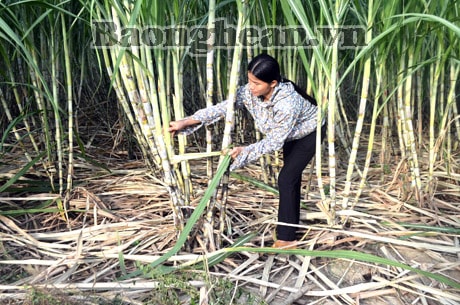
Ms. Truong Thi Vy from Soi Duoi hamlet is tending to her sugarcane crop.
Ms. Truong Thi Vy, a resident of Soi Duoi hamlet, shared: “My family only has 7 sao (approximately 0.7 hectares) of land. Before, we grew vegetables three times a year, and life was very difficult. Now we've switched to growing sugarcane on 6 sao, yielding 25 tons per harvest. The income isn't as much as others because we have less land, but compared to growing vegetables, sugarcane farming is much more profitable. Growing sugarcane gives us more free time, so we can do other jobs. 'Every little bit helps,' so life has improved noticeably.” Currently, the commune Party Committee has identified sugarcane as a key crop for the local economy and is focusing on encouraging people to introduce high-yield sugarcane varieties to the fields. This season, the entire commune has 165 hectares of sugarcane, with an estimated yield of 55 quintals/hectare, totaling 9,075 tons, promising significant value for farmers.
Another project being actively implemented in Tho Hop is encouraging people to develop forest-based economic activities in suitable hamlets such as Thung Khang, Son Tien, Coc Moc, and Tho Son, and it is initially yielding promising results. Following a rough, rocky, and steep dirt road, I had the opportunity to visit the integrated economic farm of Party member Le Van Tien's family in Tho Son hamlet. Surrounded by limestone mountains, patches of acacia, teak, mahogany, lychee, and peach trees... persistently take root in the barren soil and reach straight up towards the sky.
In the twilight, Comrade Le Van Tien shared: “When we came here to set up the farm, this area was just bushes, extremely wild and untamed. We had to gradually clear the land and plan carefully. The biggest shortage was water. I surveyed, researched, and built a self-flowing water system from the forest. With the basic irrigation problem solved, we were able to introduce new plant and animal varieties into production.” After several years of “leaving home for the forest” to start a new life with countless hardships, his family now has a fairly substantial farm covering a total area of 15 hectares. Not including the old-growth forest, the revenue from fruit trees and livestock alone brings in about 300 million VND per year.
Of course, in Tho Hop, not everyone has all the conditions to run a farm like Comrade Le Van Tien's family. But his approach has contributed to opening up a very effective direction for Tho Hop in areas previously considered barren; the shining example of this veteran Party member is an inspiration for the people to follow, transforming barren land into "golden land."
For example, in Thung Khang hamlet, implementing the commune's project, the hamlet's Party branch issued a resolution encouraging people to switch to suitable crop cultivation. Comrade Nguyen Ba Nam – Secretary of the Party branch – said: “The entire hamlet has 39 households. On the land previously used for growing beans, corn, and peanuts, which were not very productive, most people have switched to growing acacia, sugarcane, or cassava. At the beginning of this year, my family planted 1.5 hectares of acacia and it is developing relatively well.” To ensure the success of the project, the Tho Hop Commune Party Committee not only set out policies and guidelines and disseminated them to the people, but also proactively contacted units with the necessary resources to support the people with a certain amount of acacia seedlings. Aware of the benefits from the forest, the people of the commune have actively protected and replanted forests. As a result, the forest area of Tho Hop has increased steadily every year, reaching over 510 hectares to date.
Comrade Truong Van Binh – Deputy Secretary of the Party Committee of Tho Hop commune – concluded: “From a time when low-yield vegetable farming predominated, agriculture is now shifting towards sugarcane and acacia trees. The benefits from this crop conversion have contributed to increasing people's income. The current poverty rate has decreased to 19.9%. We strive to continue developing our potential in the right direction to help Tho Hop reduce poverty quickly and successfully implement the new rural development program.”
Thanh Duy


