
A brief encounter with "Muong Lac"...
(Baonghean) - Someone once told me that Muong Long (Ky Son) is inherently a mysterious maiden. Spring arrives with vibrant flowers, summer with orchards of plums and peaches laden with fruit, and winter with mountains and forests shrouded in frost. Now, as autumn approaches, Muong Long takes on a rhythm that is both tranquil and graceful... The locals here interpret Muong Long as "Lost Muong," and I have had my emotions "lost" here on several occasions...
I have visited Muong Long, often described as the Da Lat of western Nghe An province, in different seasons. The first time was in autumn, when the "Heaven's Gate" was shrouded in mist. Mong women, carrying baskets full of firewood on their backs, appeared amidst the fog before disappearing into it. Another time, I came here to escape the scorching heat of the central Vietnamese summer, and I wandered into a forest of ripe plums. I also visited Muong Long during the days leading up to Tet (Lunar New Year), when peach blossoms cascaded down the Heaven's Gate. Plum blossoms burst open in the valley like a giant white veil.
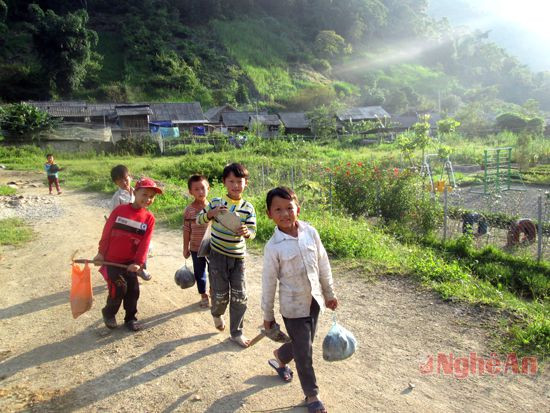 |
| Children in Muong Long (Ky Son) on the first day of school. |
Today, by chance, my footsteps led me back to Muong Long. The nearly fifty-kilometer journey from Muong Xen town, the center of Ky Son district, to Muong Long was marked by light rain. Upon reaching the "Heaven's Gate," the rain had receded. The sky quickly turned to evening. The "Heaven's Gate" today was no longer shrouded in mist as it had been in previous autumns. The deep valley appeared hazy in the faint, fading sunlight. Thousands of trees were lost in the inherent wilderness of nature. In this moment, I felt a little of what is called a purple sunset, as poetry often describes a distant autumn.
“Passing through the ‘Heaven’s Gate’ into Muong Long will reveal a completely different atmosphere,” Mr. Vu Ba Lenh, the Vice Chairman of the People’s Committee of the commune, once told me. This young official had a naturally humorous and characteristic way of using metaphors typical of the Hmong people. This man, both local and modern, told me about his aspirations for the future of this unique region on the border, while leading me under the canopy of white plum blossoms in the spring not so long ago. Back then, I found it quite amusing how such a small, young man could possess such a wealth of stories and hopes that were unlike anyone else’s. While others dream of a herd of a hundred cows or a vast cornfield spanning several hills, Vu Ba Lenh yearned for a bustling tourist area and a water source that would sustain thousands of people year-round. He was truly a lovable eccentric.
I had only just begun thinking about it when Vu Ba Lenh appeared. He seemed concerned that Muong Long didn't have a guesthouse for visitors from afar. I, however, was surprised that every time I arrived, it was always late afternoon. Perhaps it was because of the long journey, or for some other reason, but I seemed to have a special connection with the evenings in Muong Long. Each office of the commune's People's Committee had a bed, "invested" by the commune's staff, provided for us journalists to rest in. A place to rest after work right at the office was truly essential for local officials in the remote villages of Tham Hoc, Tham Hang, and Huoi Khun, located more than ten kilometers from the People's Committee office, amidst steep mountain passes and jagged rocks.
At dusk, the concrete roads of Trung Tam village were still bustling with people. Backs bent under the weight of baskets woven from bamboo. "The villagers are in the middle of the corn harvest season," the vice chairman said. My traveling companion, always carrying a guitar and a tobacco pipe on the back of the motorbike, "designed" an outdoor music night where we roasted sticky corn and sang Trinh Cong Son's songs. We were able to indulge in the music, while the Hmong men from Muong Long had the opportunity to reminisce about their student days in Hanoi, singing and playing guitars at friends' birthday parties. It was a moonless night, the weather chilly, just like the night ten years ago when we sat and sang with guitars in the Dong Van plateau, at the northernmost point of the country.
The singing only ended when the night mist thickened and the roadside fire for roasting corn died out. The village had also fallen asleep. Life in this purely Hmong highland commune has been like this for generations. People only return from the fields to cook and sleep after the chickens have gone to roost. They get up at the second rooster crowing to cook rice and prepare to go back to the fields. So, at this hour when the night mist is thick, the village is already asleep. For them, nothing in life is more precious than time spent working and a good night's sleep. A good night's sleep ensures they wake up feeling refreshed and ready to go to the fields.
The Hmong song sung by the office staff member of the commune's People's Committee woke me from my sleep. The sound of chickens clucking in the village drifted in. Outside, a thin, almost imperceptible mist hung in the forest. I threw open the window, letting the morning chill rush into the small office at the People's Committee headquarters. Grabbing my camera, I walked down to the village, along a small path hidden beneath the plum and peach trees, where children carried hoes and plastic bags filled with fertilizer. "The Muong Long students are going to school to work and prepare for the new school year," the office staff member whispered to me. After the summer, Trung Tam village will once again be bustling with the footsteps of the students.
The sun had risen above Pha Bun mountain. The plum trees in Trung Tam village were sprinkled with pink powder. I hurried along a path leading to the water tank. The autumn rains had filled the communal tank of Muong Long village. Yet, just a few months ago, the water tanks in Muong Long were completely dry. With the arrival of autumn, the water returns.
The sun had just risen, but the baskets of corn were already being carried back to the village by the people from the fields. “I got up to pick corn before I could even see my feet,” a young woman said with a bright smile when I asked why she came back from the fields so early. “I’ll finish drying the corn and then go back to carrying more baskets. I have three or four more baskets to carry, and I won’t stop to eat until the shadows lengthen at my feet.”
Behind the wooden door, a young woman's figure peeked out, watching us with a mixture of shyness and curiosity. My friend guessed she was a stunning mountain girl she had seen on her trips to the highlands. For me, she was also a charming feature of Muong Long, a captivating beauty that easily leads one astray in a land where people of the past had also wandered.
Text and photos:HỮU VI


