
The fragrant and sweet fish sauce from the countryside.
(Baonghean) - Taking advantage of abundant seafood resources, coastal fishermen in the province have created many fish sauce products with the rich flavor of Nghe An. Therefore, traditional fish sauces bearing the brands Van Phan (Dien Chau), Phu Loi - Quynh Di (Hoang Mai), and Hai Giang 1 (Nghi Hai, Cua Lo town) are highly appreciated by consumers for their aroma and rich, sweet taste…
The ancient Kẻ Vạn, now Vạn Phần, is the Cửa Vạn area encompassing Diễn Ngọc and Diễn Bích communes (Diễn Châu district), renowned for its fish sauce production. This traditional product was once a delicacy offered to the king and continues to enjoy a prestigious reputation to this day. Vạn Phần Seafood Joint Stock Company was built on this foundation, inheriting the traditional fish sauce making process of the ancient Kẻ Vạn from 1947. Through many ups and downs, the company has kept the flame alive by using traditional methods, combining fresh anchovies and the salty sea salt, along with the sunshine and wind of Central Vietnam, to create a unique fish sauce with a distinctive flavor.
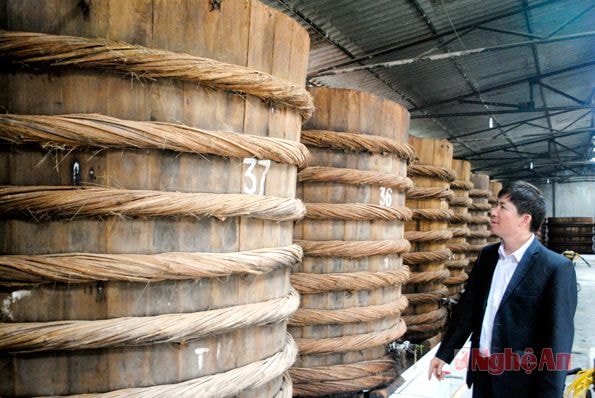 |
| Fermentation in wooden barrels at Van Phan Seafood Joint Stock Company. |
According to Mr. Vo Van Dai, Director of Van Phan Seafood Joint Stock Company, the first step in making delicious fish sauce is using fresh fish, mainly black anchovies and charcoal anchovies. Only by fermenting the fish in jackfruit wood barrels will the finished fish sauce be fragrant, delicious, and have an attractive color. The company has over 50 large wooden barrels with a capacity of over 1,000 tons of raw fish. The company's fish sauce processing method is entirely traditional, using fermentation and pressing, allowing for natural maturation without the use of additives or chemicals. The fish is mixed evenly with salt in a ratio of approximately 3:1 and then placed in large wooden barrels (one layer of fish, one layer of salt), then salt is sprinkled on top, and heavy stones are placed on top to compress it. During the first month, the mixture must be stirred daily, and after that, it is stirred once a week to keep the liquid clear. The fermentation process lasts from 9 to 12 months.
In addition, Van Phan Seafood Joint Stock Company also produces a special product: "earth-aged" fish sauce. Through a traditional fermentation process, the fish sauce is extracted into sealed jars and buried underground. The aging process typically lasts from 2 to 2.5 years or more, after which it is bottled and sold on the market. "Earth-aged" fish sauce is a nutritious food with many health benefits. It is especially suitable for young children, malnourished individuals, the elderly, and those with weak constitutions, as the protein in the fish sauce is transformed into beneficial organic compounds during the aging process. To meet customer demand, the company offers a variety of products, including fish sauces with protein content ranging from 10 to 32 degrees. To date, Van Phan fish sauce has captured a wide market throughout the province and expanded to provinces such as Quang Ninh, Yen Bai, Son La, and Hanoi… Notably, Van Phan fish sauce is also exported, selling 25,000-30,000 liters annually to Laos, Angola, Malaysia, South Korea, Australia, and China… generating revenue exceeding 10 billion VND per year and providing stable employment for over 100 workers with a salary of 4.5 million VND per person per month.
As for the Phu Loi - Quynh Di fish sauce making village (Hoang Mai town), its tradition dates back over 200 years. Initially, households mainly produced on a small scale. Since 2005, after being recognized as a traditional craft village by the Provincial People's Committee, Phu Loi fish sauce production has flourished. Many households have maintained the craft with multiple generations participating in production. A prime example is the Cuong Ngan fish sauce production and processing facility of Mr. Hoang Duc Cuong's family. Each year, this facility processes over 150 tons of anchovies, equivalent to 1 million liters of fish sauce. Mr. Cuong stated: "During the period from 2007 to 2009, the emergence of modern fish sauce brands made it very difficult for Phu Loi fish sauce producers to compete, leading to decreased production and forcing some to abandon the profession. However, in recent years, the 'Phu Loi fish sauce brand' has made a comeback. The unique characteristic that makes Phu Loi fish sauce a brand is its traditional method, yet it differs from other regions." Although also made from anchovies, Phu Loi fish sauce is not fermented in cement tanks but primarily in earthenware jars using a pressing method. The people of Phu Loi also have a secret: they add additives such as sesame seeds and roasted rice to create a unique flavor. Therefore, Phu Loi fish sauce has a mild, rich, and fragrant taste; the longer it ages, the better it tastes. It has a deep yellow color and a thick, honey-like consistency, distinctly different from fish sauces in other regions.
Mr. Nguyen Quang Dai, Chairman of the People's Committee of Quynh Di Ward, added: Phu Loi fish sauce village currently has over 150 households producing and processing fish sauce using traditional methods. With over 1,000 earthenware jars for fermenting fish, in 2014, the village processed over 2 million liters of various types of fish sauce. Sales are relatively favorable, mainly through telephone orders, with distributors from all provinces and cities coming to pick up the products. According to Mr. Dai, many fish sauce processing villages nationwide are facing difficulties in sales, while Phu Loi is not worried because in recent years, the local government and members of the village have been proactive and responsive in improving quality and promoting products, building brands. In the near future, Phu Loi fish sauce will strive to export to Laos and Thailand and increase production from 2 million liters to 2.5 million liters per year.
The coastal region of Nghe An is also famous for Hai Giang 1 fish sauce, from Nghi Hai ward, Cua Lo town. Mr. Nguyen Dien, one of the households maintaining the traditional fish sauce making craft, said: Most fish sauce in Nghe An is made from anchovies, but each region has its own "secret." The Hai Giang 1 village mainly uses fresh anchovies as raw material, then puts them into barrels made of yellow heartwood with tightly secured bands for fermentation. To make the fish sauce more fragrant and delicious, the villagers of Hai Giang 1 mix fish sauce with roasted peanuts and molasses, boil it until thick, then add water and salt, stir well, let it settle, and then cook the fish sauce. Hai Giang 1 fish sauce can also be used to protect seafarers from the cold in winter, improve the health of divers, and as a medicine to treat stomach aches caused by wind and storms. The Hai Giang 1 fish sauce processing village currently has over 75 households specializing in fish sauce production, with an average annual production of about 450,000 liters. In recent years, tourism in Cua Lo has continuously developed, and Hai Giang 1 fish sauce is an indispensable part of seafood meals at restaurants, hotels, and eateries. Therefore, when tourists visit Cua Lo, they often choose Hai Giang 1 fish sauce as a souvenir.
Despite facing fierce competition from industrially produced fish sauce and dipping sauces, the sustainable development of traditional fish sauce products in localities throughout the province has affirmed their advantages and opened up opportunities for craft villages to boost production and processing. In 2014, all three fish sauce products from Van Phan, Phu Loi, and Hai Giang 1 were recognized by the Provincial People's Committee as typical rural industrial products. This further motivates craft villages to continue striving for success.
Van Truong


