
Fragrant gifts from the fields
(Baonghean) - "Nghe Yen Thanh, Thanh Nong Cong" refers to Yen Thanh as the largest rice granary in Nghe An province, just as Thanh Hoa province has Nong Cong as its rice granary. With skillful hands and diligent, hardworking nature, the people of this rice-growing region now produce many products from rice, ranging from traditional and rustic to modern culinary goods, creating a unique experience for tourists visiting this rice-growing district.
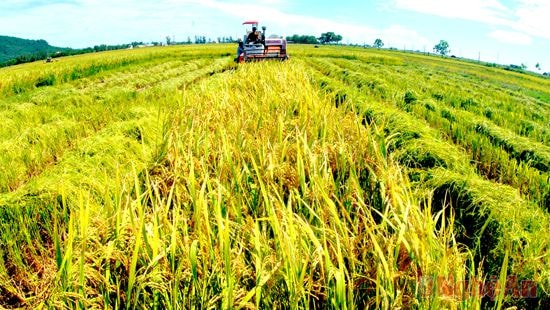 |
| Harvesting by machine in the rice fields of Yen Thanh. Photo: Ho Cac |
“The old song says, 'Nghe An has Yen Thanh. Who has ever been hungry, who has ever had tattered clothes?' The rice grains of our homeland are imbued with the sun and rain of both ends. Mothers toil in the deep rivers, their backs bent, pounding rice. Some grains for the homeland, some for friends. Such is the love of our homeland, who could ever forget it…?” The lyrics of the song “How Beautiful the Rice-Growing Homeland of Yen Thanh” (Phan Thanh Chuong) evoke a land that is the largest rice granary in the province, containing so much affection and simplicity. The children of Yen Thanh, no matter where they go, are proud and remember the memories of a time spent with their mothers, enduring the sun and rain in the golden rice fields.
I strolled through the spring rice fields with the Head of the District's Agriculture Department, Mr. Nguyen Van Duong. The scent of rice wafted along the wide, straight rural roads. The rice fields of Yen Thanh now look like they've donned a new coat. This is because the entire district has completed the land conversion. The rural roads, field boundaries, and plot borders have been widened and straightened, facilitating the movement of mechanized vehicles. This success is the result of the collective efforts and unity of the farmers, who have contributed their labor and resources to this "revolution" in the fields.
Mr. Nguyen Van Duong analyzed: Before land conversion, Yen Thanh had over 13,000 hectares producing two rice crops per year. During the land conversion process, much of the land had to be used for road construction, so after the conversion was completed, the area of two-crop rice production decreased to 12,600 hectares, a loss of about 500 hectares. However, rice yield and production did not decrease compared to before; in 2014, rice production reached 170,000 tons (no decrease compared to before). The fields have been re-planned, with each household owning only 1-2 plots, which is very favorable for intensive farming and increasing productivity. Land preparation is basically mechanized, thereby gradually reducing the labor force in agricultural production.
Speaking about rice cultivation in his district, Mr. Duong proudly stated that Yen Thanh has many advantages to become the largest rice granary in the province. The fields are relatively flat, the people are diligent and hardworking, and they have long-standing experience in intensive rice cultivation. In particular, it benefits from the Dao River irrigation system, originating from the Do Luong dam, creating a self-flowing water source that serves two-thirds of the district's rice-growing area. He recalled that 15 years ago, Yen Thanh specialized in producing purebred rice varieties with good yields, but poor quality. This stemmed from the societal demand at the time, which prioritized food above all else, without paying much attention to quality. Many localities even cultivated rice on fertile land, only planting one precarious crop per year using traditional varieties such as Bao Thai, Kim Cuong, and Moc Tuyen...
In the late 20th century, Yen Thanh basically ensured food security. Therefore, the 600 hectares of land were restructured to cultivate cash crops, with rice cultivation focusing only on areas producing two rice crops per year. Now, Yen Thanh proudly boasts that, out of its current 12,600 hectares of land dedicated to rice cultivation, 2,000 hectares produce high-quality rice and 1,000 hectares produce rice seeds, meeting social needs and increasing income for rice farmers. High-quality rice varieties include: AC5, BC15, Bac Thom, and Huong Thom.
Among the rice varieties, the most fragrant and sticky is the AC5 variety, which is supplied by Vinh Hoa Science Co., Ltd., which also purchases the harvested rice from farmers to build a brand of delicious rice. Otherwise, tourists can easily buy high-quality rice as souvenirs at kiosks along the town or at rice milling points in the district. Now, many people in Yen Thanh have invested in modern milling machines, producing shiny white rice and acting as a supplier to many rice retailers in cities. This is also the district's future goal: to build the Yen Thanh rice brand, aiming to increase the economic value for rice farmers and attract tourists.
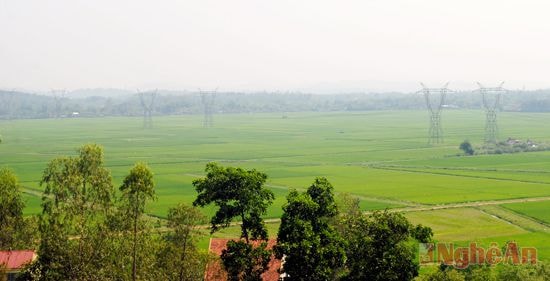 |
| The vast, flat rice fields provide ideal conditions for introducing mechanization into production. |
Over the years, with the involvement of the State, farmers in the communes of Lien Thanh, Cong Thanh, Do Thanh, Tan Thanh, Hau Thanh, Hung Thanh, Hoa Thanh, etc., have boldly collaborated with companies specializing in supplying rice seeds, such as Thai Binh Seed Company; Central Seed Company No. 1; and the Academy of Agricultural Sciences, to produce various types of rice seeds. Through this, farmers have gained access to scientific and technological advancements in intensive rice cultivation, changing their mindset from self-sufficient production to commercial rice production. Farmers now have stable product sales with purchase prices ranging from 9,000 to 10,000 VND/kg. To date, the entire district has 1,000 hectares dedicated to rice seed production, supplying over 6,000 tons of rice seeds annually to major seed producers nationwide, bringing farmers an economic value one and a half times higher than that of commercial rice production.
Besides, the people of Yen Thanh do not discard purebred rice varieties, which are used to prepare traditional dishes such as rice paper rolls and rice noodles, as well as for livestock and poultry farming. Yen Thanh is one of the districts with the largest pig population in the province, with over 200,000 pigs and tens of thousands of poultry, contributing positively to household economic development. Furthermore, Yen Thanh rice now produces many local culinary products. These include fragrant, sticky glutinous rice, used in the famous Vinh Hoa village for making banh chung (traditional Vietnamese rice cakes); and purebred rice used to make various cakes and noodles. In recent years, Yen Thanh has become known for its straw mushroom cultivation, using rice by-products as a raw material for growing mushrooms.
The traditional rice cake-making village of Vinh Hoa in Hop Thanh commune is located right next to Provincial Road 538, at the gateway to Yen Thanh district. Those involved in the rice cake making craft here proudly say that all the ingredients, from the outside to the inside of the rice cakes, are supplied by people from Yen Thanh. Each year, the Vinh Hoa rice cake making village consumes hundreds of tons of glutinous rice, mainly purchased from local farmers in the district. Therefore, the fragrant glutinous rice is grown annually by the farmers; besides storing it for their own family use, the rest is supplied to the rice cake making village. The pork used for the filling is also carefully selected from large, high-quality pigs raised traditionally by the villagers on a feed of rice bran and ground corn, resulting in delicious, flavorful meat.
Mung beans are also sourced from various harvests, grown by local farmers on fertile alluvial soil in the semi-mountainous region. The leaves used to wrap the rice cakes are primarily banana leaves, specifically those of the seeded banana variety, which are split and sun-dried to be both pliable and fragrant, making them incredibly suitable for wrapping green rice cakes. These leaves are also grown in the gardens of the people of Yen Thanh. Every day at the local markets, people from Vinh Hoa village transport rice cakes to sell, and locals exchange banana leaves. This allows them to sell their cakes and obtain banana leaves to wrap cakes the next day. In this way, the traditional rice cake-making craft of Vinh Hoa village continues to flourish.
Then there's the rice noodle making and steamed rice cake making trade, where no rice surpasses Khang Dan 18. This variety has a thin husk, high sides, a certain degree of elasticity, doesn't stick to the mold, and is easy to make into cakes. Therefore, Yen Thanh still has 25% of its rice cultivation area dedicated to Khang Dan rice, a portion of which is used for making rice noodles. The skillful and hardworking women of Hop Thanh, Vinh Thanh, Xuan Thanh, Trung Thanh… have opened rice noodle making stalls along roads 333 and 538, famous for their chewy and smooth noodles. These stalls, serving rice noodles with duck stew or offal stew, are renowned throughout the region, enough to entice visitors to return to this rice-growing area.
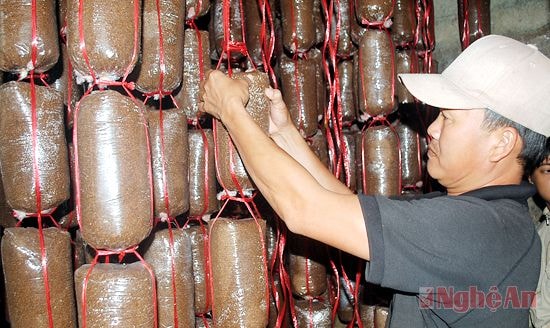 |
| Mr. Nguyen Tho Hanh's mushroom farm in Nam Thanh commune. Photo: XH |
In the rice-growing district of Yen Thanh, you can now visit mushroom farms and enjoy dishes made from oyster mushrooms, straw mushrooms, and button mushrooms. Following Highway 538, past Roc Market, and crossing the Dao River, you'll reach the mushroom farm of Mr. Nguyen Tho Hanh in Nam Thanh commune. In 2013, implementing the district's policy of developing mushroom cultivation, Mr. Nguyen Tho Hanh, then Chairman of the Farmers' Association of the commune, boldly invested in opening the largest mushroom farm in the district, producing many high-quality mushrooms such as oyster mushrooms, straw mushrooms, and button mushrooms. To date, his farm provides employment for many workers, harvesting nearly 100 kg of various mushrooms daily, creating a highlight for mushroom production in Yen Thanh. Mushroom cultivation has also expanded to Khanh Thanh, Son Thanh, and Cong Thanh, creating jobs and increasing income for rural workers, while also becoming tourist attractions for visitors to Yen Thanh.
Returning to the rice-growing district, there's still much to be said. Therefore, when discussing the future development direction for tourism in the district, Mr. Nguyen Tien Loi, Chairman of the District People's Committee, enthusiastically stated: "With the goal of creating a highlight in the agricultural sector for tourists visiting the rural areas of Yen Thanh, in the coming period, the District People's Committee encourages individuals to consolidate and transfer land, aiming to create large-scale specialized farming areas based on ecological farm models, bringing high economic efficiency. From there, we will create many marketable agricultural products to serve the needs of tourists."
Xuan Hoang


