
A message of peace
(Baonghean)The opening ceremony lasted only 25 minutes but set numerous records. Host nation Brazil showed the world the uniqueness of their country, where the samba dance can captivate all visitors. The impact of the opening ceremony promises an exciting and dramatic final round ahead.
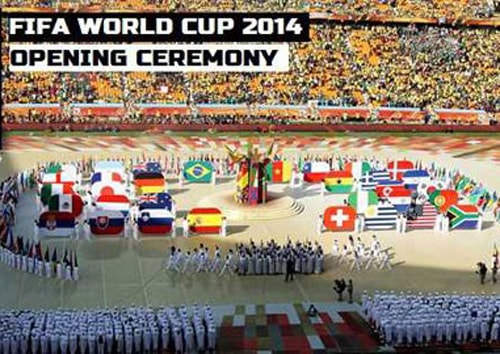 |
| Overview of the Opening Ceremony. |
Early this morning (June 13th) (Vietnam time), nearly 1 billion people worldwide turned their attention to the Arena Corinthians stadium in Sao Paulo state (Brazil) to watch the opening ceremony of the 2014 World Cup finals. This number of people watching the opening ceremony live also set a record in the history of the world's biggest football tournament, which has been held 20 times.
According to the 2014 World Cup organizing committee, Brazil spent no less than 90 million Euros to make the opening ceremony a success and a memorable event. This amount is five times greater than what South Africa spent on the 2010 World Cup opening ceremony and double the cost of England's 2012 Olympic Games. The highlight of the opening ceremony was the appearance of an LED ball made from 90,000 light bulbs to create an extremely bright display. This was followed by martial arts performances, showcasing the unique characteristics of many different cultures around the world. Through this, the program directors aimed to help Brazilians and the global audience discover unique cultural aspects, reminding them of the anti-racism campaign, and fostering unity through the game of football.
As previously stated by Brazil's Minister of Sports, Aldo Rebelo: "The affection of the Brazilian people for international fans will be the lasting impression of the 2014 World Cup. This is a time when not only Brazil but the whole world is hoping to find solutions to problems such as combating prejudice, racism, religious and ethnic differences... Therefore, this World Cup is called the World Cup of peace and the World Cup against prejudice and racism," throughout the program were performances aimed at peace and a world always filled with laughter.
It is known that for the opening ceremony to be a success, 600 artists had to go through a rehearsal process lasting 84 hours. The director of the opening ceremony was the renowned Belgian artistic director, Daphne Cornez. He spent about 6 months before creating the script for this World Cup opening night. The choreography was directed by the famous choreographer Franco Dragone, who also worked on the opening ceremony of EURO 2000. According to experts and the audience themselves, this World Cup opening ceremony was profound and carried a meaningful message of peace. Football, ultimately, aims for a world of unity and friendship, and the 2014 World Cup opening ceremony embodied that.
This difference was partly demonstrated when, at the opening ceremony, the host country only invited leaders from countries with teams participating in the finals. The majority of the remaining guests were football legends and world champions from various eras. This is a way to honor those who have contributed to the history of the World Cup; moreover, their presence gives the organizers an opportunity to share their experiences and contribute to the success of the 20th World Cup.
A final tournament focused on practical values, rather than formality, that's what sets Brazil apart from previous host nations. At the end of the program, when listening to the official World Cup 2014 song (We Are One) performed by world-renowned artists Pitbull, Jennifer Lopez, and Claudia Leitte, many were deeply moved. The whole world seemed to be one, all striving for community values, and football was no exception.
Another touching moment was when former French football legend Just Fontaine was presented with a platinum boot provided by Adidas. This was an act of honoring Just Fontaine, who set a record by scoring 13 goals in the 1958 World Cup.
The opening ceremony conveyed a message of peace, and everyone hoped that the matches would be played with intensity and friendship, providing an opportunity for nations to draw closer together.
Vinh Liem


