
Prime Minister Nguyen Tan Dung's New Year message
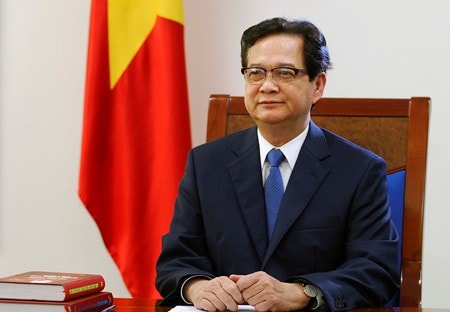
On the occasion of the New Year 2014, Politburo member and Prime Minister Nguyen Tan Dung wrote an article entitled: "Improving institutions, promoting the people's right to self-governance, successfully fulfilling the tasks of 2014, and creating a foundation for rapid and sustainable development." Nghe An Newspaper respectfully presents the full text of the Prime Minister's article.
 |
Over the past year, the entire Party, army, and people of Vietnam have strived to overcome numerous difficulties and challenges, achieving significant results. Macroeconomic stability has improved, with higher growth and lower inflation compared to 2012. Culture, society, and environmental protection have made progress. National defense and security have been ensured. Foreign relations have achieved many successes. Political and social stability has been maintained. Vietnam's position in the international arena has been enhanced.
TIn implementing the conclusions of the Central Party Committee, the National Assembly and the Government have issued a Resolution on socio-economic development in 2014. This resolution identifies the following priorities: strengthening macroeconomic stability, controlling inflation, removing obstacles and creating favorable conditions for production and business, accelerating economic restructuring, and striving for higher growth than in 2013. It also emphasizes ensuring social security and welfare, improving people's living standards, strengthening national defense and security, and enhancing the effectiveness of foreign affairs and international integration.1.
MAlthough the global economy has shown signs of recovery, and our country's socio-economic situation has improved positively, significant difficulties and challenges remain, requiring the entire political system to take action.We must act in unison with high determination to successfully complete the socio-economic development tasks for 2014. At the same time, we must decisively and comprehensively implement medium- and long-term tasks to create a foundation for rapid and sustainable development. We must focus our efforts on building a rule of law state, strongly promoting the people's right to self-governance, perfecting the socialist-oriented market economy institutions, and restructuring agriculture in conjunction with building new rural areas.
I
CWe are living in an era of globalization and deep international integration. Participation in free trade agreements with higher and more comprehensive requirements creates many opportunities for cooperation and development, but interdependence also increases and competition intensifies. Annual reports from many international organizations rank the competitiveness of economies. This is an important indicator of each country's position in the global competition. Countries with high competitiveness will have more opportunities to surpass others, develop rapidly, and sustainably.
Competitiveness is determined by many factors, among which the quality of institutions and the business environment are of paramount importance. Institutional quality not only acts as an intrinsic factor but also decisively influences the business environment, the competitiveness of the entire economy, of individual enterprises, and is a prerequisite for effectively leveraging national advantages. High competitiveness cannot be achieved without high-quality institutions and modern national governance.
NLooking back over the past nearly 30 years, the remarkable progress of our country has been closely linked to decisive institutional reforms, essentially expanding democracy and implementing market mechanisms in economic activities, with the major and comprehensive breakthrough stemming from the Sixth Party Congress.
The breakthrough in agricultural management, starting with the Contract Farming System (Khoán 10), transformed Vietnam from a food-deficient country into a leading exporter of rice and many other agricultural products worldwide. The significant expansion of business freedom through the enactment of the Company Law, the Private Enterprise Law, and the Foreign Investment Law... lifted the Vietnamese economy out of stagnation and fostered dynamic, high-speed development. Proactive integration into the international economy created new, broader opportunities for growth.
The appropriate reform policies of our Party and State have transformed Vietnam from an underdeveloped country into a middle-income developing nation, and the poverty reduction efforts have achieved impressive results, highly appreciated by the international community.
In recent years, our country's competitiveness has improved slowly. Economic growth and structural transformation have also slowed down. Society faces numerous pressing issues. One of the reasons is that the momentum generated by previous reforms is no longer strong enough to drive development. This is the time when we need more impetus to regain rapid growth and sustainable development.That driving force must come from institutional reform and the strong promotion of the people's right to self-governance.
DDemocracy is a great idea of President Ho Chi Minh. He clearly stated that our country is a democratic country, and all power belongs to the people. Our Party has affirmed that democracy is both a goal and a driving force in building and defending the Fatherland. Democracy is also an objective trend in the development process of human society. From slavery to feudalism and from feudalism to capitalism are long strides in democracy. The socialist system we are building must be superior in democracy, and our Party must firmly uphold the banner of democracy. Strengthening the leadership of the Party and the management of the State also aims to better promote the people's right to self-governance. Democracy will unleash the creative potential of each individual, contribute to eliminating inferiority complexes, strengthen social cohesion, and the great national unity.
With the rapid development of science and technology, especially information technology, the younger generation in our country is equipped with increasingly advanced knowledge and largely accesses the internet regularly to interact, learn, explore, and reflect on reality. This generation is and will play a decisive role in the development and destiny of the country. This is both a pressure and an opportunity for us to strengthen democracy and improve our institutions.
Democracy and the rule of law are twin pillars in a modern political system. Along with guaranteeing democratic rights, President Ho Chi Minh paid special attention to building a rule of law state. This is the relationship between democracy and discipline. He wrote, "A hundred things must be governed by the divine power of law." A rule of law state must uphold the supremacy of law. The law must ensure justice and fairness. Any restrictions on citizens' freedoms must be carefully considered and primarily aimed at protecting the Fatherland, ensuring national security, social order and safety, and the nation's cultural, historical, and moral values. Citizens have the right to do everything that the law does not prohibit and to use the law to protect their legitimate rights and interests. State agencies and officials are only allowed to do what the law permits. All state management decisions must be transparent.
HThe 2013 amended constitution, recently passed by the National Assembly, has opened up a new constitutional space for us to implement the great ideas of President Ho Chi Minh. No country can implement direct democracy at all levels and in all areas of social life, but the deeper and more substantive direct democracy is, the more effective representative democracy becomes. Therefore, the relationship between direct democracy and representative democracy must be placed within the overall solutions to ensure the people's right to self-governance. Direct democracy must be expanded and the electoral mechanism for the National Assembly and People's Councils at all levels must be perfected. The pilot program of direct election of the Chairman of the People's Committee at the commune level, as stipulated in Resolution No. 5 of the 10th Central Committee, should be implemented soon. At the same time, the mechanism for social critique must be improved, and the participation of the people in the policy-making process and the selection of officials must be strengthened. The quality of questioning activities of the National Assembly and People's Councils at all levels, and the accountability of the heads of policy-making agencies, must be enhanced.
DTo best promote the people's right to self-governance,The state must effectively fulfill its function of fostering development.The state should not do things for the people, but should focus on building a suitable institutional framework and creating the necessary conditions for everyone to develop their abilities and creativity for their own benefit and contribute to society. Only when the people are prosperous can the nation be strong. Socialization is not only about mobilizing resources but also about creating conditions for society to perform functions and tasks that it can do better. Only in this way can we build a streamlined, effective, and efficient state administrative apparatus.
The State must ensure and promote the genuine right of the people to self-governance, especially the right to participate in policy-making, the right to choose their representatives, and the right to own property. This right to self-governance must go hand in hand with social responsibility and civic duty, the first and foremost of which is compliance with the law.
The State must create an environment of equal competition based on market mechanisms; strictly control and eliminate business monopolies as well as policies that lead to inequality in competition. Laws and policies must create the most favorable conditions for all citizens and businesses to develop production and business. National resources must be allocated to entities with the capacity to use them most effectively for the country.
The State must have policies to train high-quality human resources and mobilize investment resources to build socio-economic infrastructure to meet development requirements. It must proactively and actively integrate internationally, creating a favorable environment and conditions for building and protecting the country.
The state must build a streamlined, effective, and efficient administrative apparatus with a team of officials and civil servants who possess high qualities, capabilities, and professionalism. Every agency and civil servant must be assigned clear responsibilities. The evaluation of organizations, officials, and civil servants must be based on the results of task completion. Evaluation criteria and mechanisms for monitoring the performance of public duties must be improved. The head of an administrative agency must be responsible for the results of performing their assigned functions and tasks and must be granted corresponding decision-making authority regarding personnel organization.
It is necessary to strengthen interaction between agencies within the state apparatus and between the state apparatus and socio-political organizations. Expand dialogue with citizens and businesses through various forms to bring the State, officials, and civil servants closer to the people and ensure that policies, laws, and regulations are more aligned with reality. Coordination between legislative, executive, and judicial branches must be based on ensuring independence according to assigned functions and the requirement of mutual control and support as stipulated by law. Promote decentralization, foster initiative and creativity at lower levels, while ensuring unified management of the entire system. Continuously strengthen socio-political stability.
TIn that spirit, 2014 must focus all efforts on drafting and amending laws to implement the Constitution. At the same time, it is necessary to review and supplement institutional and policy mechanisms, and improve the organizational structure to further promote...Building a rule of law state, strongly promoting the people's right to self-governance, and perfecting the socialist-oriented market economy system.Strengthening the effectiveness and efficiency of law enforcement, discipline and order, and building a clean and strong state apparatus. Emphasizing the responsibility of the Government as a whole and each member of the Government in the development and promulgation of legal documents, ensuring timeliness and quality.
II
TOver the past years, we have made significant progress in perfecting the socialist-oriented market economy institutions, focusing on creating an environment of equal competition and administrative reform. This is also a strategic breakthrough outlined in the Resolution of the 11th National Congress of the Communist Party of Vietnam. In a socialist-oriented market economy, first and foremost, we must fully respect the laws of the market economy, while simultaneously having regulatory tools and distribution policies to ensure fairness and social progress. In the coming period, we must continue to implement comprehensive solutions to effectively achieve the aforementioned strategic breakthrough, focusing on addressing two important and closely related issues:Implement market pricing for essential goods and services and ensure fair competition.
PThe government must consistently implement market-based pricing mechanisms for all goods and services. For essential goods and services whose prices are currently set by the State, the costs must be accurately and fully reflected, the factors determining the price must be publicly and transparently disclosed, and market pricing must be consistently implemented according to a suitable roadmap. At the same time, policies should be in place to support the poor, policy beneficiaries, ethnic minorities, and people in remote and disadvantaged areas.
All businesses, regardless of their economic sector, must operate according to market mechanisms. Monopolies and policies that create inequality in business, especially in access to resources, must be eliminated.
PThe government is determined to restructure state-owned enterprises, focusing on privatization, including economic groups; divesting from non-core investments and selling off shares that the State does not need to hold according to market principles, including those operating profitably. State-owned enterprises should concentrate only on key, essential sectors, important geographical areas, and national defense and security. The tasks of production and business should be separated from political and public service tasks. The mechanism for exercising state ownership rights and representing state ownership in enterprises should be perfected. The management, supervision, and inspection by the state owner should be strengthened. The management personnel should be improved and corporate governance capacity enhanced. The results of state-owned enterprises' operations should be publicly and transparently disclosed in accordance with the law. Strict action should be taken against violations of the law and failure to seriously implement the approved restructuring plan.
COnly in this way can we create a level playing field for competition and improve the operational efficiency of state-owned enterprises, strengthen the power of the state economy, contribute to macroeconomic stability, and restructure the economy.
III
TFollowing the Doi Moi (Renovation) policy, Vietnam's agriculture has made remarkable progress, contributing significantly to the country's overall achievements. In recent years, however, the growth rate of agriculture has been declining, revealing the weaknesses and limitations of a fragmented, household-based agricultural system lacking linkages, with low productivity and quality in the context of increasingly fierce competition. Therefore, it is necessary to effectively implement three strategic breakthroughs: innovating the growth model, restructuring the economy, especially...Accelerate the restructuring of agriculture towards increasing added value and sustainable development, linked with the construction of new rural areas.This is a crucial aspect of economic restructuring and an urgent requirement that needs to be implemented vigorously through a variety of synchronized solutions, focusing simultaneously on promoting the application of science and technology and reorganizing agricultural production.
PThe government places farmers at the center and in a key role in implementing agricultural restructuring and building new rural areas. The state has policies and mechanisms to promote the widespread application of science and technology, especially biotechnology and information technology, in agricultural production and management, and to accelerate agricultural industrialization and rural modernization. It encourages the development of diverse forms of cooperation and linkages, especially between farmers and businesses in production and services, on an appropriate scale. It aims to form value chains, ensuring a harmonious balance of interests among all participating entities from production and processing to consumption. The focus is on developing products with comparative advantages, competitiveness, and market demand. The goal is to gradually form high-tech agro-industrial-service complexes, closely linked with farmers, and towards building a multi-functional, sustainable agricultural production model.
TStrongly attract businesses to invest in rural areas, develop production and business in agriculture, industry, and services; focus on agricultural processing industries and labor-intensive industries to promote land consolidation, labor restructuring, and rural economic development. Innovate methods and improve the effectiveness of vocational training. Mobilize resources to invest in infrastructure development. Effectively implement the sustainable poverty reduction program. Pay attention to environmental protection; preserve and promote the cultural identity and fine traditions and customs of Vietnamese villages.
KIt is urgent to conduct a preliminary review of the implementation of Resolution No. 7 of the 10th Central Committee on agriculture, farmers, and rural areas in order to accelerate the restructuring of the agricultural sector and the building of new rural areas.
son-in-law
BOver the past year, since the 11th Party Congress, the entire Party, army, and people of Vietnam have had to confront many difficulties and challenges. We have devoted much effort and resources to addressing immediate issues and achieved important results. At the same time, we have also focused on implementing medium and long-term tasks, but the results achieved have not met expectations. Practical experience shows that if these tasks are not addressed effectively, we will not be able to ensure stable macroeconomic conditions, effectively exploit the country's potential and opportunities in international integration, and create a foundation for rapid and sustainable development.
NThe task ahead is extremely arduous. The difficulties and challenges are immense. But this is an opportunity to promote stronger reforms. It requires very high determination and political fortitude. The fortitude of our Party and people shone brightly in the struggle for national independence and reunification. That fortitude also shone brightly when our country faced the socio-economic crisis of the early 1980s, leading to the formation of the reform policy.
NToday, our position and strength are much greater. That resilience will surely shine through again.To comprehensively accelerate the reform process.In the spirit of the Resolution of the 11th National Congress of the Party, we aim to elevate the cause of national construction and defense to a new level for a socialist Vietnam – a prosperous people, a strong nation, democratic, just, and civilized.
_______
1With the following key indicators:
The goal is to achieve a GDP growth rate of approximately 5.8%; GDP per capita of approximately US$2,100; export turnover increase of approximately 10%; trade deficit of approximately 6% of export turnover; consumer price index (CPI) increase of approximately 7%; total social development investment capital equal to approximately 30% of GDP; and a state budget deficit of 5.3% of GDP. The poverty rate is targeted to decrease by 1.7-2%, with a 4% reduction in poor districts; approximately 1.6 million jobs are to be created; the urban unemployment rate is below 4%; the proportion of trained workers reaches 52%; per capita income increases by approximately 20%; the rate of malnutrition among children under 5 years old is to decrease to below 15.5%; and the number of hospital beds per 10,000 people (excluding beds at commune health stations) reaches 22.5. The rate of seriously polluting facilities that have been dealt with reached 85%; the rate of operating industrial parks and export processing zones with wastewater treatment systems meeting environmental standards reached 80%; and the forest cover rate reached 41.5%.


