
US Governor lets his child get chickenpox.
Kentucky Governor Matt Bevin believes that intentionally contracting chickenpox is a good way to prevent the disease later in life.
According toAP, in an interview in mid-March withKWCTMatt Bevin revealed that he intentionally exposed his children to the chickenpox virus so they would get the disease and develop immunity.
"All my children have had chickenpox," Mr. Bevin said. "They got it intentionally. We had a neighbor who was sick, I let the children come into contact with him and they got infected."
The governor said his children "suffered for a few days" but were eventually "all fine." Bevin and his wife Glenna have nine children, four of whom were adopted.
|
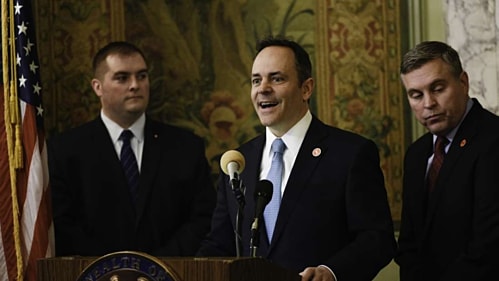
Mr. Bevin (center) prevented his child from getting chickenpox by letting the child contract the disease. Photo:IFL. |
Following the Kentucky governor's statement, several health experts have expressed their disapproval.
"No one should follow this," advises Dr. William Schaffner, an infectious disease expert from Vanderbilt University Medical Center. "We need to vaccinate our children. Vaccination is a huge victory in public health in America; let's not take a step backward."
Mr. Bevin still recommends that parents have their children vaccinated against chickenpox, but believes the government should not mandate vaccination.
"Why are we forcing young children to get vaccinated?" Bevin asked. "In many cases, vaccines are very good. But for some, there are reasons to do things differently."
According to Kentucky state law, children must be vaccinated against chickenpox before starting preschool. Parents can request an exemption on religious grounds or provide proof that the child has previously had the disease.
Chickenpox is a highly contagious disease caused by the Varicella-Zoster virus. It occurs at all ages, most commonly in school-aged children. Typically, a person only gets chickenpox once and develops immunity immediately after the illness. However, if the immune system is weak, the disease can still recur.
Chickenpox typically doesn't manifest immediately upon viral entry, with an incubation period of about 13-15 days. After this time, patients experience mild fever, runny nose, loss of appetite, aches and pains, itching, and red spots appearing all over the body in no particular order. The initial spots are clear, gradually turning cloudy due to the presence of pus. Complications from chickenpox include infections, pneumonia, and encephalitis.
There is no specific cure for chickenpox, therefore the World Health Organization (WHO) recommends vaccination as the most effective way to prevent the disease.


