
The unified name of the country is the Socialist Republic of Vietnam.
Continuing the agenda of the 5th session of the 13th National Assembly, National Assembly deputies spent the entire day of May 27 discussing in groups the draft amendment to the 1992 Constitution - one of the important contents of this session.
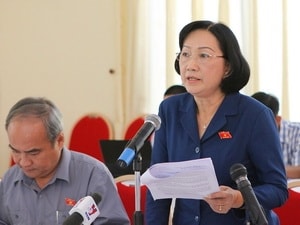
National Assembly representative Truong Thi Anh from Ho Chi Minh City delivered her remarks.
(Photo: Duong Giang/VNA)
Through discussions, National Assembly delegates assessed the implementation of the National Assembly's Resolution on organizing public consultations on the Draft Amendment to the 1992 Constitution. They noted that agencies, organizations, and localities had implemented the process promptly, comprehensively, democratically, widely, and on schedule. The public consultation on the Draft Amendment to the Constitution attracted deep interest and widespread support from various segments of the population. The Draft Amendment to the Constitution was disseminated and publicized through mass media, and feedback was collected through various appropriate methods...
National Assembly delegates assessed that the public consultation on the draft amendments to the Constitution was truly a democratic and extensive political and legal activity involving all strata of the population and the entire political system. This consultation not only mobilized the active participation of people at home and Vietnamese people abroad in contributing ideas to improve the draft, but also promoted the people's right to self-governance, raising awareness and a sense of responsibility among individuals, agencies, and organizations regarding the drafting of the Constitution, as well as its future implementation.
Representative Nguyen Bac Son (Hanoi) assessed that, in addition to creating a huge social impact with over 26 million comments from the people on the draft amendment to the Constitution, many heartfelt opinions from people nationwide have been compiled and sent to the Constitutional Amendment Drafting Committee.
Delegates emphasized the proactive and positive role of news agencies and the press in disseminating information and guiding the public to contribute opinions to the draft amendments to the Constitution, reflecting the heartfelt opinions of the people to the Party and the State...
It was unanimously agreed to continue to stipulate that the country's name is the Socialist Republic of Vietnam.
During the group discussions, delegates provided specific feedback on many aspects of the draft amendment to the Constitution. Regarding Article 1, the majority of opinions suggested retaining the name of the country as the Socialist Republic of Vietnam.
The analysis of this name emerged in the context of Vietnam having just completed the national democratic revolution, unifying the country, and moving towards socialism, clearly affirming the path and goals of building a socialist regime by the Party, the State, and the people. This name has been used stably from July 1976 to the present, and has been officially enshrined in the 1980 Constitution and the 1992 Constitution. Retaining the name Socialist Republic of Vietnam aims to further affirm the goals and path of building and developing the country towards socialism.
Expressing agreement with the explanations, feedback, and revisions of the Constitutional Amendment Drafting Committee, delegate Dao Van Binh (Hanoi) stated that the name of the country, Socialist Republic of Vietnam or Democratic Republic of Vietnam, clearly reflects the republican form of government and the democratic nature of our State. However, retaining the name Socialist Republic of Vietnam aims to further affirm the goals and path of building and developing the country towards socialism, ensuring stability and avoiding the need to change the national emblem, seal, and name on documents. Furthermore, after 37 years, this name has become familiar to the Vietnamese people and international friends.
Affirming the Party's leadership role over the State and society.
Regarding Article 4, many opinions supported affirming the Party's leadership role over the State and society, and agreed to add a provision in the draft amendment to the Constitution stating that the Party is closely connected with the people, subject to the people's supervision, and accountable to the people for its decisions. Opinions suggested that retaining Article 4's provision on the Party's leadership role is necessary. This provision inherits the provisions of Article 4 of the current Constitution, affirming the historical and objective necessity of the Party's leadership in the revolutionary process, national construction, and defense of our country.
Many opinions agree with the content of Article 4 as published in the Draft because it fully reflects the content and spirit of the Party's Platform and Charter regarding the class nature and ideological foundation of the Party.
Representative Truong Thi Anh (Ho Chi Minh City) agreed with the structure of the three clauses in Article 4. In particular, she concurred with the explanation of the Constitutional Amendment Drafting Committee regarding the suggestion to further clarify the mechanism of the Party's leadership over the State and society, the mechanism of the Party's accountability, and the mechanism for the people to supervise the Party.
According to the delegates, the Communist Party of Vietnam is the ruling party, leading the State and society. The Party leads through its Platform, strategies, orientations, and major policies and guidelines... The methods and content of leadership are expressed flexibly, meeting the requirements of each stage and period. In addition, the provision that all Party organizations and members operate within the framework of the Constitution and laws is an important guarantee that the people have the opportunity to supervise, helping our Party become increasingly clean and strong, worthy of being the leading force of the State and society.
We appreciate the inclusion of human rights in the draft amendment to the Constitution.
In the discussion of Chapter 2, on human rights, fundamental rights and obligations of citizens, many opinions highly appreciated the inclusion of human rights in the Draft, which covers most of the basic civil, political, economic, social, and cultural rights of human beings according to international treaties to which Vietnam is a signatory.
Some opinions suggest that the Draft continues to affirm and further clarify the fundamental rights and obligations of citizens as enshrined in the 1992 Constitution, while also adding some new rights.
Commenting on Clause 1, Article 25, which stipulates that all religions are equal before the law, Representative Nguyen Minh Quang (Hanoi) suggested amending it to state that religions recognized by the Socialist Republic of Vietnam are equal before the law, because currently there are religions not recognized by the State that still operate secretly, with the intention of attracting and inciting the people...
Regarding the proposal to review the way human rights and civil rights are regulated, separating human rights and civil rights into different sections in the draft Constitution, some opinions agree with the Constitutional Amendment Drafting Committee that human rights and civil rights have an organic and interconnected relationship, therefore the draft does not separate them into distinct sections, but rather regulates them according to the structure of international conventions on human rights.
Affirming that land belongs to the entire people.
One important issue, which received many comments from National Assembly deputies, was the issue of land ownership. Many opinions suggested that the draft Constitution's continued affirmation that land belongs to the entire people, with the State acting as the representative owner, is appropriate.
Representative Than Duc Nam (Da Nang) argued that land ownership is not only an economic issue but also a political, social, and national security issue. The essence of the Vietnamese State is that it is a state of the people, by the people, and for the people; therefore, the people must be the owners of the particularly valuable means of production, namely land, and must benefit from its value in all forms. Public ownership creates conditions for workers to access land, establishing a mechanism for workers to benefit from land more fairly and equally.
The delegates analyzed that affirming the State as the sole representative of the people in owning land is entirely correct.
Regarding land expropriation (Article 58), many delegates assessed that the majority of land-related complaints stem from people's frustration over the State's expropriation of land for socio-economic development projects, where compensation for those whose land is expropriated is inadequate and does not harmonize the interests of those whose land is expropriated and those of the project investors. Many opinions suggested that the draft Constitution should include clear and strict regulations on this issue. Some opinions noted that Clause 3, Article 58 of this draft adds the provision: Cases of land expropriation are determined by law. Land expropriation must be compensated, publicly disclosed, transparent, and fair in accordance with the law.
Clearly defining certain principles in land acquisition, as outlined in the Draft, will help limit the abuse of legal regulations for widespread land acquisition and will also provide important guidance for amending the Land Law to better suit practical requirements.
Regarding concerns about land expropriation cases, Representative Nguyen Thi Quyet Tam (Ho Chi Minh City) suggested that compensation issues need to be clearly defined, and the concept of expropriation needs to be clearly defined. She proposed that regulations should clearly stipulate that cases of expropriation within the same project and in the same area should have equal compensation levels, without differentiating based on the nature of the project when compensating the people.
According to the delegates, if this is not clarified, the situation of land disputes and complaints will continue for a long time.
It is necessary to establish a Constitutional Council.
Regarding the Constitutional Council (Article 120), the Constitutional Amendment Drafting Committee believes that the current Constitution has established a mechanism for protecting the Constitution through provisions on the position, role, functions, duties, and powers of agencies within the state apparatus, especially the National Assembly and its agencies. The current mechanism for protecting the Constitution is fundamentally consistent with the nature and characteristics of the organizational model of the Vietnamese State apparatus, but recent practice shows that this mechanism has not been truly effective and therefore needs further improvement. Along with further affirming and improving the current mechanism for protecting the Constitution, the Draft proposes the establishment of a Constitutional Council.
According to the Committee, the provisions regarding the Constitutional Council as in the Draft do not contradict the provision that the National Assembly is the highest state power organ, and at the same time reflect the principle of unified state power, with division of labor, coordination and control among organs in the exercise of legislative, executive and judicial powers.
During the discussion, many opinions agreed on the necessity of establishing a Constitutional Council, but suggested adding more tasks and powers to this institution to suit the requirements and demands of practice.
Representative Tran Ngoc Vinh (Hai Phong) assessed that the Constitutional Council is a new institution, and if regulated as drafted, it will only be an advisory body, and if put into operation, it will only be effective to a limited extent.
Delegates also raised concerns about whether the establishment of a Constitutional Council would overlap with the activities of some existing agencies and committees of the National Assembly.
Representative Chu Son Ha (Hanoi) disagreed with the view that establishing a Constitutional Council would inflate the state apparatus, arguing that the draft only stipulates that some members currently holding positions in state administrative agencies participate in the Council. The representative agreed on the necessity of establishing a Constitutional Council to address instances of unconstitutional actions and emphasized the need to clearly define the responsibilities and powers of the Constitutional Council.
At the session, National Assembly delegates discussed and gave specific opinions on many other contents in the draft amendment to the Constitution. Regarding the model of local government, many opinions suggested that the current model of local government in Vietnam is facing the reality that it needs to be reformed to suit the new situation and the level of development of the country.
The Constitutional Amendment Drafting Committee presented two options to the National Assembly regarding the model of local government. Option 1: Retain the provisions on administrative units and general provisions on the organization of local government. According to this option, Chapter IX would consist of two articles: one regulating administrative units, and the other regulating the establishment, functions, duties, and powers of local government as prescribed by law. Option 2: Retain the provisions on administrative units and the organization of local government as in the current Constitution.
According to the program, on June 3rd and 4th, National Assembly delegates will continue to give their opinions in the plenary session on the draft amendments to the 1992 Constitution. This important session will be broadcast live on radio and television so that voters nationwide can follow it.
According to (VNA) - LT


