
"Letter to comrades in the home province" by President Ho Chi Minh after the August Revolution.
(Baonghean) - It is remembered that in Tan Trao, Tuyen Quang province, on August 16, 1945, the National Congress convened and enthusiastically approved the policy...
(Baonghean) - It is remembered that on August 16, 1945, in Tan Trao, Tuyen Quang province, the National Congress convened and enthusiastically approved the Party's plan for a general uprising and the Viet Minh's ten policies. It decided to establish the Vietnam National Liberation Committee, the provisional government, with Comrade Ho Chi Minh as its chairman. Immediately after the Congress, President Ho Chi Minh sent a letter appealing to the people and soldiers nationwide: "The decisive moment for the destiny of our nation has arrived. All compatriots throughout the country, rise up and use your strength to liberate yourselves!"
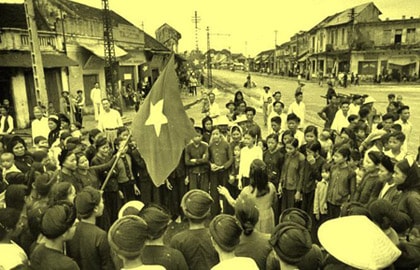
People rejoice in the joy of independence - Archival photo
Faced with the rapidly changing situation nationwide and within the province, the Standing Committee of the Viet Minh Front of Nghe An - Ha Tinh promptly established an uprising committee and launched an uprising to seize power throughout the province. Seizing the opportunity presented by the unconditional surrender of the Japanese fascists to the Allies, the Nghe An - Ha Tinh Uprising Committee issued orders to local areas to immediately arrange for the seizure of power, depending on their specific circumstances. On August 16th, the people of Thanh Thuy commune in Nam Dan district seized power. This was followed by villages around Vinh, such as Yen Dung and Loc Da, on August 17th. Quynh Luu was the first district in Nghe An to successfully seize power at the district level on August 18th. At exactly 12 noon on August 21st, revolutionary forces surrounded the Governor's Residence, and the then Governor, Dang Van Huong, surrendered. On behalf of the Provisional Revolutionary Committee of Nghe An, Comrade Le Viet Luong declared the abolition of the old government, the establishment of a new government, and encouraged the masses to help maintain security in the city, contributing to the protection of the fledgling government. The successful uprising in Vinh created momentum to rapidly advance the seizure of power in the remaining districts… Thus, in just 9 days, from August 18 to 26, 1945, the uprising in Nghe An achieved complete victory!
Nghe An province has made a significant contribution, along with the rest of the country, to "a miraculous revolution and from there gradually leading to many other great victories" (History Furuta Mooto, Japan). Returning to his hometown of Nghe An after many years of separation, on June 14, 1957, speaking at the provincial cadre conference, President Ho Chi Minh praised and acknowledged: "During the resistance war, you comrades united the people and led them to serve the resistance until victory. That is a good point!"
In Nghe An, right after the revolutionary upsurge of that autumn, there was an event not everyone knows about: Under the pseudonym Ho Chi Minh, Uncle Ho wrote "A Letter to the Comrades in My Home Province." The letter, less than 900 words, dated September 17, 1945, was written in Hanoi, under the name of an old comrade, with the purpose of sharing some experience with his comrades from his hometown. The letter consists of four clearly numbered sections to convey four main points:
- The immense significance of the national revolution;
- Explain why the revolution was successful;
- The task of building and developing a new society after seizing power;
- In the longest, boldest part at the end of the letter, Uncle Ho outlined the difficulties that needed to be overcome, emphasizing the need to learn as you go, and most importantly, to strictly follow the policies issued by the Government.
According to President Ho Chi Minh, the government's policy immediately after seizing power could be summarized in just two things: consolidating unity and correcting shortcomings. The strength of national unity was well known, but clearly identifying and demanding correction of the shortcomings in many key areas among cadres and party members at that time was not something everyone understood. These shortcomings, specifically, included excuses, narrow-mindedness; abuse of punishment; lax discipline; and some despicable acts such as acting like revolutionary officials, authoritarianism, and using public office for private revenge… All of this caused public confusion, shook national unity, and negatively impacted the prestige of the government and organizations. Gaining power was difficult, but maintaining it was even more challenging – deeply understanding this principle, President Ho Chi Minh urged comrades and compatriots in his province to immediately rectify these issues. He clearly stated, "We shouldn't fear having shortcomings, only fear lacking the determination to correct them, fear lacking a selfless and impartial heart for the people and the nation!"
Sixty-seven years have passed, yet the message in "Letter to Comrades in the Home Province" still retains its historical value of a glorious period and its contemporary relevance to the critical and self-critical thinking of cadres and Party members at all levels in these times...
Kim Hung


