
The Indian Prime Minister and the strategy to consolidate India's "backyard" position.
(Baonghean) - Indian Prime Minister Narendra Modi recently completed a five-day tour of three Indian Ocean countries: Seychelles, Mauritius, and Sri Lanka. These three countries are located in New Delhi's "backyard" and are considered strategically important in the Indian Ocean region. Therefore, according to analysts, Prime Minister Modi's trip aimed to adjust foreign policy, reaffirm India's position in the region, amidst China's increasing influence and the declining image of New Delhi in its own "backyard" in recent years.
Purpose of the trip
Prior to the trip, Indian media reported that Prime Minister Modi's three-country Indian Ocean tour aimed to send a message to regional countries about the need to strengthen cooperation to address security challenges and to pursue joint security and defense cooperation plans in the region. And, of course, this included a rival, China. Although, as is customary, the China element was absent from the talks and discussions at Prime Minister Modi's stops, it was clear that New Delhi's moves were all directed toward Beijing.
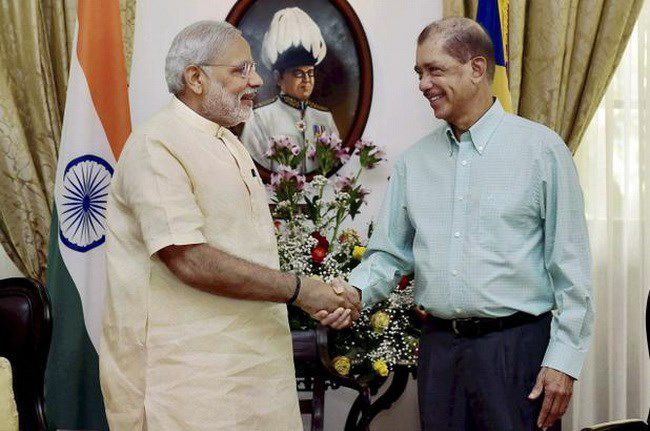 |
| Indian Prime Minister Narendra Modi and Seychelles President James Alexis Michel. Source: thehindu.com |
Looking back over the years, China's presence through diplomatic channels and economic cooperation programs, as well as financial support, with island nations in the Indian Ocean region has demonstrated a strategy of increasing Beijing's presence and influence in the area.
In fact, India has long had a well-structured strategy for the region known as its "backyard," but according to analysts, although China arrived later, it has been quicker and more aggressive in its approach. This has caused New Delhi to "wake up" and adjust its policy towards the Indian Ocean.
The agreements recently reached and those under discussion between Prime Minister Modi and the leaders of Seychelles, Mauritius, and Sri Lanka demonstrate this. These include plans for defense cooperation and support, such as providing patrol vessels, capacity building, expanding trilateral military exercises (India-Maldives-Sri Lanka) with Seychelles and Mauritius, and exploring ways to enhance maritime security cooperation. Also noteworthy is the inauguration of the first radar system on Mahe Island in the Syschelles. Seven more stations will be deployed in Seychelles within the next six months. Further stations will be located on Mahe and other islands outlying the area. Experts believe this network will support the control of the Exclusive Economic Zones of Indian Ocean island nations, while also helping India monitor ships transiting its "backyard." Clearly, since coming to power, Prime Minister Modi has recognized China's moves and has been gradually showing Beijing that the Indian Ocean remains New Delhi's "backyard."
Reaffirming its strategic position
As a strategic backyard, the Indian Ocean region and its countries hold paramount importance in India's foreign policy. Beyond China, cooperation in various areas with countries like Seychelles, Mauritius, and Sri Lanka is also part of India's long-term development strategy. The Indian Ocean, covering 75 million square kilometers, is the third largest after the Pacific and Atlantic Oceans and plays a crucial role in security, maritime affairs, energy reserves, and mineral resources. Naturally, it is a target for major powers such as Russia, China, and, of course, India. The Indian Ocean contains vital sea lanes connecting the Middle East, Africa, and East Asia with Europe and the Americas, as well as important shipping routes for oil and gas. Statistics show that approximately 40% of the world's offshore oil and gas production originates from the Indian Ocean.
Prime Minister Modi's current policy focuses on maintaining and developing safe and effective maritime security; exploiting marine resources and fuels; promoting international cooperation on environmental protection; and, in part, competing with China. Therefore, Prime Minister Modi emphasized that his visit to the three island nations in the region reflects India's foreign policy priorities towards its neighboring and broader countries.
In this new context, Prime Minister Modi is promoting cooperation on two main fronts: Firstly, economic cooperation, which is India's main focus and also the approach China is taking. Secondly, diversifying other areas of cooperation to serve the strategic goals that Prime Minister Modi has set in the region. For example, India is defining its role as a provider of cybersecurity, patrol vessels, surveillance radar, and marine mapping for these island nations. In Seychelles, for instance, India and the island nation signed four agreements to strengthen their security and maritime partnership, including cooperation on hydrology, renewable energy, infrastructure development, and the exchange of electronic nautical charts. Similarly, with Mauritius, Prime Minister Modi plans to provide financial support for the country to acquire 13 Barracuda-class vessels in the near future.
Competition is not conflict
Undeniably, Prime Minister Modi's visit is a strategic move to regain India's influence and position in the Indian Ocean and South Asia through diplomacy and economic and defense cooperation. Analysts have repeatedly stated that the Indian Ocean will be one of the leading targets in major power rivalries in the 21st century. This prediction is increasingly being proven true with China's $40 billion "Maritime Silk Road" project. This strategy by Beijing, seen as limiting New Delhi's influence, has made it difficult for Prime Minister Modi's administration to remain passive, thus prompting them to increase their defense presence in the region.
While competition exists in politics, economics, and defense, experts predict that a conflict between China and India in the region is unlikely. Both sides understand that such a scenario would only undermine their respective strategies. Minor clashes may occur, but mutual warnings remain the primary focus. Therefore, it remains to be seen whether China or India will win the race for influence in the Indian Ocean. However, Prime Minister Modi's visit to Seychelles, Mauritius, and Sri Lanka marks a pivotal new phase in this ongoing competition.
Khang Duy
| Indian Prime Minister Narendra Modi was born on September 17, 1950, the third child in a family of grocery sellers in Mehsana, northern Gujarat. He officially entered politics after joining the Bharatiya Janata Party (BJP) in 1987. Before becoming Prime Minister, Modi served as Chief Minister of Gujarat for 10 consecutive years and transformed the state into a leading economic powerhouse in India. |


