
The Prime Minister has directed ministries, agencies, and localities to proactively respond to Super Typhoon Ragasa.
Deputy Prime Minister Tran Hong Ha has just signed Official Dispatch No. 170/CD-TTg dated September 22, 2025, from the Prime Minister, directing ministries, sectors, and localities to proactively respond to Super Typhoon Ragasa.
The telegram was sent to the Secretaries and Chairmen of the People's Committees of provinces and cities from Quang Ngai northward; the Ministers of the Ministries of: National Defense, Public Security, Agriculture and Environment, Construction, Industry and Trade, Culture, Sports and Tourism, Science and Technology, Education and Training, and Health; the Directors General of: Vietnam Television, Vietnam Radio, and Vietnam News Agency; the Editor-in-Chief of Nhan Dan Newspaper; and the Office of the National Civil Defense Steering Committee.
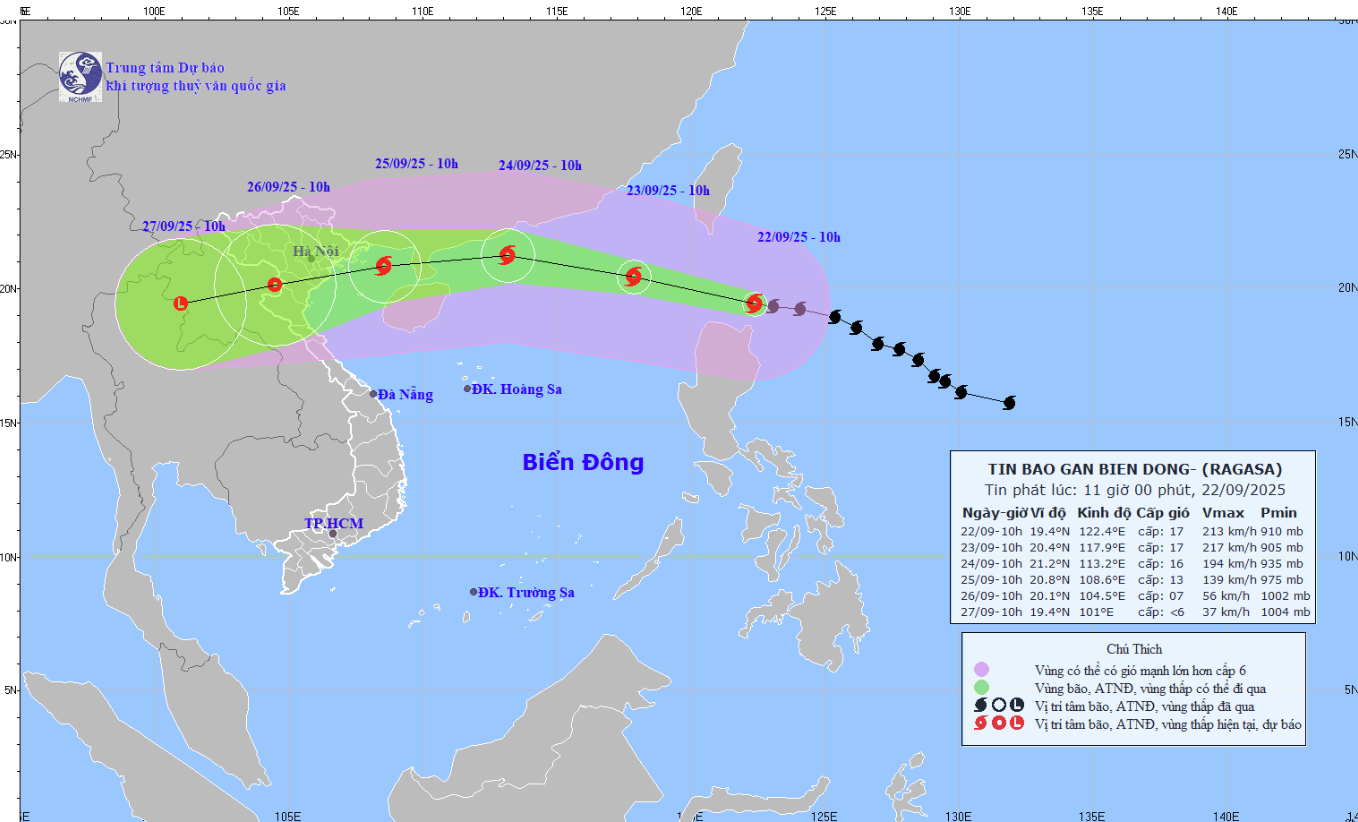
The dispatch stated: The storm, internationally named Ragasa, is currently active in the waters east of Luzon Island (Philippines). At 7:00 AM on September 22, 2025, the storm's center was located at approximately 19.3 degrees North latitude and 123.1 degrees East longitude, about 200 km northeast of Luzon Island. The strongest winds near the storm's center reached level 17 (super typhoon), with gusts exceeding level 17..
According to the National Center for Hydro-Meteorological Forecasting, Typhoon Ragasa will move into the East Sea tonight (September 22, 2025) (the 9th typhoon in the East Sea in 2025). After entering the East Sea, the typhoon will move faster at a speed of about 20 km/hour and maintain its maximum intensity at level 16-17, with gusts exceeding level 17 on September 22-23, 2025 (wind speed equivalent to and stronger than the maximum intensity of Typhoon Yagi in 2024), with waves over 10m high, extremely rough seas, and particularly dangerous for ships operating in the northern and central East Sea areas.
From September 24, 2025, the storm is likely to gradually weaken. Between the night of September 24 and the early morning of September 25, 2025, the storm will cross Leizhou Island (China) into the Gulf of Tonkin with its intensity remaining at level 12-14, gusting to level 15-16. It is predicted that on September 25, the storm may make direct landfall in Vietnam, in the area from Quang Ninh to Ha Tinh.
This is a very strong storm (currently a super typhoon and expected to maintain super typhoon status for the next two days as it moves across the East Sea), with a very wide area of strong winds (very strong winds from north of latitude 18 degrees north), and it is especially important to be prepared for thunderstorms and tornadoes before the storm directly impacts (even when the storm's center is still about 300-400km away)..
According to the National Center for Hydro-Meteorological Forecasting (as of now), Typhoon Ragasa is likely to directly affect the mainland of the Northern and North Central provinces. However, the typhoon's development is still very complex, and local authorities, agencies, and the public need to regularly monitor and update the latest typhoon forecast bulletins regarding the development of Super Typhoon Ragasa.
To respond to Super Typhoon Ragasa early and proactively, ensuring the safety of people's lives and minimizing property damage, especially to ships and activities at sea and along the coast, the Prime Minister requests:
1. Ministers of the following Ministries:The Ministries of National Defence, Public Security, Agriculture and Environment, Construction, Industry and Trade, Science and Technology, Education and Training, and Health; the Secretaries and Chairmen of the People's Committees of provinces and cities from Quang Ngai northward must not be negligent or complacent, but must organize the monitoring, updating, and thorough understanding of the storm's developments and the local situation; they must focus on leading, directing, reviewing, and updating plans, and be ready to immediately implement measures to respond to Super Typhoon Ragasa with the most decisive spirit, early, from afar, proactively implementing the highest level of response measures, anticipating the worst-case scenario to ensure the safety of people's lives, minimize damage to people's and state property, and avoid being passive or surprised in any situation.
2. Comrade Secretary and Chairman of the People's Committee of the provincesCoastal cities from Quang Ninh to Quang Ngai, especially Quang Ninh, Hai Phong, Hung Yen, Ninh Binh, Thanh Hoa, Nghe An, Ha Tinh, Quang Tri, and Hue (areas predicted to experience very strong winds and storms), should postpone non-essential meetings, mobilize the entire political system, and focus on leading, directing, and supervising the response to Super Typhoon Ragasa, including:
a) Urgently review and count all local vessels and means of transport operating at sea and along the coast; coordinate with relevant agencies to inform ship owners and captains of vessels and means of transport still operating at sea about the development and predicted direction of the storm; guide them to move out of and avoid entering areas at risk of being affected by the storm; call upon and guide vessels and means of transport to safe shelters; and at the same time guide and support the implementation of necessary measures to ensure the safety of vessels at anchorage.
b) Based on the specific situation regarding the risk and impact of the storm, localities should proactively decide to restrict ships and vehicles from going out to sea or prohibit maritime activities when necessary (note: take precautions against thunderstorms and lightning before the storm directly affects the area); decide to control and restrict traffic during the storm when strong winds and heavy rain occur to minimize incidents and ensure the safety of people's lives.
c) Implement storm prevention and control measures as early as possible at sea, on islands, coastal areas, and inland, paying particular attention to proactively reinforcing and ensuring the safety of houses, infrastructure, and sea dikes, minimizing damage to production, especially agricultural production in coastal areas; support people in harvesting agricultural products that are nearing harvest time with the motto "better to harvest while the crop is still green than to let it wither in the field" to minimize damage from storms.
d) Review plans, forces, and resources ready to organize and deploy support for the evacuation and relocation of people in unsafe areas before the storm directly impacts them, and deploy response, rescue, and relief efforts when adverse situations occur.
3. Minister of Agriculture and Environment:
a) Direct meteorological and hydrological forecasting agencies to closely monitor, coordinate, and refer to international forecast information to provide the most complete, timely, and accurate information on the development and impact of the storm, while also assessing the worst-case scenario so that relevant agencies and the public are aware and can proactively implement appropriate, timely, and effective response measures.
b) Proactively direct efforts to ensure the safety of fishing vessels operating at sea and along the coast; implement measures to protect dikes, irrigation reservoirs and dams, and agricultural production; coordinate with the industry and trade sector to support localities in directing the safe and efficient operation of the interconnected reservoir system, preventing any dam safety incidents.
c) Closely monitor the situation, regularly update and proactively notify ships and vessels operating at sea about dangerous areas to prevent them from entering and to ensure they leave these areas. Direct and urge relevant sectors and localities to implement appropriate response measures based on the actual situation, promptly report and propose to the National Civil Defense Steering Committee and the Prime Minister on matters beyond their authority.
4. Minister of Construction:
a) Direct relevant agencies to coordinate with local authorities to immediately review all ships and transport vehicles operating at sea, along the coast, and in estuary areas at risk of being affected by the storm (including river-sea vessels), and proactively guide them to move away from or out of dangerous areas, or to safe shelters.
b) Directing the review and preparation for implementing measures to ensure the safety of civil works, construction activities, and traffic safety during the period affected by the storm.
c) Direct the Vietnam Maritime Search and Rescue Coordination Center to deploy vessels in key areas predicted to be directly affected by Typhoon Ragasa, ready to coordinate with relevant units and forces to quickly implement response and search and rescue operations should adverse situations occur.
5. Minister of Industry and TradeDirecting the review of plans and implementation of safety measures for industrial production activities, especially offshore oil and gas exploration, mining, and underground mining; ensuring the safety of hydroelectric dams and power systems; minimizing damage from storms and floods; ensuring the supply of essential goods, preventing shortages, and avoiding unreasonable price increases due to natural disasters.
6. Ministries: National Defence, Public SecurityDirecting the implementation of safety measures for military and police forces, vehicles, and equipment; directing units stationed in areas at risk of being affected by Typhoon Ragasa to proactively review plans and deploy forces and resources to be ready to support local authorities in evacuating and relocating residents, responding to the typhoon, and conducting rescue operations when required.
7. Minister of Science and TechnologyDirecting telecommunications service providers to review and proactively implement plans to ensure the safety of telecommunications infrastructure, guaranteeing continuous and uninterrupted communication between the central and local levels, and between provincial and commune/village levels, and addressing communication disruptions during storms and floods.
8. Ministers of the Ministries of Education and Training, and HealthDirecting the implementation of safety measures for students, personnel, equipment, and infrastructure under the sector's management to minimize damage, prevent disruption to students' learning, maintain emergency services, and promptly restore normal medical examination and treatment activities for the people immediately after storms and floods.
9. Minister of Culture, Sports and TourismDirecting the implementation of measures to ensure the safety of tourists and tourism activities, especially at sea, on islands, and in coastal areas.
10. Chief of Staff of the National Civil Defense Steering CommitteeIn coordination with relevant agencies of the Ministry of Agriculture and Environment, closely monitor the situation, proactively review response scenarios, and be ready to coordinate and mobilize forces and resources to support localities in responding to storms and floods according to assigned functions and tasks.
11. Directors General: Vietnam Television, Vietnam Radio, Vietnam News Agency and other media organizationsIncrease broadcast time and news coverage so that people can stay informed about the storm's developments, the directives of the Government, the Prime Minister, and relevant agencies at the central and local levels, enabling them to proactively implement response measures and minimize damage caused by natural disasters; guide people on storm response skills to reduce losses.
12. Government OfficeMonitor and urge ministries and localities to strictly implement this directive; promptly report to the Prime Minister and the Deputy Prime Minister in charge of any unexpected or emerging issues./.


