
The Prime Minister urges the deployment of a network of satellite hospitals.
"Why can other localities do this, bringing many benefits to the people, while this locality cannot?" The Prime Minister questioned the localities and requested that, in 2016, any province without a satellite hospital must plan and implement this project. If there is a lack of equipment, investment from various sources, such as the budget and social mobilization, is necessary to provide for the people.
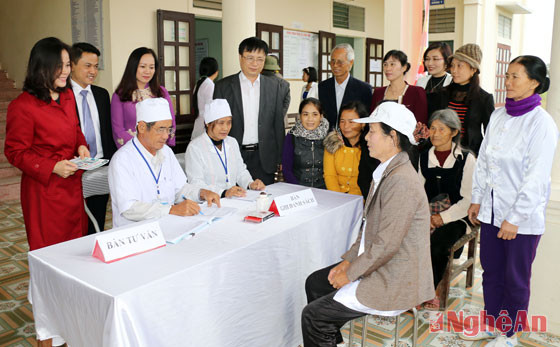 |
| Delegates visit a model of medical examination and treatment for the elderly at the Quỳnh Lộc commune health station (Quỳnh Lưu - Photo courtesy). |
According to the Ministry of Health's Provincial Telemedicine Project, from 2012-2015, telemedicine hospitals will be established at the provincial level. Priority will be given to developing a network of 48 telemedicine hospitals in five severely overloaded specialties (oncology, trauma surgery, cardiology, obstetrics, and pediatrics). However, as of the end of December 2015, only 41 provinces nationwide had established telemedicine hospital connections with central and tertiary hospitals.
At the Government's online conference with localities on implementing the National Assembly's Resolution on socio-economic development tasks and the 2016 State Budget estimate, Prime Minister Nguyen Tan Dung emphasized that localities must link local hospitals with central hospitals and tertiary hospitals to improve the quality of medical examination and treatment for the people, especially in advanced techniques.
In reality, it has been shown that if a locality focuses on directing this work, there will be a significant improvement. Specifically, previously, some provincial hospitals never thought they could perform heart surgery on patients; however, today, up to 7 provincial hospitals can perform heart surgery very well locally. A prime example is Can Tho Provincial General Hospital.
Thus, it is clear that the network of satellite hospitals both benefits the people and contributes to reducing the overload at central and tertiary hospitals. And this is the fundamental solution to reduce hospital overload and improve the quality of medical examination and treatment at the lower levels, not administrative solutions. This is something we can absolutely do, the Prime Minister emphasized.
The Prime Minister instructed the Ministry of Health to consider options regarding human resources. If there is a shortage, they must mobilize and train a team of highly qualified doctors, aiming to connect each department and specialty with satellite hospitals to serve the people. "For provinces without specialized departments or hospitals in overloaded specialties like oncology, what plans should the Ministry also have?" the Prime Minister reminded the Ministry of Health.
Regarding local authorities, the Prime Minister requested that provincial leaders integrate provincial hospitals into satellite hospitals of central-level hospitals to improve the quality of medical examination and treatment for people right in their localities. At the same time, they must link district hospitals with provincial hospitals to provide support in terms of human resources and improve professional skills to serve the people right in district hospitals, as traveling from the district to the province for treatment is already very costly for the people.
"Why can other localities do it, bringing many benefits to the people, while this locality cannot?" The Prime Minister questioned the localities and requested that any province without a mobile health station must plan and implement this in 2016. If there is a lack of equipment, investment from various sources, such as the budget and social mobilization, is necessary to serve the people.
According to VGP
| RELATED NEWS |
|---|


