
The Prime Minister departs to attend the 26th ASEAN Summit.
Today (April 26), Prime Minister Nguyen Tan Dung and his delegation departed Hanoi to attend the 26th ASEAN Summit (ASEAN 26 Summit) to be held in Kuala Lumpur and Langkawi, Malaysia (April 26-27) at the invitation of Malaysian Prime Minister Najib Tun Abdul Razak.
The 26th ASEAN Summit was the first high-level meeting during Malaysia's 2015 ASEAN Chairmanship, themed "Our People, Our Community, Our Vision".
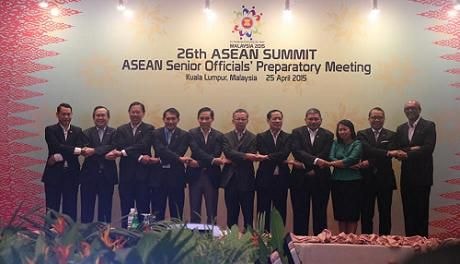 |
| The ASEAN Senior Officials' Meeting (SOM) on April 25th marked the beginning of preparatory meetings for the 26th ASEAN Summit. Photo: ND |
The conference identified eight priority areas for the chairmanship year, including: Preparing for the formation of the ASEAN Community by December 31, 2015; Completing the drafting of the ASEAN Community Vision after 2015; Strengthening ASEAN institutions; Bringing ASEAN people closer together; Enhancing cooperation among small and medium-sized enterprises; Expanding intra-ASEAN trade and investment; Promoting regional peace and security; and Enhancing ASEAN's global role.
At this meeting, the leaders of the 10 ASEAN countries will focus on discussing directions and measures to further promote the formation of the ASEAN Community by 2015; building a vision for the ASEAN Community after 2015; improving the organizational structure and working methods; the Association's external relations; ASEAN's central role; challenges facing ASEAN and how to address them; and exchanging views on regional and international situations.
Regarding documents, at the 26th ASEAN Summit, in addition to the customary Chairman's Statement, ASEAN leaders are expected to adopt three documents: the Kuala Lumpur Declaration on a People-Centered ASEAN; the Langkawi Declaration on the Global Moderation Movement; and the Kuala Lumpur Declaration on Institutionalizing ASEAN, Communities and People's Resilience to Disasters and Climate Change.
Playing a proactive, positive, and responsible role within ASEAN, Vietnam's participation in this Conference aims to contribute to promoting a more closely integrated and effective ASEAN, consolidating and strengthening ASEAN's unity and its important role, especially in ensuring peace, security, cooperation, and development in the region.
Over the past period, ASEAN has continued to strengthen regional and national efforts to ensure the timely formation of the ASEAN Community by the end of 2015; actively preparing for the post-2015 development phase. Simultaneously, ASEAN has also continued to prioritize strengthening regional connectivity and narrowing the development gap through two main frameworks: the ASEAN Master Plan on Connectivity (MPAC) and the ASEAN Integration Initiative (IAI). Currently, ASEAN has implemented 40% of the ASEAN Master Plan on Connectivity, and within the framework of the ASEAN Integration Initiative, 285 projects have been implemented, mainly focusing on human resource development and infrastructure projects.
At the same time, ASEAN is striving to promote the implementation of measures to improve the efficiency of the ASEAN organizational structure in order to meet the higher requirements when ASEAN enters the Community, as well as the higher stage of development thereafter.
Regarding external relations, ASEAN continues to strengthen and deepen relations with its dialogue partners. Within the ASEAN+1 framework, in addition to existing strategic partners, ASEAN recently agreed to elevate the ASEAN-Australia relationship to a strategic partnership; is working towards a strategic partnership with the EU; and is considering proposals from the United States and New Zealand to upgrade their relationship to a strategic partnership. ASEAN continues to play a leading role in regional cooperation processes and frameworks such as ASEAN+3, ARF, ADMM+, EAS, etc.
Furthermore, ASEAN continues to maintain a common stance on the South China Sea issue, emphasizing the need to maintain peace, stability, security, and safety of maritime and air navigation in the South China Sea; to resolve disputes peacefully on the basis of international law, including UNCLOS 1982; to exercise restraint, avoid complicating the situation, strictly and fully implement the DOC, and to reach a COC as soon as possible.
According to chinhphu.vn


