
Prime Minister Nguyen Tan Dung pays official visit to India.
At the invitation of Prime Minister Narendra Modi, Prime Minister Nguyen Tan Dung will pay an official visit to the Republic of India from October 27-29.
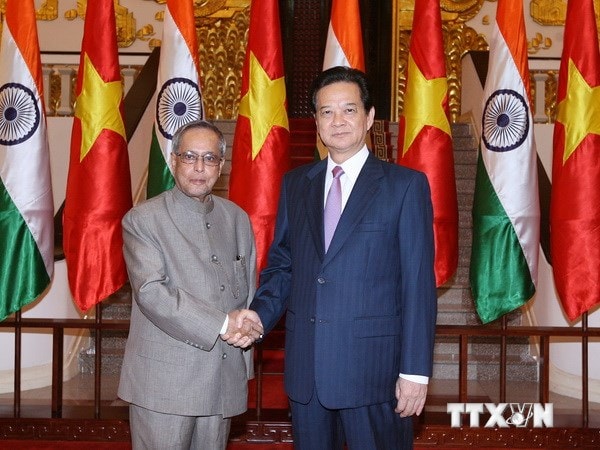 |
| Prime Minister Nguyen Tan Dung met with Indian President Pranab Mukherjee during his state visit to Vietnam. (Photo: Thong Nhat/VNA) |
Located in South Asia, India is one of the cradles of human civilization, with a history spanning over 5,000 years.
The long-standing traditional friendship between Vietnam and India, formed in the early decades of the 20th century, was founded by President Ho Chi Minh and Prime Minister Jawaharlal Nehru, and has been diligently nurtured by successive generations of leaders and people of both countries.
The two countries established diplomatic relations on January 7, 1972. India actively supported Vietnam in its past struggles for independence and national reunification, as well as in its current process of reform and development.
The traditional friendship between Vietnam and India is developing well, with frequent exchanges of high-level delegations between the two countries. Vietnamese delegations visiting India include President Truong Tan Sang (October 2011); Prime Minister Nguyen Tan Dung attending the ASEAN-India Dialogue Relations 20th Anniversary Summit in India (December 2012); and General Secretary Nguyen Phu Trong (November 2013).
Indian delegations visiting Vietnam include Vice President Hamid Ansari (January 2013); Indian Foreign Minister Sushma Swaraj (August 2014); Indian President Pranab Mukherjee (September 2014); and most recently, Prime Minister Narendra Modi.
The two countries also regularly hold meetings of cooperation mechanisms such as the Vietnam-India Intergovernmental Committee, the Joint Trade Subcommittee, etc.
The Vietnam-India strategic partnership is developing increasingly deeply and broadly, especially in five areas: politics, economics, security and defense, science and technology, and culture and education.
India values developing relations with Vietnam and considers Vietnam a crucial pillar in India's Look East policy.
Building on strong political relations, cooperation between the two countries in many other fields has also developed vigorously. Bilateral trade turnover has increased over the years since the two countries established a strategic partnership in 2007.
The two countries have become important trading partners, with bilateral trade reaching US$5.23 billion in 2013, a 32% increase compared to 2012.
The two countries are striving to achieve the goal of increasing bilateral trade to $15 billion by 2020.
Vietnam mainly exports components, chemicals, wood and wood products, iron and steel, coal, agricultural products, transport vehicles and parts, textiles, and footwear...
Regarding investment between the two countries, there have been positive signs and are expected to increase rapidly in the near future with the implementation of the US$1.8 billion Long Phu II Thermal Power Plant project in Soc Trang province by TATA Group. Currently, India has 73 investment projects in Vietnam with a total registered capital of US$273 million (as of May 2014).
In terms of cultural and educational cooperation, India is helping Vietnam train high-quality human resources in the fields of information technology, economics, law, and English.
The two countries regularly cooperate in organizing cultural and artistic exchange programs to enhance mutual understanding between their peoples. India is also working towards opening an Indian Cultural Center in Hanoi soon.
Vietnam and India have always coordinated closely and supported each other in regional and international forums (United Nations, ASEAN, ARF, ADMM+, RCEP). India supported Vietnam's candidacy for a non-permanent seat on the United Nations Security Council for the 2020-2021 term. Vietnam supported India's participation in the UN Security Council for the next term and supported India becoming a permanent member when the Security Council is expanded.
Prime Minister Nguyen Tan Dung's official visit to India aims to further promote the strategic partnership between the two countries, with a focus on economic cooperation; and to develop deeper and broader cooperation in various fields such as science and technology, culture and education, tourism, and aviation.
During the visit, the two sides will also discuss regional and international issues of mutual interest.
According to VNA


