
Chinese Prime Minister faces pressure in India.
Today, May 19th, Chinese Premier Li Keqiang begins a visit to India at a time when relations between Beijing and New Delhi are seriously deteriorating following last month's incident involving Chinese soldiers infiltrating Indian territory.
According to the India Express, Li Keqiang will meet with Indian Prime Minister Manmohan Singh today. Indian Foreign Ministry spokesperson Syed Akbaruddin stated that New Delhi “appreciates” Li Keqiang’s choice of India as his first foreign destination.
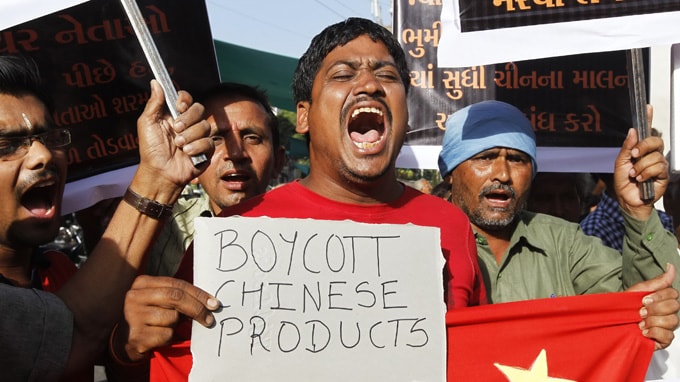
However, at the same time, a senior Indian Foreign Ministry official, Gautam Bambawale, affirmed that Prime Minister Singh would frankly address “all issues” between India and China with Mr. Li. The focus of the discussion will be the incident last month involving Chinese soldiers infiltrating Indian territory.
Determined to prevent the recurrence of intrusion
In mid-April, a group of Chinese soldiers crossed the Sino-Indian Line of Actual Control (LAC), penetrating 20km into Indian territory and setting up camp there. The location of the Chinese encroachment was Ladakh in the western Himalayas. After numerous negotiations between the two sides, the Chinese troops finally withdrew on May 5th.
Despite New Delhi's objections, Beijing insists that the Chinese troops "did not cross the LAC." Indian public opinion has criticized the New Delhi government for its weak response to China's encroachment. Yesterday, the Press Trust of India quoted several Indian government officials as saying that New Delhi is determined to pressure Beijing to prevent similar incursions from recurring.
Furthermore, the Hindustan Times reported that the Indian Ministry of Defence recently released a report warning of the "significant risk" posed by China's increased naval deployment in the Indian Ocean, near the gateway to India. The report asserts that the Chinese navy aims to control "sensitive sea lanes" in the Indian Ocean.
The Daily News & Analysis reports that, in addition to territorial disputes, Prime Minister Manmohan Singh and Premier Li Keqiang will also have to discuss another pressing issue in bilateral relations: the trade balance heavily skewed in favor of China. India will also demand that China ensure that Beijing's construction of three more large hydroelectric dams on the Brahmaputra River (which China calls the Yarrlung Tsangpo River) will not affect downstream water resources within Indian territory.
The ingenious tactic of "creating disputes to claim sovereignty"
A dangerous gamble In The Diplomat, Yaping Wang, an expert from the Carnegie Endowment for International Peace (CEIP), argues that China's "status-altering" tactics will lead to numerous risks for Beijing itself. These include the risk of maritime conflict, rising anti-China sentiment in other countries, and a clear understanding from the international community that China is the "bully." Therefore, the security environment surrounding China will deteriorate. "China is playing a dangerous gamble," expert Yaping Wang stated. |
Recently, the International Crisis Group (ICG) published a report criticizing China for using the tactic of "creating disputes to assert sovereignty" in the East China Sea and the South China Sea. The report, titled "Dangerous Waters," states that Beijing is employing a common tactic in both seas: viewing actions by other nations to defend their sovereignty as "acts of aggression," and then retaliating with strong measures aimed at "changing the status quo" in a way that benefits China.
After Japan nationalized the Senkaku/Diaoyu Islands in September 2012, China immediately declared the waters surrounding the Senkaku Islands as its "territorial baseline." According to China's own law, the "baseline" encircling the Senkaku Islands implies that the archipelago belongs to Chinese sovereignty. Since then, Beijing has continuously deployed patrol vessels to the waters around the Senkaku Islands. The ICG stated that this is effectively an act of "establishing overlapping control" in the Senkaku waters to force Japan to acknowledge it as a disputed area.
China has also repeatedly employed this tactic in the South China Sea. Using the pretext of the Philippines deploying warships to arrest Chinese fishermen illegally fishing at Scarborough Shoal, Beijing seized control of the shoal. Thus, China altered the status quo at Scarborough Shoal to its advantage while still accusing the Philippines of "aggression."
To deceive international public opinion, Beijing portrays the actions of regional countries as "small countries bullying big countries." The ICG states that the goal of this tactic is to permanently alter the status quo in China's favor. Most recently, China has repeated this tactic on its border with India.
According to Tuoitre - DT


