
Autumn brings back memories of August of yesteryear.
Sixty-eight years have passed since the victory of the August Revolution. Along with the rest of the country, the history of Vinh City has entered a new chapter: Vinh has become a Class 1 city with steady progress in economic, cultural, and social development. However, to achieve this today, we cannot forget Vinh of the days before the Party's guidance. Memories of the past.
(Baonghean)Sixty-eight years have passed since the victory of the August Revolution. Along with the rest of the country, the history of Vinh City has entered a new chapter: Vinh has become a Class 1 city with steady progress in economic, cultural, and social development. However, to achieve this today, we cannot forget Vinh of the days before the Party guided its way.
Old memories
One day in early August, we visited the Quang Trung Temple on Dung Quyet Mountain. Standing at an altitude of 97 meters above sea level, we looked out in all directions and saw Vinh stretching out unusually long, wide, and expansive. To the north, the Thien Ly 1A highway stretched far into the distance like a red thread running from south to north, and our Vinh lies between the two economic, cultural, and political centers of the country… It's no wonder that in 1788, Quang Trung Nguyen Hue chose Vinh to build Phuong Hoang Trung Do. Although not yet complete because King Quang Trung suddenly passed away in 1792, Phuong Hoang Trung Do holds immense significance in the history of Vinh's formation and development.
In Nguyen Quang Hong's "Vinh City - Formation and Development," there is a passage that reads: "Until Quang Trung built Phuong Hoang Trung Do, the administrative center of Nghe An was still located in Lam Thanh. In May 1804, King Gia Long issued a decree to General Le Van Duyet to oversee the construction of fortifications and ramparts to move the administrative center of Nghe An from Lam Thanh - Phu Thach to present-day Vinh. This is an important milestone officially marking Vinh becoming the administrative center of Nghe An, becoming one of the 29 military districts of our country at that time." By the end of the 19th century, Vinh was described as a well-established city.
In 1901, the book "General Overview of Annam" wrote: "Vinh is 400 kilometers from Hue and 296 kilometers from Hanoi. It has 40 Europeans, 161 Chinese, and 12,000 Vietnamese people. It is the provincial capital of Nghe An. Two years ago, Vinh became a real city with beautiful, straight cobblestone streets, streets lined with shops owned by Chinese and Vietnamese, and shops selling handicrafts such as ironwork, embroidery, umbrellas, paper effigies, and wood and bamboo. The area where the Chinese live has many beautiful, tall houses with courtyards built of stone, arranged closely together."
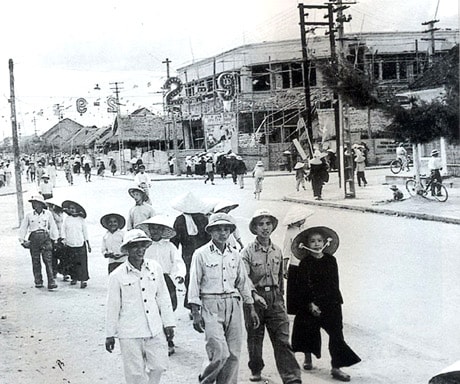
Vinh town in 1958.
To better understand the economy, life, society, and people of Vinh at that time, we visited the homes of several local residents and veteran revolutionaries who had lived and worked there before the August Revolution. We heard that after occupying Nghe An, the French colonialists, with their policy of "exploiting in small packages," focused their attention on the Ben Thuy area. Ben Thuy, from a military outpost and a river port, gradually developed into a major port and a gateway to an industrial zone.
To develop transportation, the French colonialists restored several important provincial roads: the old Thien Ly road, now named National Highway 1 (trans-Vietnam), the Trans-Indochina railway; the river from Ben Thuy to Cua Hoi was dredged and widened to become a large port (in 1927, the total volume of goods exported through the port was 14,741 tons). By this time, National Highway 8, starting from Vinh, and National Highway 7, officially starting from Phu Dien intersection, had been explored and opened to connect with neighboring Laos… Factories in Vinh - Ben Thuy sprang up in increasing numbers: the Laotian company selling forest and agricultural products and purchasing industrial goods; the Indochina Match Company, the Central Vietnam Commercial Forestry Company, the Northern Vietnam and Laos Automobile Transport Company…
In particular, the anonymous Indochina Railway Company SACFI established a locomotive repair and carriage manufacturing workshop in Vinh called the Truong Thi Factory – the second largest locomotive repair workshop in Indochina (after the Gia Lam Locomotive Factory). This very locomotive factory was the site of later revolutionary worker protests in Vinh. Later, this company also established a small locomotive storage and repair facility near the station, called the Vinh Depot.
In 1927, the Governor-General of Indochina established the city of Vinh - Ben Thuy by merging three urban centers: Vinh, Truong Thi, and Ben Thuy. Vinh was divided into 10 wards, from District 1 to District 10. At this time, Vinh was envisioned not only as the center of Nghe An province but also as a major city of Central Vietnam, the center of the entire North Central region. The Vinh power plant was established in Ben Thuy. In 1936, Vinh's electricity consumption was one-quarter of that of Central Vietnam, double that of Da Nang, five times that of Quy Nhon, and ten times that of Hoi An.
The electricity grid stimulated the expansion of factories, shops, and capitalist companies such as: the Vuong Dinh Chau printing factory (Maestro Phoc Street), the Indochina Bank, the Canh Nong Bank (De Nhat Street), the Legrone sawmill at Cua Tien Bridge, the De Cornus rubber trading company, the Manger timber trading shop (Ben Thuy), along with the hardware shops Dupe, Bisope, Edrolot… and the French-Asian oil companies, the Standa import company... Chinese-owned shops almost exclusively controlled the supply of traditional Chinese medicine, spices, and high-end food. They, along with Indians, controlled the cotton and textile supply, such as Vinh Huong Tuong, Vinh Hung Long, Vinh Ky...
The rapid development of industry, trade, and services led to equally significant development in cultural life: This was also a transitional period between the old system of learning and examinations and the new methods of education. Vinh National School was established to educate secondary school students from the provinces of Thanh Hoa, Nghe An, Tinh Hoa, and Binh Dinh. Several newspapers such as Sao Mai, Thanh Nghe Tinh… and various music, folk performance, and cultural and artistic associations… were also established to meet the needs of the upper class and a segment of the petty bourgeoisie and intellectuals…
A series of cultural institutions also emerged: there were three cinemas, with the An Nam Cinema alone having a capacity of 800 seats. Besides Buddhism and Confucianism, Catholicism also penetrated a segment of the population; the Cau Ram Church became a landmark associated with the cultural life of the people of Vinh. During this period, football, volleyball, tennis courts, and swimming pools were built. Bookstores, photo studios, and barbershops sprang up in increasing numbers. There was even a whole street with many brothels, which the locals often called "the street of courtesans."
Back then, there were famous football teams like Lam Thanh Football, ASZAT, Poolit, and especially ASNA. The yellow color of the once-illustrious ASNA team still remains in the jerseys of Song Lam Nghe An. By the end of the 20th century, the population of Vinh had increased to nearly 20,000 people, with around 400 rickshaw drivers, and over 8,000 workers employed in the Truong Thi, Ben Thuy factories and the Vinh railway depot.
To maintain strict control, the administrative apparatus in Nghe An was used by the French to manage Vinh City - Ben Thuy District, rather than managing it separately. They imposed numerous regulations on the collection of various taxes: from taxes on slaughtering buffalo and cattle, bidding taxes, to taxes on the sale of livestock, and taxes on boats docked at the port…
Revolutionary fervor
Before the August Revolution, alongside the relatively affluent lifestyles of merchants and businesspeople, a significant number of people in Vinh and surrounding areas lived in abject poverty. A segment of the population worked for meager wages in factories owned by the French, often facing beatings and interrogations. Laborers working as cart pullers and porters also suffered from constant unemployment and insufficient food. This situation, coupled with fervent patriotism, led to numerous uprisings: from the Phan Đình Phùng rebellion to the Đông Du movement of Phan Bội Châu, and the Duy Tân movement of Phan Chu Trinh…
Although these spontaneous uprisings were unsuccessful, they marked the beginning of the struggle against oppression by the people of Nghe An province. Following the founding of the Party on February 3, 1930, came the Nghe Tinh Soviet Uprising of 1930-1931, and then the demonstrations by railway depot workers in Vinh and workers in Truong Thi - Ben Thuy demanding higher wages and shorter working hours. The highlight was the August 1945 uprising.
To lead this uprising, in 1941, Nguyen Ai Quoc founded the Vietnam Revolutionary Alliance, which had a manifesto, program, and specific operating regulations. Also in Vinh, the resurgent grassroots party organizations actively directed the revolutionary movement in the area. Following the Japanese coup against the French, seizing power, they plundered food supplies, causing a famine that killed over 2 million Vietnamese people. The streets of Vinh, the province, and the country were littered with dead bodies and beggars.
In this situation, national salvation associations were also established in factories, and many people joined street self-defense forces. On August 13, 1945, Japan surrendered to the Allies. The opportunity had arrived; from August 13 to 15, 1945, our Party met in Tan Trao and issued the order for a general uprising. Following the Central Committee's order, the Viet Minh alliance of Nghe An and Ha Tinh provinces launched an uprising throughout the province. It began with the people of Thanh Thuy commune, Nam Dan district (August 16, 1945), followed by uprisings in Vinh such as Yen Dung and Loc Da (August 17, 1945), and Quynh Luu and Hung Nguyen on August 18, 1945. Particularly noteworthy was the uprising in Vinh - Ben Thuy on the morning of August 21, 1945, when tens of thousands of people from the city and suburbs, including all classes of workers, farmers, intellectuals, and students, from old to young, armed with sticks and spears, marched and protested along the streets, raising the red flag with a yellow star.
Faced with the overwhelming momentum of the Vietnamese revolution, the Japanese were forced to accept unconditional surrender. At exactly 12 noon on August 21, 1945, the masses surrounded the Nghệ An provincial governor's residence. A provisional revolutionary people's committee was established, followed by a provisional revolutionary workers' committee at the Trường Thi factory and other factories. The uprising in Vinh ended quickly and successfully in just one day without bloodshed. Following the victory in Vinh, the districts of Diễn Châu (August 21), Thanh Chương and Anh Sơn (August 23), Yên Thành (August 25), and others also rose up to seize power.
Sharing in that fervent atmosphere, Mr. Duong Xuan Tuy, 89 years old and a Party member for 65 years, from Mau Don hamlet, Hung Loc commune, Vinh City, can never forget the feeling of pride he felt when he participated in and witnessed the day the army and people of Vinh City seized power from the Japanese fascists. That day, he was the head of the Red Self-Defense Team of Loc Da commune (now Hung Loc commune). Mr. Tuy was assigned the task of communication by the Viet Minh Front Committee. He recalled: "On the 21st, we rehearsed in the communes. On the 22nd, we gathered the masses, marching in rows of 5 or 6, shouting slogans like 'Overthrow the Japanese fascists,' 'Establish a revolutionary people's government,' 'Long live the Viet Minh,' 'Long live Ho Chi Minh'..."
The general uprising, which took place from the cities and plains to the highlands, lasted only nine days but achieved brilliant success. This was the result of a long and arduous struggle by all strata of the people since the French colonialists first set foot in Nghe An. The victory of the uprising to seize power in Nghe An made a worthy contribution to the overall victory of the entire country, shattering the colonial and feudal regimes and ushering in a new era for the Vietnamese nation, as beloved Uncle Ho affirmed in the Declaration of Independence on September 2, 1945: “…The French fled, the Japanese surrendered, King Bao Dai abdicated. Our people have overthrown the colonial shackles of nearly 100 years to build an independent Vietnam. Our people have also overthrown the monarchy of many centuries to establish a democratic republic…”
New day
This morning (August 17th), going out into the streets, I felt a strange sense of joy. In the gentle breeze heralding the arrival of autumn, Vinh seemed more beautiful, serene in the golden hues of the autumn sun. The streets appeared wider and more vibrant with banners and slogans welcoming the August Revolution and National Day on September 2nd.
Suddenly, the lively melody of the song "August 19th" echoed from the loudspeakers at the corner of Quang Trung Street (formerly De Nhat Street). It turned out that the residents of Block 6 were excitedly celebrating their title as a culturally advanced block. In his welcoming speech, the block secretary emphasized with emotion: The victory of the August Revolution opened a new chapter in the history of the country, and Vinh - the political, economic, and cultural center of our province - is also part of that general trend.
Along with other localities in the province, Quang Trung – one of the key wards of the city, where before the August Revolution, large factories, shops of the Chinese community, printing workshops, theaters, etc., were mainly concentrated on this street – quickly overcame the consequences of war and rose up. With the close guidance of the Quang Trung Ward Party Committee and the unity and solidarity of the residents, Block 6 is delighted to receive the title of "Cultural Block" today, in the atmosphere of the whole nation looking forward to August 19th and National Day on September 2nd. This is an important event marking the block's development over the past period. This event contributes a small part to the overall development of the ward. To have a prosperous and happy life today, we can never forget the contributions and sacrifices of our forefathers…
Mr. Nguyen Xuan Do – Secretary of the Party Committee and Chairman of the People's Committee of Quang Trung ward – happily stated: After more than 10 years since the ward's establishment, Quang Trung has changed a great deal. The economy is focused on services and trade; the cultural life of the people is developing, and many professions from before the revolution are still maintained by the people, such as small businesses at Vinh market, motorbike repair shops, tricycle transport, and photography studios… To restore the traces of old Vinh, the province has also rebuilt the Nguyen Thi Minh Khai Memorial Area on De Nhat Street (formerly the home of Mrs. Han Binh - Minh Khai's mother, now the Little Prince Restaurant), the 12/9 Cinema (formerly Annam Cinema), and a project is currently underway to gradually restore the Diec Pagoda, bringing back the ancient beauty of what was then the largest pagoda in Vinh.
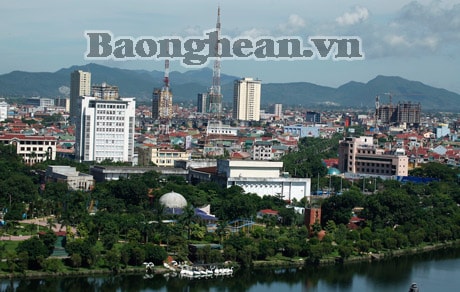
Vinh City today. Photo: Xuan Nhuong
Along with Quang Trung and Truong Thi - Ben Thuy, Vinh today has expanded northward with 20 wards and communes, concentrating various industries: commercial services in key wards and communes, and commercial vegetable and fruit production in suburban communes. Over the years, Vinh has become a destination for many domestic and international projects due to its convenient air, sea, and road connections. In 2008, on the occasion of the 220th anniversary of Phuong Hoang Trung Do and the 45th anniversary of Vinh City, the Prime Minister recognized Vinh as a Class I urban area under Nghe An province, presenting both new opportunities and challenges.
This year, 2013, the Party Committee, government, and people of Vinh City are undertaking many activities to commemorate the 225th anniversary of Phuong Hoang Trung Do, the 50th anniversary of Vinh City, and the 5th anniversary of Vinh becoming a Class I urban area. Vinh has been and is undergoing renewal and development worthy of the sacrifices of previous generations, the expectations of the Party and State, and the trust and love of the people.
Thanh Hien


