
The earth awakens with me!
(Baonghean) - The propaganda officer of the Que Phong District Party Committee was enthusiastic when I expressed my desire to learn about the agricultural and rural situation in the district, and most importantly, to meet a genuine farmer who has made sustainable wealth on his homeland's land. He said, "This guy is very interesting! He's good at farming and good at livestock breeding, and making hundreds of millions of dong in net profit every year is commonplace..."
The "revelation" from the propaganda officer seemed to lift my somewhat gloomy spirits during those rainy days in Que Phong. The once remote border region now seems closer in the minds of visitors from afar due to positive changes in its socio-economic life, and in recent years, has become an ideal destination for many people from all over to come and work and live. As the propaganda officer enthusiastically led me on a tour, said, "Good land attracts good people." Many people who aren't originally from Que Phong, but live and work here, contributing to this land, still feel proud to call themselves "Que Phong people"!
...The interesting "guy" we're rushing to meet is a typical "resident" of the area. His estate, spanning over 6 hectares, is located in Na Den village, Tien Phong commune. Looking around, it seems there's not a single plot of land left empty; everything is being utilized by the owner for profitable farming and cultivation. We had to wait a while for the owner. We wandered around, looking around, asking questions, and were astonished to hear the young men and women in pristine white shirts, knee-high plastic boots, and medical masks explain that they were all salaried employees at the farm, and all had intermediate, college, or university degrees in agriculture, forestry, or veterinary medicine. Wow, so this "guy" is doing business in a very systematic and strategic way!
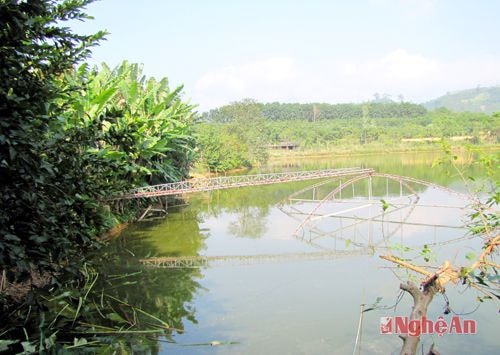 |
| The fish pond of Mr. Hoang Quoc Hai's family. |
I heard the rumbling of a car at the entrance. The car door slammed shut, and a tall, agile man stepped out, followed by the friendly smile of a kind-hearted woman. “This is Mr. Hoang Quoc Hai, the farm owner, and his wife, Ms. Ngo Thi Suu!” the district propaganda officer introduced me. Seeing my hesitation in asking questions, Hoang Quoc Hai took the initiative to strike up a conversation...
“We’ve been in Que Phong for over 14 years, starting from small, handcrafted businesses and now we’ve built up what we could call a large-scale enterprise. Many newspapers and television stations have come to visit, but we’ve politely declined, not wanting to see them. It’s not arrogance, but partly because I’m busy with livestock farming like a parent with young children; and partly because I’m naturally inclined to avoid the attention and opinions of outsiders. This time, since we have some free time, let’s chat freely!” – the voice betrayed a straightforward and resolute character. Surely, such firmness and determination were necessary to persevere in establishing a livelihood in this remote land, especially during the 2000s, when socio-economic conditions here were still fraught with difficulties.
Hai and his wife are originally from Dien Lam (Dien Chau). In 1998 and 1999, their homeland suffered from crop failures and drought. Farmers facing natural disasters could only cry out to heaven, but their pleas went unheard. Day after day, he secretly went to visit the barren fields, the cracked earth where no sprout could grow. At night, he tossed and turned, sleepless, reflecting on the farming life of his ancestors, with its many ups and downs, yet poverty still clung to them. He pondered the future, wondering if his children and grandchildren would also follow the same path of "the buffalo leading the way...". The more he thought about it, the more his will to overcome adversity seemed to be re-energized.
Mr. Hai discussed with his wife that they had to leave, go far away, to a place with rich land potential, because they were farmers, and they couldn't abandon their roots. They would still do agriculture, but modern, large-scale agriculture. He said this confidently to boost his wife's morale, but in reality, even now, when recounting those days to me, Mr. Hoang Quoc Hai's voice still shows a hint of hesitation: "Looking back, I still think we were reckless. I told my wife to leave the children with their grandparents and we'd try our luck in Que Phong. When I was young, I'd been there a few times with friends involved in trading. I saw the cool climate, fertile soil, and vast, sparsely populated land – it could be an opportunity for us. We discussed it today, and the next day we set off."
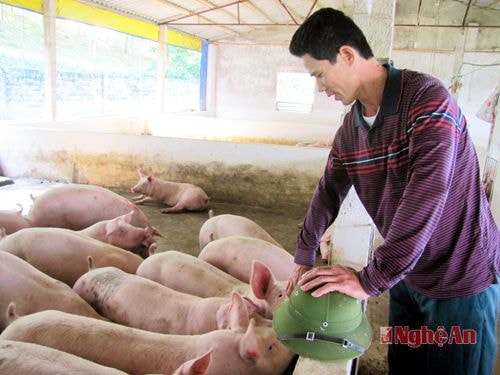 |
| Mr. Hai takes care of the pigs raised for meat. |
Back then, on their old Minsk motorbike, the couple traveled over 120 km, searching for a remote land with the hope of making a living. Their only possessions were the old Minsk, which later became their main source of income, sustaining them through the arduous days in Quế. With no relatives, unfamiliar territory, and surrounded by a foreign language, they rented a tiny 15-square-meter shack on the roadside in the center of Kim Sơn town to rest. Hai chose to work as a motorbike taxi driver to make ends meet, while his wife, Sửu, toiled from dawn till dusk selling vegetables at the market. “Working during the day was manageable, but at night, the thought of our child brought tears to my eyes. Every night I cried until my pillow was soaked with tears because I missed home and my child so much. Poor thing, having to leave home at only five years old. And my parents were also very confused at the time, wondering if this was the right thing to do, if it was a good idea.” - Ms. Ngo Thi Suu recalled.
"The land is kind and compassionate to the hardworking people," Mrs. Suu said jokingly. And indeed, after only a few years of establishing themselves in a foreign land, accumulating small amounts and borrowing from relatives and friends, the couple managed to acquire a spacious plot of land right in Kim Son Town. Mr. Hai shared: "We were fortunate to have the support of the district leaders. In 2003, when the land allocation program was introduced, my wife and I submitted an application and it was approved immediately. Then we applied for household registration, and the district and town authorities enthusiastically supported us. With the land, my wife and I built a temporary house and excitedly planned our new business ventures."
That plan wasn't exactly a "breakthrough," but it was a timely business approach in Que Phong at the time. Hoang Quoc Hai and his wife realized that the local food market had many gaps, especially in pork and fish, which were mainly imported from the lowlands at prices one and a half times higher, and the freshness and quality were inferior. They did thorough research, meticulously counting the meat stalls in Kim Son Town Market—11 in total—and Tien Phong Market—6. The demand was enormous! “At first glance, anyone would think that in this mountainous region, the meat, fish, and vegetables must all come from the remote ethnic minority communities, but that's not the case. The supply from these communities is very limited, estimated to only meet about one-third of the consumption demand, and it's unstable due to their traditional farming and livestock raising methods, which depend on nature. My husband and I spent a whole month researching and decided to focus on livestock farming. As farmers, we're only comfortable with raising animals; we're not as skilled or experienced in wholesale trading as others,” confided Ms. Ngo Thi Suu.
And reality proved the aptitude of these simple farmers. On an area of nearly 800 square meters, the couple hired additional workers and toiled day and night clearing the land, digging a fish pond, and building pigpens. Initially, with limited capital, the fish pond only had a few kilograms of fingerlings, the pigpens only had a couple of fattening pigs, and the feed mainly came from leftover rice and soup scraps from restaurants and eateries around the market. Gradually, after a few months, the first batch of pigs was bought on the spot by traders, and the couple happily added a little more capital to raise a few more pairs of fattening pigs.
After a few years, the 800 square meter property in Kim Son town had flourished, boasting a well-organized and spacious pig farm housing nearly 100 pigs, with strict and scientific procedures for quarantine, import, and export. Hai and Suu's pig farm also became a familiar supplier to the market, and only then did the couple dare to breathe a sigh of relief after nearly a decade of struggling to make a living in this land. At that time, they welcomed their baby child to live with them, and their home became warm with a simple, loving rhythm of life...
That's a story from years ago, but about seven years ago, the couple moved permanently to Na Den (Tien Phong) to settle down and focus on developing the largest farm in Que Phong district. The area where I'm sitting now was once a barren swamp and deserted wasteland belonging to the Youth Volunteer Brigade 7. In 2007, they applied to join the brigade and reclaimed over 6 hectares with the goal of "awakening" the land's potential. Now, the farm radiates a new energy, with over 2 hectares of ponds teeming with catfish, carp, and tilapia... The remaining area is largely dedicated to livestock farming with 150 sows, over 1,000 fattening pigs, several hundred free-range chickens, not to mention over 2 hectares of lush green rubber trees on the hillside behind their house. On average, nearly 14 tons of pork are sold each month, while at least 30 kilograms of fish are caught daily, roughly generating several hundred million VND per year.
Mr. and Mrs. Hai affirm that their success stems from a modern agricultural mindset, the application of scientific and technological advancements, and high-quality human resources. Every year, they travel to and learn from large-scale farm models both within and outside the province, including Quang Binh, Thanh Hoa, Hung Yen, Nam Dinh, and Bac Ninh… The quarantine process at the farm is very strict; visitors are strictly prohibited from entering and exiting without permission, must wear masks, sterile white gowns, and knee-high boots; disinfectant is sprayed twice a week; and livestock and poultry are vaccinated regularly according to schedule.
The farm employs eight professional workers with proper qualifications, earning an average salary of 6-10 million VND per person per month. The farm has become a model for people from near and far to visit, learn from, and receive advice on breeds and effective farming methods. Everyone has a lot of affection for the enthusiastic couple who never keep their trade secrets. Smiling brightly, Mr. Hoang Quoc Hai shared about a nearly 40-hectare integrated VACR (Vegetable, Animal, and Crop) farm that is gradually taking shape in his hometown of Dien Lam (Dien Chau). He said, "I love this arduous farming profession so much that I always yearn to 'conquer' it, to master it with technology and science, rather than depending on the unpredictable nature of the environment..."
Ky Phuong


