
Waking up to a melody…
(Baonghean) - Christmas season, also the time when the year draws to a close. Surely, in this bustling moment, as the cold weather gradually deepens, everyone wants to draw closer together, sharing their feelings and thoughts. It's as if there's a sudden realization: Oh, how fast has it gone? Before long, my hair will be gray! What have I done, how have I lived these past months? How have I stood among millions of people on this land?
And as if unconsciously, I typed the phrase "Many trees together make a forest" into my keyboard, only to be surprised to hear a song with that title featured on the provincial Party newspaper's website (www.baonghean.vn)...
I believe that music is truly magical in its ability to touch every emotional nerve, stirring within us feelings that we often forget or are even unaware of. In some way, music penetrates and awakens the fragile threads of emotion that are often quite "hidden" in the human soul and mind. It makes people feel their most human by allowing them to discover things that have been long concealed within the shell of habitual thinking and rationality. One could say that, before music, people are like children again, bathing in a river of primal, pure emotions.
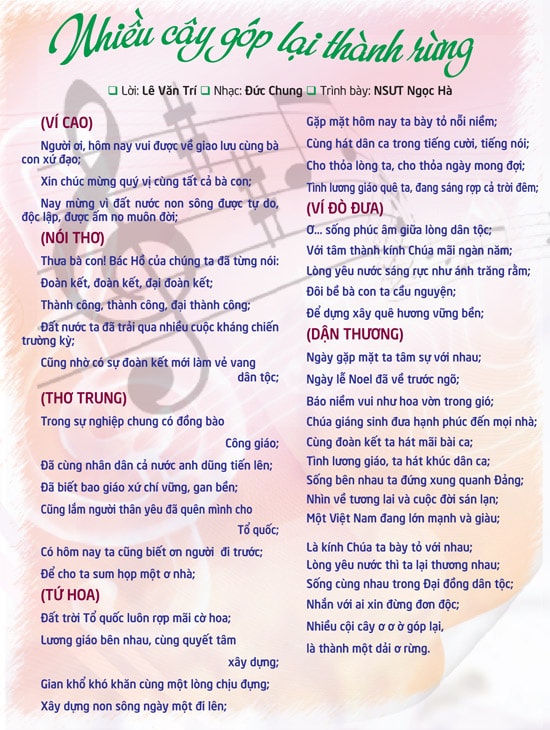 |
When the first notes are sung, perhaps everyone feels a profound sense of familiarity, as if each note, each beat, is being poured from their own soul. The song, performed by Meritorious Artist Ngoc Ha, is deeply rooted in the folk music of Nghe An province, and what's particularly interesting is that the lyrics were written by a dedicated and passionate Catholic official working for the District Front Committee – Mr. Le Van Tri.
Even I, who was once captivated by the folk melodies of Nghe Tinh, was surprised by this incredibly fresh and harmonious combination of music. Guided by that familiar, gentle melody, the author's words come to us in a very natural and intimate way. The opening verse is like a heartfelt message: "My dear friends, today I am happy to be here to socialize with the people of this religious community / Congratulations to you and all the people / Today I rejoice because our country is free, independent, and prosperous for generations to come." The joy of the reunion, the excitement of the gathering, the immense happiness at the independence, prosperity, and renewal of the nation... all permeate every word and melody of the high verse. Following the verse, the silence allows the poetry to rise in a quiet, contemplative way, like a heartfelt expression of affection, a message of cherished sentiment. The author reiterates President Ho Chi Minh's call for unity, which has been etched into the hearts of all Vietnamese people as a rallying cry for national pride. The author also emphasizes that "It is thanks to unity that the nation achieves glory."
The lesson of unity is a lesson we have learned after countless protracted wars of resistance throughout history, after so much bloodshed, loss, and suffering. Over the years, we have endured two sacred wars, and even a thousand years before that, we stood firm against invasion and resisted natural disasters like storms and floods, all thanks to unity. We Vietnamese share the same blood, the descendants of Lac and Hong, a common ancestry, we eat from the same rice fields, drink from the same river… With so much shared blood and flesh, why should hearts be divided? Unity is like the clasped hands of a circle of people. It connects individual beings in the warmth of a radiating strength, a strength from the human heart, from blood and flesh, from sacred feelings that, without it, would lead to isolation and the destruction of all values.
The lyricist, a Catholic, proudly affirmed: “In the common cause, there are Catholic compatriots/ Who have bravely advanced alongside the people of the whole country/ So many parishes have shown unwavering determination and courage/ And many beloved individuals have sacrificed themselves for the Fatherland.” Indeed, in the common cause, regardless of gender, region, or religion, with their patriotic and courageous traditions, the Vietnamese people throughout the country rose up, together “determined to die for the Fatherland,” defending the nation to the very end. Amidst the bloodshed, countless people bravely fought in battles with a single determination, a single goal: to serve God and the Fatherland. For them at that time, the path their faith affirmed was the Gospel understood in its broadest sense, encompassing goodness, struggle, and national identity.
I suddenly remembered my visit to the Military Region 4 Museum years ago. Among the hundreds, even thousands, of artifacts there, I was particularly impressed by the bottle lamp and the story behind it. It was the story of Catholic layman Vu Dang Ninh. When museum officials visited his home in a poor district of Thanh Hoa province, in that extremely simple house, they saw the bottle lamp hanging in a prominent corner instead of medals and decorations. It was a lamp he had created from glass bottles and student ink cartridges, which he and other people from Thanh Hoa used to transport supplies during the Dien Bien Phu campaign. From his ingenious idea, thousands upon thousands of such lamps were subsequently made to serve the campaign. This layman, with all his love for God and his country, brought light to countless groups of people on their way to the front lines.
His lamp ignited and extended the flame of love and national unity. He and many of God's followers truly became exemplary figures in the history of the people's struggle, a history written in blood, sweat, and tears, a history defined by patriotism, courage, and solidarity. Many devout Catholics, like him, fell to protect peace for the nation. Like the Catholic Party member Nguyen Van Luan of the 12.7mm Company named Phung Chi Kien (Dien Chau) years ago. Before entering the final battle, he managed to leave behind a blood letter in which all his heart and mind were focused on his purpose in life: "I am Nguyen Van Luan, from Dien Ky. To live is to fight, to love everyone. I am determined to fight, to defeat the Americans and the puppet regime. I am not afraid of death!"
The author Le Van Tri and the composer Duc Chung shared a common vision, leading to the creation of this meaningful song. "Many Trees Together Make a Forest" comprises various sections and rhythms, yet they are linked by a clear and coherent theme. Each section stands independently, but all utilize familiar folk melodies to convey their message. Following the poetic verses is a four-part verse filled with joyful lyrics. The author praises the love between religious and secular people, and behind the words, the music evokes an optimistic and life-affirming spirit with a heartfelt, gentle, and familiar rhythm. The "vi do dua" melody, a poignant and lyrical folk song from Nghe An province, is effectively used by the author to celebrate reverence for God and love for the country. Reverence for God and love for the country are now intertwined, harmoniously blended. And isn't striving for a peaceful, free, harmonious, and friendly life with everyone around us the ultimate goal for all nations and religions?
The Christian faith's philosophy of life, embodying both worldly and moral values, aligns with the common life philosophy of the vast majority of the people. This philosophy is about living a life beneficial to one's family and nation, living in harmony with God's will and the hearts of the people. "Living the Gospel in the heart of the nation," a theme mentioned in the song with its smooth melody, has become the core principle of devout believers. Their faith is directed towards God, and their God encourages them towards goodness, tolerance, and harmony – sentiments and ways of life that are in harmony with the national spirit. Deep within the subconscious of every person lies a yearning for peace, happiness, and a path towards goodness.
Their yearning, their inclination towards goodness, is almost instinctive, something that exists primal in every human being before undergoing any process of awareness, education, or experience. Over time, this longing multiplies and is expressed in one way or another, influenced by countless factors such as knowledge, culture, and religion. However, while religion sustains this yearning through faith, the difference between non-Catholics and Catholics in fulfilling their aspirations lies only in their spiritual foundation, not in their purpose or means. Therefore, in the festive atmosphere of the Catholic community, the song by author Le Van Tri and composer Duc Chung speaks for both Catholics and non-Catholics, so that "Both sides pray / To build a strong and lasting homeland"...
The author chose the "angry-loving" melody for the final section of the song as a message to those who are deliberately going astray, who have not listened to the voice of the majority of Catholic people, and who want to incite hatred and create divisions between Catholics and non-Catholics, to turn back. The recurring folk melodies from beginning to end of the song are a distinctive artistic technique of this work. Using elements of folk music and traditional music, the author has made the song deeply resonate with listeners, expressing heartfelt words so that those who love will love even more deeply, so that those who have gone astray can find a way back, and so that all souls can find a place of refuge.
In my jumbled memories, the peaceful rooftops of churches always appear, an image that we have all encountered somewhere across the country. The church roof, the statue of Christ, the bell tower, and the melodious ringing of the bells… This peaceful picture makes one smile and feel a deep love for life, a place where, if each person lives well, harmoniously, and tolerantly, they can reach the holy water of peace and happiness; a place where we all need to hold hands tightly to gain immense, enduring strength, to move forward together; a place where “Many trees together make a forest,” where many streams merge into rivers and seas. A place where we all joyfully sing together the hymn: “Living together in national unity / Tell everyone not to be alone / Many trees together make a forest.”
I love that song, not for the elaborate or flowery nature of either the music or the lyrics. I love it for its sincerity and simplicity. It's like a message from a man to a woman, like words between friends at their closest. And I realize that it not only soothes our hearts with its melody, but also awakens the deepest and most sacred feelings within us...
Quynh Lam


