
Awakening the green resource region of Pu Hoat
(Baonghean)Located within the Western Nghe An Biosphere Reserve, Pu Hoat is considered a typical pristine area, home to thousands of rare and precious plant and animal species. Surrounding Pu Hoat are the residential areas of ethnic minority communities, and several hydroelectric projects are putting pressure on forest protection efforts. The Pu Hoat Nature Reserve Management Board has been established with the responsibility of improving the effectiveness of forest management, protection, and development; while simultaneously preserving and promoting the unique values of Pu Hoat...
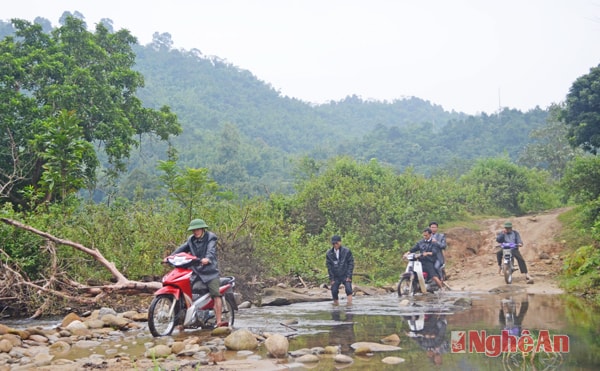 |
| The road to Na Luom, the "kingdom of the fern," is rugged. |
| RELATED NEWS |
|---|
To reach Thong Thu Border Gate, it takes almost two hours by car from Phu Phuong intersection. The road is steep but beautiful, and with the majestic scenery of Pu Hoat mountain, despite the cold weather, everyone was very excited. The car stopped at Huoi Luom Resettlement Area, and we, along with Phan Tien Long, Nguyen Dinh Nguyen, and Sam Van Tai – young officers from the Thong Thu forest protection station – proceeded to Na Luom. It was drizzling, the ground was damp, and the path was a small trail with many steep slopes and streams. We traveled by motorbike and on foot for another two hours before reaching the "kingdom of reeds." Indeed, the praise of the reed forest being "more beautiful than in Chinese historical dramas" is not wrong. Having traveled to many places such as Chau Thang, Chau Tien (Quy Chau), Tien Phong, and Dong Van (Que Phong) to write about the exploitation of reeds, I am not unfamiliar with this plant. The long-stemmed bamboo, with segments about 50-60cm long and 4-5cm in diameter, has captivated bamboo weavers. Yet in Na Luom, the bamboo segments reach 80-100cm in length, with an average diameter of 8cm, and some even reaching 10cm in diameter. The bamboo grows densely, closely packed together like green walls. The deeper you go, the denser the bamboo becomes. Phan Tien Long said that it would take a local several days to explore the entire bamboo forest, but it's impossible for us. The bamboo is beautiful, but it's a protected area, so we can't exploit it, and even locals are forbidden from entering..."
The Pù Hoạt Special-Use Forest is identified as the core area of the World Biosphere Reserve in Western Nghe An Province, recognized by the United Nations Educational, Scientific and Cultural Organization (UNESCO) since September 2007. The Pù Hoạt Special-Use Forest covers an area of 35,723 hectares, located in five communes: Hanh Dich, Nam Giai, Thong Thu, Tien Phong, and Tri Le. According to documents preserved at the Pù Hoạt Nature Reserve, this forest area possesses exceptionally unique natural values, serving as a model of ecosystem and biodiversity. The vegetation in Pù Hoạt is composed of three types: high-altitude tropical rainforest with mixed broadleaf and coniferous trees; medium-altitude tropical monsoon broadleaf forest; and low-altitude tropical monsoon broadleaf forest.
Mr. Le Van Nghia, Deputy Head of the International Cooperation Department of Pu Hoat Nature Reserve, explained that the first type of vegetation is largely located deep within the core zone, is less affected, and has a very high degree of pristine nature. The dominant plants are broadleaf and coniferous trees, some of which are very large. The dominant tree species in this forest include: *Re*, *Chop*, *Boehmeria*, *Khao*, *Ca Oi*, *De La Tre*, *Com*, *May Chau*, *To Hap*... The second type of vegetation is distributed at altitudes from 800 to 1500m, spreading across the slopes of Pu Pa Nha, Pu Cao Ma, and the eastern side of Pu Hoat peak. This forest type still retains its basic pristine nature. The dominant plants are broadleaf trees that grow well, with typical species such as *Sau Sau*, *De*, oak, *Re*, mulberry, sapodilla, *Xoan*, *Bo Hon*...; and coniferous trees such as *Thong Nang* and *Kim Dao*. The forest is divided into four layers, including the emergent layer which contains valuable tree species such as Shorea spp. and Dalbergia spp. The third layer of vegetation is distributed at altitudes below 800m with many tree families such as: castor oil tree, mahogany, mulberry, Acacia mangium, Terminalia catappa, Terminalia chebula, Dioscorea spp. ...
The biodiversity of Pu Hoat is confirmed by the fact that, to date, scientists have discovered 763 plant species belonging to 427 genera and 124 families; more than 30 species are listed in the Vietnamese Red Book. Regarding trees, there are valuable and noteworthy species such as: Dipterocarpus spp., Dalbergia spp., Shorea spp., and Shorea spp.; initial surveys of gymnosperms have identified 7 species, including 4 rare species: cypress, cypress, fir, and fir. Among them, the fir population discovered in Pu Hoat includes trees with very large diameters, averaging over 1.5-2m, and heights exceeding 45m, with some trees reaching up to 2.8m in diameter and over 50m in height.
The forest fauna of Pu Hoat has been cataloged as 176 vertebrate species belonging to 4 classes: 45 mammal species, 131 bird species, 11 reptile species, and 6 amphibian species. The fauna of Pu Hoat has a structure and species composition similar to the fauna of Northwest Vietnam. The mammal class includes characteristic species such as: gaur, grey heron, squirrel, civet, etc.; the bird class includes species of the thrush family. The composition of bird and mammal species in Pu Hoat is recorded as equivalent to that of Vu Quang (Ha Tinh) and Pu Mat areas, ranking above Pu Huong. Mammals include typical and rare species such as: elephant, tiger, leopard, clouded leopard; birds include: golden pheasant, white pheasant, peacock, hornbill, white-bellied sandpiper; reptiles include: bordered mountain turtle, golden box turtle, big-headed turtle, land turtle, cobra, reticulated python, and Burmese python...
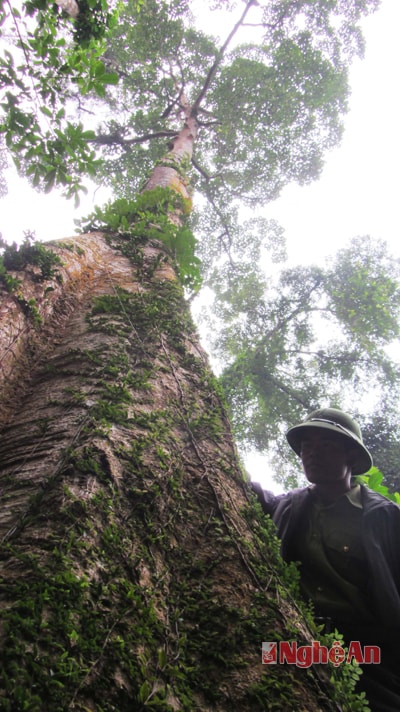 |
| An ancient tree in the middle of the Pù Hoạt forest. |
According to Director Nguyen Danh Hung, Pu Hoat possesses exceptionally rich and diverse forest resources, but its protection and management were previously primarily handled by the commune-level authorities and the Forest Ranger Station, resulting in low effectiveness. Deforestation has persisted for many years, with some very serious incidents occurring. Furthermore, rapid population growth; socio-economic projects such as hydropower projects, border ring roads, and rural roads; along with logging for housing construction under Decision 167, are directly putting heavy pressure on forest protection efforts.
Meanwhile, the Vietnamese government has committed to protecting the Southwest Nghe An Biosphere Reserve with UNESCO. Therefore, on April 2, 2013, the Provincial People's Committee decided to transform the Que Phong Protective Forest Management Board into the Pu Hoat Nature Reserve Management Board with the goal of having a state-owned forest owner with sufficient qualifications and conditions to carry out the task of conserving special-use forests. The Pu Hoat Nature Reserve Management Board was assigned nine tasks. Among them, the most important task is to protect and develop the forest to conserve and promote the special values of nature, ecosystem models, biodiversity, biological genetic resources, historical and cultural relics, and landscapes; conduct scientific research; and provide environmental services.
With its current staff of 50 people, the Pù Hoạt Nature Reserve Management Board manages a total of 90,741.10 hectares of forest and forest land, including 28,045.8 hectares of strictly protected forest; 7,677.2 hectares of forest in the ecological restoration zone; 18,748.8 hectares of buffer and protection forest areas; and 35,615 hectares of protection forest areas. Therefore, forest protection work is very demanding. According to Mr. Nguyen Duc Tinh - Head of Na Chang Station, who has 30 years of experience in forest protection, the Pù Hoạt Nature Reserve Management Board has currently established 6 forest management and protection stations.
The lives of forest protection officers have become relatively stable compared to 2012. Not only have the permanent staff received their salaries and bonuses on time, but the Management Board has also created conditions for the stations to increase production and livestock farming to improve their lives, so the morale of the officers and staff at the stations is very good, and they are wholeheartedly dedicated to their work. However, the staff is still too small. Director Nguyen Danh Hung said that, according to principle, with the forest area assigned to the Pu Hoat Nature Reserve Management Board for management and protection, approximately 100 officers and staff are needed. However, in the face of general difficulties, initial sharing is needed to complete the task.
To effectively protect the forest, the Pù Hoạt Nature Reserve Management Board established checkpoints at key forest areas and encouraged staff to carry out their duties; it also established a subordinate Forest Ranger Station with 12 staff members. Simultaneously, it sought assistance from local authorities and coordinated with border guards, the army, police, local forest rangers, and militia forces. In 2013, the Pù Hoạt Nature Reserve Management Board contracted with 1,593 households for a total of 36,994.76 hectares.
In addition, in coordination with the Forest Protection Department and the local authorities of the communes, the management board organizes propaganda and legal education, raising awareness and mobilizing people to actively participate in forest management, protection and development activities. "The task of the Pu Hoat Nature Reserve Management Board is to manage, protect, develop and promote the special values of the special-use forest; therefore, we will implement it step by step. We believe that with the guidance of the province, the assistance of relevant agencies, the local authorities, the efforts of our staff and the people's awareness of forest preservation and protection, the Pu Hoat Nature Reserve Management Board will fulfill its mission..." - Director Nguyen Danh Hung confided.
Text and photos:Nhat Lan


