
Remembering Huu Khuong
(Baonghean) - That small village gradually emerged from the mist of a chilly late afternoon at the end of the year. As the boat docked, the young students rushed out to greet us, their faces radiant with anticipation…
Huu Khuong commune in Tuong Duong district lies isolated amidst towering mountains and the azure waters of Ban Ve lake, dotted with thatched-roof houses and precarious bamboo walls. The scene is both peaceful and tranquil, yet also marked by hardship and deprivation. Of the 554 households in the commune, 520 are poor, accounting for over 90% of the total. There is no electricity, no roads, no market, and no communication signal. The Thai, Mong, and Khmu ethnic people here live primarily self-sufficiently. All connection with the bustling daily life outside depends solely on the ferry crossings on Ban Ve lake. Perhaps that is why the people of Huu Khuong eagerly anticipate and rejoice at the visits of people from the lowlands, simply to breathe new life, warmth, and joy into their lives.
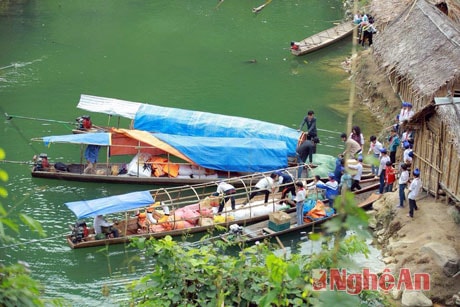 |
| Boats carrying gifts arrive at Con Phen village, Huu Khuong commune, Tuong Duong district. |
Our boat docked at Con Phen village, the center of Huu Khuong commune. The students rushed out to greet us, surrounding the members of the Nghe An Photography Club, their faces innocent and carefree in front of the camera. The warm welcome from the students and teachers made us forget all the fatigue of our long journey. This was a charitable trip, "Warmth of the Border Region," to give gifts to the students and villagers of Huu Khuong, aiming to contribute "a warmth, a heartbeat" of loving hearts as Tet (Lunar New Year) approaches.
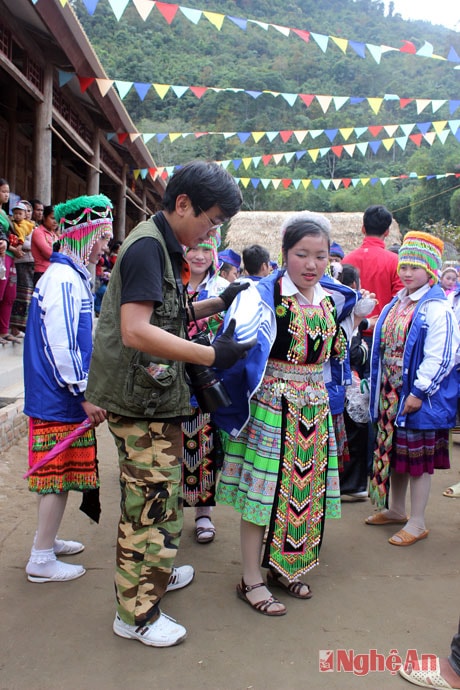 |
| New shirts for the students. |
Everyone lent a hand, helping to transport goods ashore: 300 pairs of sandals, 300 woolen hats, and 297 new warm jackets donated by model and actress Huynh Trang Nhi to the Nghe An Photography Club to give to students during the spring season. This helped keep the children warmer during the cold winter. Lo Thi Le (Grade 6A, Huu Khuong Secondary School) nervously touched the hem of her jacket, shyly asking the volunteers: “At my school, many students come from poor families, but we give gifts to those who are more disadvantaged, and we also give gifts to those who do well in school.” Seeing the children smile brightly as they received their new jackets, and sharing even tiny balloons to play with, everyone felt they had done something meaningful and received so much more in return from the children.
Because it reminds all of us of our childhood, of the wishes of Tet (Vietnamese New Year) of yesteryear, of new clothes, candy, and lots of balloons to blow… It awakens in us simple, peaceful joys that seem to have been forgotten amidst the worries, struggles, and weariness of adult life. It helps us rediscover countless unfulfilled dreams, countless memories of home, of mother, of grandmother, memories that seemed so illogical when we first set foot on this unfamiliar land. The children will grow up too; among them, who will leave, and who will stay in their small village? But surely, they have had a childhood, though poor and lacking, that was pure and genuine, and that will sustain them throughout their long journey ahead, just as it did for us…
Tet gifts delivered directly to the poorest villagers in Huu Khuong commune included rice, cooking oil, fish sauce, salt, seasoning powder, MSG, and confectionery, along with used warm clothes. These are essential daily necessities that the people of Huu Khuong need most, given their isolated living conditions on the edge of the lake… Mr. Pit Van Quyen (70 years old) from Con Phen village excitedly hugged his bag of gifts, speaking in broken Vietnamese: “This means we have food for Tet, I’m so happy, thank you all so much. My wife and I are so poor, we’re old and don’t know how to make a living, our children have all gotten married and started their own families.”
I've been to the highlands many times, each place with its own difficulties and hardships. But coming to Huu Khuong, when all communication is cut off, when no one is engrossed in their mobile phones, breaking free from the virtual world of the internet, and dedicating all my senses and soul to feeling, I realize how harsh life still is for the people in this reservoir area. There are hunched figures on the steep, precarious road, burdened with baskets of vegetables and bamboo shoots. Their feet have worn down the mountains and forests, never having seen a motorbike or bicycle. There are bareheaded, barefoot children covered in mud. Along the rugged stream bank, a mother and her children are catching fish for dinner. And in an empty stilt house, a woman cooks porridge for her child, looking up at the unfinished roof: "No one will help anymore, my husband is dead, I'm building this house all by myself, and it's only this much so far..."
They lived in such hardship, yet their lives were filled with kindness and affection. There was the young girl who, waking early in the morning, would light the fire in the kitchen and quickly send down to the older sister who had given her gifts the day before a handful of hot sticky rice wrapped in banana leaves; there was the boatman in the middle of the river who would suddenly invite strangers to visit his makeshift house on the lake, to offer them a jar of sweet rice wine.
Here, the children's laughter still rings out as they play on banana tree swings or spend afternoons sliding on the sand on the hillside without a nap. Mothers diligently weave the last of the palm leaf mats to place on the roof. The rhythmic sound of pestles pounding rice echoes in the warm afternoon sun. That's the rice the villagers cultivate. The people here still mainly live by farming on the hillsides and fishing in the Bản Vẽ lake. But they have also learned to raise pigs and chickens. They know to send their children to school when they reach school age, so they can learn to read and write, and so their lives will be brighter, more beautiful, and happier in the future.
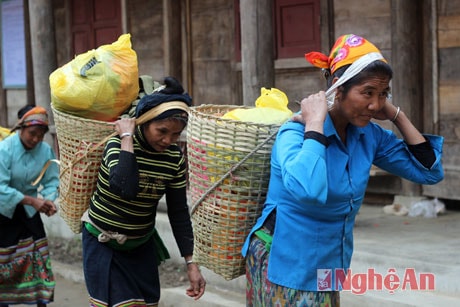 |
| The villagers carried gifts back to their village. |
While the man busied himself carrying his machete into the forest, clearing weeds and preparing the land for the new planting season, the woman stayed home brewing rice wine in earthenware jars. The rice wine was sweet and mild, yet intoxicating; the New Year celebration required wine for singing, dancing, and revelry. Her meticulous hands had finished sewing each pattern on the dress, which was then stored away in a chest, awaiting the day of the festival…
At night, when the bonfire was lit, everyone joined hands and danced the Lam Vong dance: "Come, let's be together, all you intoxicated souls...". When the wine had taken effect, their cheeks flushed, and distances disappeared, the teachers also embraced their instruments and enthusiastically played. Some were new to the school, some had been in Huu Khuong since its re-establishment, and others had been connected to the mountains and forests for nearly 20 years, carrying with them countless emotions and affections. Some were from Tuong Duong, but there were also teachers from as far away as Quynh Luu and Thanh Chuong who came here to teach... So many years have passed in the blink of an eye.
Teacher Lo Thi Phuong has been working here for four years, since the re-establishment of Huu Khuong Ethnic Boarding Junior High School. She lives in Hoa Binh town, and when she first came to work in Huu Khuong after finishing school, seeing the makeshift school and boarding facilities built of bamboo and reeds, the young teacher couldn't help but feel a pang of sadness. But she felt even more deeply for the children who lived far from the school, walking all day, far from their parents, to come here to learn. So she stayed, and couldn't bear to leave. “Now I'm used to it. The children are well-behaved and appreciate the teachers, so I feel happy. Especially since the school and boarding facilities were rebuilt, things have become much easier. Now I live here permanently, I just hope there will be electricity and better roads…”
The teachers also built houses to live in, grew vegetables, and raised chickens… A new life began on the land of Huu Khuong, filled with dedication and love for their students, those children who, one day, would take their teachers' place and travel to all corners of the world.
Mr. Lo Van Tung, Vice Chairman of the People's Committee of Huu Khuong commune, shared: "Huu Khuong commune was re-established 5 years ago, and the infrastructure is much better than before. However, there are still many difficulties and shortages, and it remains isolated from the surrounding areas. Especially the lack of electricity and convenient transportation routes. If we receive support, it will greatly benefit the lives of the people of Huu Khuong."
Coming and going, Huu Khuong is not only filled with the joy of the honest villagers, not only with the poignant farewells of those who remain, but also with the happiness of benevolent hearts, the happiness of sharing, of empathy, of giving and receiving love. It's been a long time since I've witnessed such a moving farewell at the ferry landing. Tight hugs, tears, and the boat slowly receding, the waving hands of the teachers, students, and villagers of Huu Khuong fading and disappearing behind the deep green mountains.
The boat, returning upstream, was lightly laden with goods but heavy with countless emotions. Everyone was silent, each lost in their own private thoughts, memories, and heartfelt hopes for a better life for the people of Huu Khuong: electricity, roads, markets… To remind each other, we will return to that place… with good news awaiting us.
Ho Lai


