Untapped potential?
The western region of Nghe An province comprises 11 districts and towns: Thanh Chuong, Anh Son, Con Cuong, Tuong Duong, Ky Son, Que Phong, Quy Chau, Quy Hop, Tan Ky, Nghia Dan, and Thai Hoa town, covering an area of nearly 1.4 million hectares, accounting for 84% of the province's total area. It is home to Pu Mat National Park and two national nature reserves, Pu Hoat and Pu Huong, both of which have recently been recognized by UNESCO as World Biosphere Reserves. However, investment in ecotourism development in the western region has been very modest in recent years...
As a nature reserve with diverse and abundant flora and fauna, including many endemic species listed in the Red Book of Vietnam and the world, and essentially retaining its pristine, untouched beauty, these are crucial factors for the development of ecotourism.
Specifically, these nature reserves contain many ancient forests with trees thousands of years old, including many valuable timber species such as the ancient Pơ mu and Sa mu dầu trees with diameters ranging from 3.4 to 4.7 meters, which experts consider rare in Asia. The flora comprises over 2,600 species, including 50 rare species, and over 250 valuable medicinal plants. The fauna includes 150 species of mammals, 300 species of birds, 25 species of reptiles, 82 species of fish, and 15 species of amphibians, many of which are listed in the Red Book of endangered species.
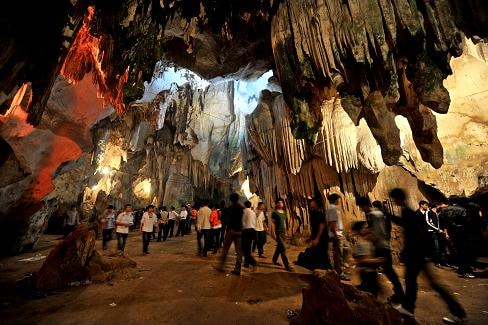 |
Hang Bua - an attractive tourist destination in Quy Chau district - Photo: SM |
The western region of Vietnam is situated on a terrain of interconnected limestone mountain ranges, with many peaks exceeding 2,700 meters, and boasts numerous attractive caves and waterfalls such as Kem Waterfall in Con Cuong, Xao Va Waterfall, Seven-Tier Waterfall in Que Phong, Bua Cave, Tham Om Cave, and Tham Chang Cave in Quy Chau...
Furthermore, the Mekong Delta is a vast region inhabited by six ethnic groups for generations, boasting numerous historical and cultural relics and unique cultural features such as the Tra Lan Citadel, the Ma Nhai stele, the Con Chua Banyan Tree in Con Cuong, the Nine-Room Temple in Que Phong, and the Lang Vac archaeological site in Thai Hoa town. It also preserves many customs, folk songs, folk dances, traditional crafts, culinary culture, costumes, and stilt house architecture, all imbued with distinctive cultural characteristics, representing significant potential for community-based and ecotourism development.
Western Nghe An province possesses immense tourism potential, both in terms of natural and socio-cultural aspects. With 37% of its population belonging to ethnic minorities (over 426,000 people), Western Nghe An can develop community-based tourism combined with ecotourism, similar to the mountainous regions of Northwest Vietnam. Furthermore, the region boasts numerous caves, waterfalls, and hot springs, allowing for the development of unique tourism products such as health tourism, sports tourism, adventure tourism, and scientific research tourism.
In recent years, tourism development in the western part of our province has made initial progress, such as the formation of two important tourism centers: the Pu Mat National Park Tourism Center and the Quy Chau - Que Phong Cultural and Ecological Tourism Center along two routes (National Highway 7 and Highway 48). This has initially attracted investment and facilitated the development of tourism in the western region in line with established directions. Many tours visiting Pu Mat National Park, Xao Va Waterfall, Khe Kem Waterfall, etc., have been organized to serve tourists, especially with the number of visitors to Pu Mat National Park increasing year after year (including many foreign tourists). Tourism infrastructure, especially transportation to tourist destinations, has received more investment.
Notable examples include: upgrading the road connecting National Highway 7 to Pu Mat National Park, the road to Khe Kem Waterfall in Con Cuong; the road from National Highway 48 to Hang Bua and Tham Om Cave; and roads connecting border districts... In addition, more attention has been paid to training tourism personnel in the Western region, and awareness of tourism development has also been raised.
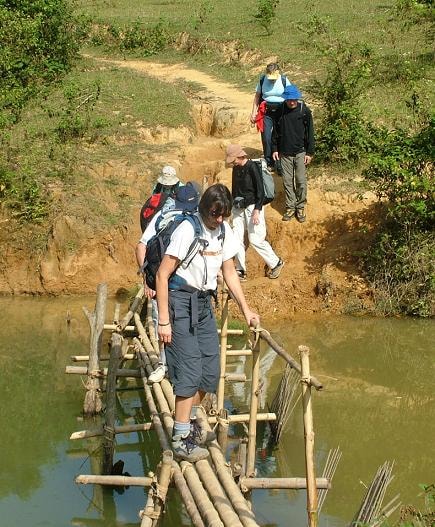 |
Foreign tourists visiting Pu Mat (Con Cuong) - Photo: HN |
Firstly, the publicity, promotion, and marketing efforts have not met the requirements; the tourism potential of the Mekong Delta has not been widely and regularly promoted to tourists and the domestic and international tourism markets.
Secondly, environmental protection and biodiversity conservation have not received adequate attention, resulting in many negative impacts on the ecosystem, especially in areas near populated communities. The hunting of rare wild animals remains prevalent without effective preventative measures. The number of tourists visiting the Mekong Delta annually is still modest compared to its potential, leading to slow tourism growth and failing to create a significant shift in the region's economic structure.
Thirdly, tourism infrastructure and services (transportation, accommodation, entertainment, healthcare, communication, electricity and water, etc.) are still very inadequate. To date, the entire region only has 41 accommodation establishments with 468 rooms, capable of serving 180,000 tourists per year, mainly guesthouses owned by government agencies, most of which do not meet the standards for receiving tourists; only the guesthouse of Pu Mat National Park and a few hotels in Thai Hoa town meet the minimum standards for receiving international guests. Fourthly, research and surveys aimed at identifying unique tourism products in the Mekong Delta have not been organized or invested in; therefore, there is insufficient documentation to support promotional activities for tourists.
On the other hand, the lack of unified regulations between the management units of Pu Mat National Park and the two nature reserves of Pu Hoat and Pu Huong also creates many difficulties in transporting tourists to the area.
Developing tourism in Western Nghe An is one of the important tasks in implementing the socio-economic development plan for Western Nghe An, which was approved by the Prime Minister in 2005. On August 8, 2007, the People's Committee of Nghe An province issued Decision No. 94/2007/QD-UBND approving the tourism development plan for Western Nghe An until 2010.
According to the approved plan, by 2010, the planning of tourist areas and sites in the region will be basically completed; focusing mainly on Pu Mat National Park, Pu Hoat, Pu Huong, and Quy Chau - Que Phong nature reserves. At the same time, the planning of tourist sites that have emerged during the region's development, such as the Ban Ve hydroelectric lake, Khe Bo, Ban Mong, and Hua Na, will also be completed, linked to ecotourism in the region.
Focus on investing in tourism infrastructure and services, creating unique tourism products. Specifically, in Pu Mat National Park, focus on ecotourism products, exploiting the Lai Ferry - Khe Khang route and the route to Kem Waterfall, the core area of the National Park, via river and road. Invest in opening new routes to Tung Huong village and to the Pu Xiem Liep ancient forest, and traditional handicraft villages specializing in brocade weaving...
Mr. Cao Dang Vinh, Director of the Department of Culture, Sports and Tourism, said: To develop tourism in the Mekong Delta sustainably and in an environmentally friendly manner, the province will focus on investing in projects such as regulating the flow of the Giang River from Pha Lai Dam to Co Phat village, a distance of 8 km with 52 waterfalls and rapids, ensuring safe year-round access for tourist boats; building service points at Pha Lai Dam, Co Phat village, and Kem Waterfall; investing in opening a road from Highway 7 to Tung Huong village and a hiking trail to the ancient forest of Pu Xiem Liep; investing in the restoration of Tra Lan Citadel and upgrading the road to Ma Nhai stele. The Quy Chau - Que Phong tourist route will focus on the project to build the Sao Va Waterfall ecological tourist area, and opening more tours to the Hang Bua festival and the Chin Gian Temple festival...
Each tourism center needs to urgently focus investment on 1-2 community-based tourism destinations, considering them as highlights and unique tourism products of the region. Along with focusing investment and opening new tourism routes, it is necessary to strengthen the promotion and marketing of tourism in the Mekong Delta in many aspects, such as educating the community about nature conservation and preserving ethnic cultural identity to prevent its erosion; promoting and enhancing the image of Mekong Delta tourism, especially introducing unique tourism products of the Mekong Delta through various forms such as brochures, CDs, VCDs, tourism films, and launching a website for Mekong Delta tourism in Nghe An.
All sectors and levels need closer, more urgent, and more synchronized coordination in promoting tourism development. Localities with tourism potential need to coordinate with relevant sectors and tourism businesses in surveying, researching, and developing tourism products, and intensifying the promotion and advertising of tourism in the western region of Nghe An province.
Thanh Thuy