
Livestock vaccination: Low achievement rate, why?
(Baonghean)Although the planned end date for autumn livestock and poultry vaccination has passed, the results achieved are very low. This has been the reality in our province for many years, despite the continuous outbreaks of disease.
The latest figures from the Provincial Veterinary Department show that as of October 14, 2011, one and a half months after the end of the autumn vaccination campaign, only 261,875 doses of hemorrhagic septicemia (HS) vaccine had been administered to cattle and buffaloes out of 546,733 animals requiring vaccination. Similarly, for swine HS, 138,440 doses had been administered to 708,967 animals (19.5%), and for swine cholera, 145,390 doses to 708,967 animals (20.5% of the plan). Many localities achieved extremely low vaccination rates, such as Vinh City (28.7%) for cattle and buffalo HS and Tan Ky (20.2%). For swine HS, Vinh City achieved 14%, Quy Hop 11.3%, Que Phong 12.3%, and Thai Hoa Town 2.9%...
Those figures reflect a worrying reality that has persisted for many years in our province. According to Mr. Dang Van Minh, Deputy Head of the Epidemiology Department of the Provincial Veterinary Sub-Department: This year, in addition to the reasons mentioned in previous years, there are also objective, unavoidable factors. Since the beginning of the vaccination campaign, several prolonged periods of rain and flooding have disrupted the vaccination process. Most importantly, however, to date, the demand for both primary vaccines – foot-and-mouth disease (FMD) and avian influenza – has not been met. Since the FMD outbreak in Tan Ky, our province has only received 100,000 doses of the FMD multi-type vaccine. Therefore, besides the livestock in Nghia Dan, Thai Hoa, and Cua Lo districts that have already been vaccinated against Foot-and-Mouth Disease (FMD) from the dairy belt program, 100,000 doses of vaccine are only enough for our province to vaccinate the affected and threatened areas of Tan Ky district and some high-risk areas with previous outbreaks such as Nam Dan, Hung Nguyen, and Nghi Loc. Equally concerning, we have not yet received a single dose of avian influenza vaccine. Explaining this issue, the Central Veterinary Department stated that after finalizing the technical aspects, they are currently bidding for FMD vaccines but have not yet agreed on a price with foreign partners. Therefore, it will take some time before FMD vaccines are available for livestock vaccination. Regarding avian influenza vaccines, the avian influenza virus in Vietnam has mutated into a different form, and a compatible vaccine source has yet to be found. Therefore, it is very worrying that the poultry in our province have not yet been vaccinated during this period.
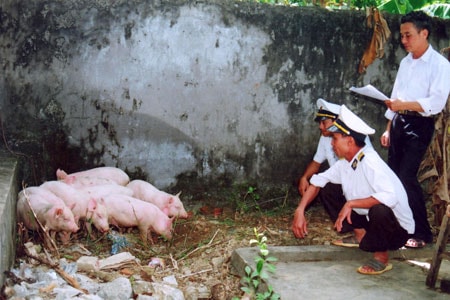
Veterinary officers from Anh Son district station inspect and vaccinate livestock.
Photo: Sy Thuan
However, despite the aforementioned objective reasons, even with sufficient vaccines for diseases like hemorrhagic septicemia and swine cholera, the vaccination rate for livestock in our province remains very low. The reasons are still the same old ones: the lack of awareness among livestock farmers and the negligence of some local authorities. Mr. Tran Minh Hanh, Deputy Head of the Provincial Veterinary Department, stated: Although propaganda efforts have been intensified down to every hamlet and family, many livestock farmers still do not fully understand the role of vaccination in protecting their assets, and do not voluntarily report cases, leading to inaccurate livestock statistics and the omission of livestock and poultry that should be vaccinated. This is very dangerous, especially given that our total livestock population is very large but mainly consists of small-scale, fragmented farming. Authorities cannot control this effectively without the active cooperation of the households themselves.
Currently, the high price of vaccines against African Swine Fever (ASF) and Foot-and-Mouth Disease (FMD), at over 17,000 VND per dose, is a significant reason why many small-scale farmers are reluctant to spend money and only vaccinate their poultry in a haphazard manner. In reality, only large-scale farms and family farms provide complete vaccinations. In recent years, with close guidance from the province, local authorities have shown significant improvement in directing and coordinating with veterinary forces in vaccination efforts. However, some professional staff and local authorities remain negligent and lack genuine commitment. The management of local veterinary staff is inconsistent, leading to a lack of responsibility among those involved. In remote and disadvantaged areas, where living conditions are difficult, vaccinating poultry has not yet become a habit in the minds and actions of the people.
Since the beginning of the year, outbreaks of disease have continued to occur in our province, despite well-planned control and containment measures. This alarming situation is partly due to weak vaccination efforts. According to Mr. Dang Van Minh, Deputy Head of the Quarantine Department of the Veterinary Sub-Department, before organizing vaccination campaigns, it is necessary to seriously implement biosafety measures such as using lime powder and chemicals to disinfect and sterilize high-risk areas. In addition, training veterinary staff at the grassroots level on vaccination techniques and ensuring quality control of common vaccines in the area are also crucial. In particular, the process must be carried out rigorously, ensuring accuracy from the initial stages of livestock and poultry surveys and statistics, guaranteeing that no animals requiring vaccination are missed. Furthermore, it is necessary to continue strengthening public awareness campaigns about the benefits of vaccination and the harmful effects of unvaccinated livestock. Actively encourage livestock farmers to voluntarily vaccinate their animals, helping them understand that vaccination is a way to protect their own assets. Therefore, it is crucial to proactively vaccinate livestock, avoiding a mentality of dependence and reliance on government support, even when offered free vaccinations.
Phu Huong


