
Dr. Pham Huy - A son of Co Bai village
In the work "Customs of Worshiping Gods and Legends of Nghe An," published by the Nghe An Department of Culture and Information, 2000 (pp. 370-373), Associate Professor Ninh Viet Giao affirms that Co Bai Temple in Dong Hai commune (now Phuc Tho commune, Nghi Loc district) is a place of worship for General-Doctor Pham Huy (1470-?), who passed the Third Class Doctoral examination in Quy Suu year, the 24th year of Hong Duc (1493) during the reign of King Le Thanh Tong, held the position of Minister of Public Works and once went on an embassy to China. During his lifetime, the General loved and cared for the villagers, so the people here respectfully erected a temple to worship him.
In the work "Customs of Worshiping Gods and Legends of Nghe An," published by the Nghe An Department of Culture and Information, 2000 (pp. 370-373), Associate Professor Ninh Viet Giao affirms that Co Bai Temple in Dong Hai commune (now Phuc Tho commune, Nghi Loc district) is a place of worship for General-Doctor Pham Huy (1470-?), who passed the Third Class Doctoral examination in Quy Suu year, the 24th year of Hong Duc (1493) during the reign of King Le Thanh Tong, held the position of Minister of Public Works and once went on an embassy to China. During his lifetime, the General loved and cared for the villagers, so the people here respectfully erected a temple to worship him.
The Phạm family genealogy in Cổ Bái village records a story from long ago about a mother and son from Hưng Yên who were begging in the village. Seeing a well-off house in the village, the two entered to ask for alms. The homeowner, seeing a handsome boy of about 10 years old named Phạm Lồng, expressed his desire to adopt him and provide for his education, while his mother continued her begging. Phạm Lồng, expressing his gratitude, said he couldn't bear to leave his mother alone and asked if she could stay and help with household chores. Touched by Phạm Lồng's filial piety, the homeowner agreed to let the two stay and changed his name to Phạm Huy, hoping for a glorious future for him.
Pham Huy increasingly demonstrated exceptional intelligence, and before long his academic abilities surpassed those of his peers. His foster father had to send him to a village teacher in the neighboring village (now Nghi Xuan commune, Nghi Loc district) to continue his studies. In the Quy Suu examination of the 24th year of the Hong Duc reign (1493), Pham Huy was listed on the golden list with the title of Doctor of Philosophy. The court ordered the local authorities to organize a ceremony to pay respects to his ancestors.
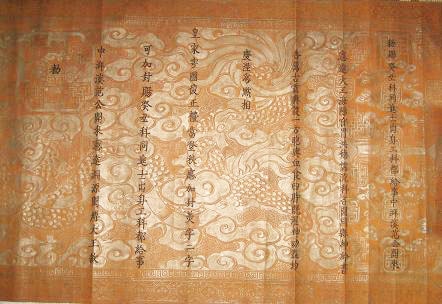 |
Royal decree of King Canh Hung (Le Dynasty) in recognition of the merits of Doctor Pham Huy. |
Journalist Giao Huong (from Lao Dong Newspaper, based in Nghe An - Ha Tinh), who was born and raised in this region, recounted that when he was a child, he heard villagers in Co Bai village recount a dispute between two villages over the right to preside over the ceremony of honoring Doctor Pham Huy's return home. The neighboring village argued that without the village's learned teachers, there would be no Doctor Pham Huy today. Co Bai village, however, reasoned that without the care and support of his adoptive parents, how could Pham Huy have achieved such success and inscribed his name on the golden榜 (list of successful candidates)? Furthermore, since Pham Huy and his mother had stayed in Co Bai village, they were already part of the village, therefore the right to perform the ceremony belonged to Co Bai village. Neither village would yield, and eventually the imperial court intervened to settle the dispute, with Co Bai village winning.
After entering the civil service and rising to the position of Minister of Public Works, Pham Huy retired and brought his family back to live in Co Bai village. Both during his time as an official and after his retirement, Pham Huy always loved, protected, and helped the villagers. Therefore, the people of Co Bai village revered him as their tutelary deity and erected a temple in his honor. According to the elders, the Co Bai village temple existed until the 1950s, but later, due to war and unrest, it was not renovated and eventually collapsed. In 2001, Phuc Tho commune inaugurated the Dong Hai Temple (also a leading historical site of the former Dong Hai commune, where the national hero Yet Kieu and the sea-dwelling Great King Hoang Ta Thon, the two founders of the riverine profession, were worshipped) right on the grounds of the old Co Bai village temple.
The memorial tablet of Dr. Pham Huy is given a place of honor in the Dong Hai Temple by the people of Co Bai. It should be added that the Dong Hai Temple was rebuilt thanks to the generosity of physician Pham Thien Long (1922-2006), a successful son of Co Bai village in Saigon, and a descendant of Dr. Pham Huy.
Returning to the ancient village of Co Bai, following Mr. Tran Van Nam (a retired lecturer from Vinh University) to Dong Hai Temple, we respectfully lit an incense stick before the memorial tablet of Doctor Pham Huy. The caretaker of Dong Hai Temple opened a box for us to admire seven royal decrees from the Le and Nguyen dynasties related to the life, career, and merits of the Doctor from Co Bai village. The content of the decrees affirms the merits of protecting the nation, helping the people, and safeguarding the crops of the revered figure worshipped at Co Bai Temple, and orders the villagers to offer incense, worship, and hold annual ceremonies throughout the year.
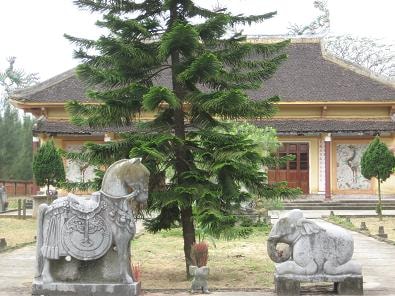 |
The Dong Hai Palace was rebuilt on the site of the ancient Co Bai Temple. |
In particular, the royal decree of the 14th year of the Canh Hung era (Le Dynasty) affirmed that the ancestors bestowed upon Pham Huy the title of Tu Vuong ("God governing and enjoying long-lasting blessings in a region") and now continued to "bestow upon Do Cap Su Trung Bai Khe Pham Cong Khai, a scholar of the Quy Suu year, the title of Hien Dat Dai Vuong". Later, King Le Chieu Thong further bestowed the title "Hien Dat Uyen Nguyen Hung Bai Dai Vuong". During the Nguyen Dynasty, in the 11th year of the Tu Duc era, Pham Huy was "granted the additional title of Tan Luong Than". In the 33rd year, he was again "granted the Bao Chieu Dam Am, and allowed to perform rituals on National Day". In the 2nd year of the Dong Khanh era, Pham Huy's merits were "remembered in the divine genealogy and granted the additional title of Duc Bao Trung Hung Chi Than". In the 3rd year of the Duy Tan era, a royal decree was issued allowing the villagers to perform rituals on National Day. In the 9th year of the Khai Dinh era, he was further "granted the additional title of Quang Y Trung Dang Than, and specially authorized to perform rituals on National Day".
The career and contributions of General-Doctor Pham Huy are a source of pride for generations of people in Phuc Tho commune, Nghi Loc district in particular, and the entire Nghe An province in general. Therefore, today's generation needs to take practical actions to remember and honor this exemplary son of the homeland.
Bui Cong Kien


