
The sound of the mandolin celebrating Independence Day in prison.
(Baonghean) - At 86 years old, with 67 years of Party membership, and having endured imprisonment in colonial-imperial prisons, Mr. Nguyen Duy Nhon will never forget the time he celebrated Independence Day in Cam Ranh prison.
In Kim Hoa hamlet, Vo Liet commune (Thanh Chuong district), following directions, we walked across fields beginning to ripen, along winding roads, and heard the sound of a mandolin echoing from the house of Mr. Nguyen Duy Nhon (born in 1931). On the porch, Mr. Nhon was engrossed in his instrument, his aged fingers still displaying skillful and masterful technique.
As the guest approached, his fingers finally left the guitar, and he gave a friendly look: "These days, I feel like I'm living in nostalgia for the years gone by, my youth, then joining the army, being captured by the enemy, and celebrating National Day right in prison..."
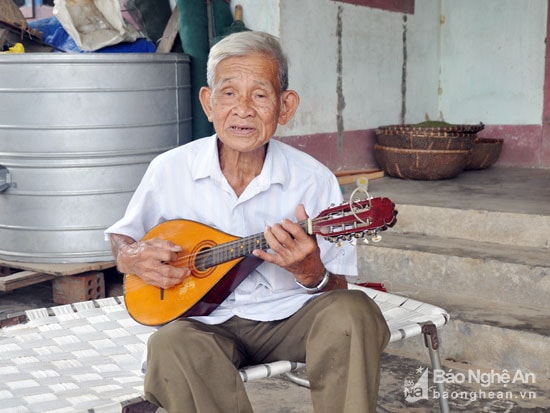 |
| Mr. Nguyen Duy Nhon finds joy in playing the mandolin. Photo: Cong Kien |
Mr. Nhon's father was from Dong Van commune (Thanh Chuong district), his mother was from Quang Tri province, and he was born in Quy Nhon, named after the region. During the general uprising, the young boy, still attending elementary school, paid close attention to the events unfolding in Quy Nhon.
The two older brothers soon joined the revolutionary ranks, following the mass struggle movement. Although he didn't fully understand what revolution was, the young student Nguyen Duy Nhon still blended into the crowd participating in the struggle. Listening to speeches, he grasped a little that from now on they would shed their enslaved lives, the country would be free, and there would be no more oppression and exploitation.
At the age of 19, Nguyen Duy Nhon enlisted in the army and fought alongside his unit in the mountainous region of western Quang Tri. That same year, he was honored to be admitted into the Party. In early 1952, during a counter-insurgency operation in Phong Dien district, due to overwhelming force disparities, his unit suffered heavy losses, and he fell into enemy hands.
 |
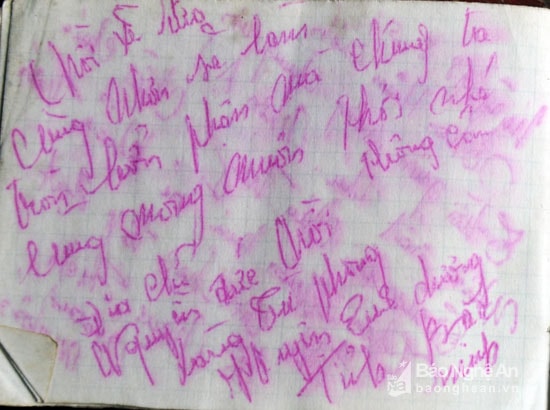 |
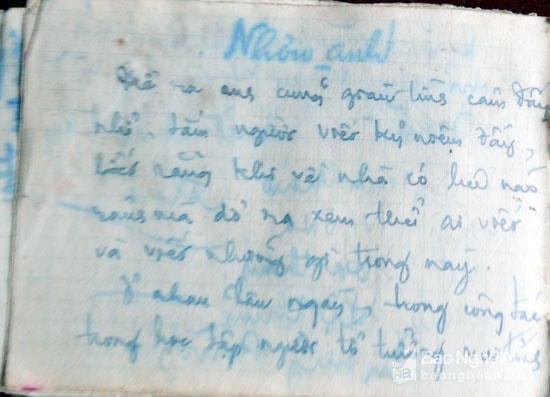
| 2. The notebook – a memento from the time of Mr. Nguyen Duy Nhon's imprisonment in an imperial prison. Photo: Cong Kien |
The enemy used torture to extract information, but he refused to reveal anything. They then transferred him to prisons in Hue, Da Nang, and finally Cam Ranh (Khanh Hoa). In prison, the communist soldiers continued their struggle for improved meals, access to medicine, education, and cultural and artistic activities during traditional holidays.
“Throughout my life, I will never forget celebrating the 8th Independence Day right in Cam Ranh prison. There were no lavish feasts, no slogans, no loudspeakers, but the prisoners had a truly joyful day. The French had to admire the patriotism of the Vietnamese people,” Mr. Nhon confided.
It was 1953, early autumn, and the brothers were planning to celebrate Independence Day. To deceive the prison guards, they all agreed to hold the celebration under the guise of the Mid-Autumn Festival and the Vu Lan Festival. Each person prepared a task: some crafted musical instruments, others set up backdrops, cut letters, made decorative patterns, and practiced performing arts. Mr. Nhon, in particular, focused on crafting a mandolin.
On the appointed day, the brothers sent someone to invite a representative from the prison to attend the ceremony. The French officer came down and was surprised to see the magnificent backdrop, the colorful lettering and patterns attached to it and decorating the entrance, and the homemade musical instruments playing heartfelt and majestic melodies.
The brothers explained that the backdrop was sewn from scraps of discarded canvas; the letters and patterns were made from cardboard; the colors were mixed from crushed medicinal pills mixed with water. And the mandolin was made from pieces of wood discarded in the backyard and steel wires left by the fence; the flute was made from rolled-up pieces of tinplate with holes drilled for air.
Upon hearing this, the French officer gaped in astonishment, then went back to his room to get his camera and photographed the "artworks" created by the communist prisoners.
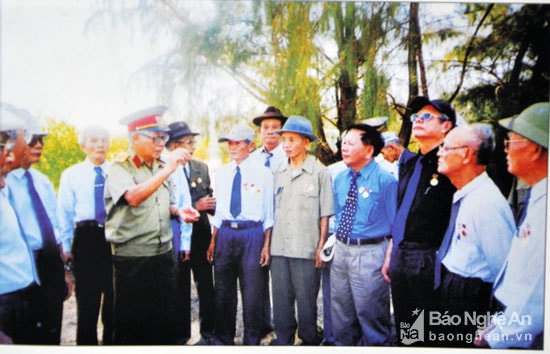 |
| Delegations from the provinces and cities of Hanoi, Nghe An, Ha Tinh, Quang Binh, Thua Thien - Hue, Da Nang, and Ho Chi Minh City visited the former prison camp in Cam Ranh. (Archival photo) |
The men lined up, facing north, their mouths seemingly praying but in reality humming the national anthem, sharing the same thoughts of the national flag and the determination to fight to protect their homeland. The French also guessed the main purpose of the ceremony but could only shake their heads. The sounds of stringed instruments, flutes, and singing filled the air, everyone joined in, and the French officer went around shaking hands with each person.
Nearly a year later, on August 25, 1954, in accordance with the Geneva Accords, Mr. Nguyen Duy Nhon was released by the French in Quy Nhon, his birthplace. Afterward, he joined his unit in the North, transferred to a different profession, and returned to his hometown of Thanh Chuong to work in production and participate in social work at the commune level.
The only memento Mr. Nhon still keeps from his years in prison is a small notebook with nearly 100 pages, in which his fellow prisoners recorded their feelings. The notebook has faded, and most of the pages are blurred, but the affection the former prisoners had for each other remains intact.
Mr. Nhon shared: “I have returned to Cam Ranh several times to visit the old prison camp, and each time I feel nostalgic and emotional remembering my comrades from those years. And I remember most vividly the time we celebrated Independence Day, commemorating the 8th anniversary of the country's National Day. It feels like just yesterday, but 64 years have passed...”
Cong Kien


