
Mouth harp
(Baonghean) - It's rare to find a musical instrument as unique as the mouth harp. Small, no bigger than a bamboo leaf, the mouth harp is no less sophisticated than modern instruments. However, nowadays, this instrument is little known to young people. In western Nghe An province, mouth harps can only be found in a few Mong communities in the border district of Ky Son...
Some news reports indicate that in England, France, and some European countries, mouth harps and similar instruments are used. In some Southeast Asian countries, healers use the mystical sound of the mouth harp to treat illnesses. Many ethnic minority communities in Vietnam, such as the Hmong, Gia Rai, and Thai, have about 10 different types of mouth harps made from bamboo and metal, with copper being the most common. Copper mouth harps are more durable and have a higher vibration than those made from bamboo. In the Thai epic poem "Xong Chu Xon Xao" (Farewell to the Beloved), a poor young man, before deciding to go trading to earn money to marry his beloved, gave her a mouth harp so they could recognize each other later: "We love each other, I send you this copper mouth harp / We still love each other, the copper mouth harp will wait forever / When fate brings us together, let's bring it out to recognize each other..." (translation). Later, the young man accidentally found his lover being sold in the market. He bought her for just three bundles of banana leaves to take home as a servant. One sad night, missing her former lover, the girl took out her mouth harp and played it. It was then that they recognized each other and rekindled their love after many hardships. This story demonstrates that the mouth harp was once very popular among Thai communities.
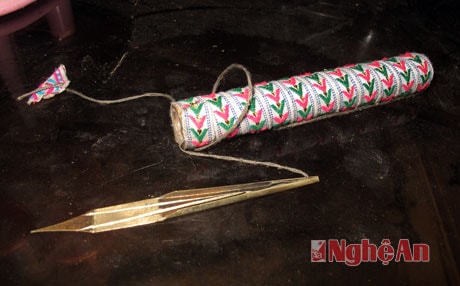 |
| The mouth harp. Photo: Lang Luong |
While searching for traditional musical instruments of ethnic minorities in the highlands, we heard from elderly people and Thai cultural researchers in Quy Hop that the local Thai people call the mouth harp "m'tan" and play it "toi tan." However, in many Thai villages throughout the western districts of Nghe An province, we could no longer find any mouth harps. Mr. La Van Ba, residing in Son Ha village (Ta Ca - Ky Son district), a passionate collector of ethnic minority musical instruments, said: Occasionally, when he returns to his ancestral home in Son La province, he only sees middle-aged and elderly people who still know how to play the mouth harp. In Ky Son, only the Mong community in Hoa Son village, near Mr. Ba's village, still preserves the mouth harp.
We visited Hoa Son village (Ta Ca - Ky Son). The villagers boasted that this was the first cultural village in the entire district. When asked about the mouth harp, the locals said that only a few families still had people who knew how to play it. Among them was Ms. Ha Y Nenh, one of the best in the village. Ms. Y Nenh married early, still quite young, and already has daughters-in-law, sons-in-law, and a large number of grandchildren. She has been playing the mouth harp since she was a young girl. However, she still keeps her mouth harp at home as a memento. Ms. Y Nenh showed us the mouth harp she has kept for decades. The instrument consists of a brass plate with a reed. The Hmong people call the mouth harp "tran gia". When playing, the left hand holds the harp close to the middle of the lips near the teeth, while the right hand plucks one end of the harp. The music is created by the combination of the oscillating frequency of the harp and the breath from the player's mouth. Some players even create sounds from the roof of their mouth to make the music more interesting.
Y Nenh's husband, Mr. Mua Ba Hua, recounted his youth: "In the past, Hmong boys and girls didn't know how to write love letters, nor did they have mobile phones. When a Hmong boy fell in love with a girl, he would bring his mouth harp to the wall outside her bedroom at night. He would play the most beautiful love songs until the girl opened the door to share her feelings. If the girl also knew how to play the mouth harp, she would respond with her own music. The girl's melodies carried various meanings that only the Hmong community understood. Through these melodies, they would understand each other's feelings. In the past, Hmong boys of courtship weren't allowed into a girl's house at night. Using a bamboo flute would disturb her sleep. Therefore, Hmong boys chose the mouth harp to express their feelings. The sound of the mouth harp at night was the 'whispering' between Hmong boys and girls once they had become close." Hearing familiar melodies, the girl would approach the partition wall to converse with her lover. At first, they would only speak to each other through the gaps in the wall. Until one day, feeling she could trust him, the girl would dare to push the door open and go outside to sit and be intimate...
During the spring festival, young men and women in the Hmong villages don't have to go to the fields to work. They spend their holiday attending the pao throwing festival. Hmong boys bring not only the khene (a type of bamboo flute) but also the mouth harp. Usually, only the boys know how to play the khene. With the mouth harp, courtship becomes more lively as the girls also play the harp in response to the boys' love songs. Therefore, the festivities seem to last forever throughout the spring days.
According to Mr. Mua Ba Hua, skilled mouth harp players are admired by the community. If they are Hmong, they know how to listen to each melody of the instrument and recognize truly talented people. The mouth harp is not an easy instrument to play; only those who have truly practiced diligently can play it well, like Ms. Y Nenh. As a community that values genuine talent, the Hmong will not easily praise someone for playing the instrument well. Only truly excellent playing is recognized by the community.
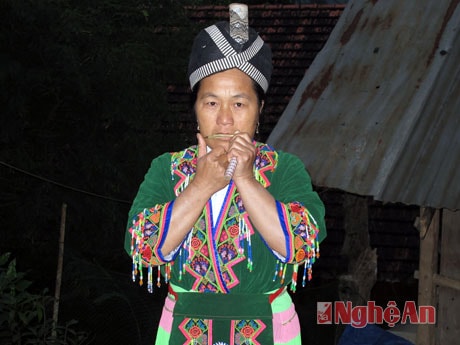 |
| Ms. Ha Y Nenh plays the mouth harp. Photo: Lang Luong |
In Hoa Son village now, not many people can play the mouth harp anymore. The young people in the village still listen to Hmong music, and the boys still learn to play the khene (a type of bamboo flute) when they grow up. However, few people still like the mouth harp. People like Ms. Y Nenh only keep their mouth harps as mementos. Mr. Mua Ba Hua explains that the reason why young people today no longer like the mouth harp is partly due to the influence of modern lifestyles on their way of life. The mouth harp, once a musical instrument used by young men and women to express their feelings, now has many other ways for young people to connect with each other. They are more free to get to know each other. Messages can be easily sent with just a text message.
The demand for mouth harps in the community, including among the Hmong people, is gradually decreasing. The highland markets in Nam Can and Huoi Tu are becoming increasingly deserted. Mr. Ba Hua said: "A few years ago, you could still see Laotians selling them at the border market. But now, even if you go to the market often, it's hard to find someone selling mouth harps!"
Crafting this instrument is also a difficult task. Looking at its appearance, some might assume the mouth harp is mass-produced by industrial machinery. In reality, the instrument is made entirely by hand by skilled craftsmen. Only skilled hand-wound artisans can forge a mouth harp, even though it is tiny.
According to Mr. Bá Hùa, for many years now, no one in the Hmong villages has been making mouth harps. Those who play them usually buy them from local markets or from Lao traders. Occasionally, they still visit the villages to sell Hmong flutes and brocade fabrics...
Huu Vi


