
The sound of the sea trumpet
(Baonghean) - The Ocean Hotel is quiet this season, with few people around. The weather has turned cool and autumnal. My room is near the room of the artist and his son. Many times, I've seen the little boy model for his father's paintings. Whenever we meet in the dining room, the boy just smiles at me. The two of them sit at a table inside, silently like two shadows. After eating, they hold hands and stroll along the beach. I later learned that the boy was born mute. The artist said that his birth was a difficult one.
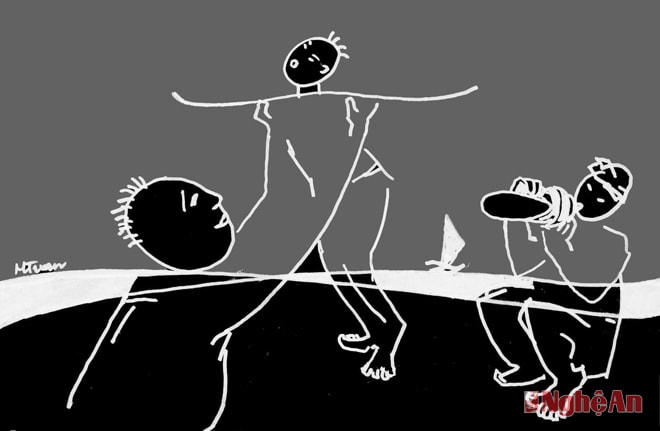 |
| Illustration: Huu Tuan |
The mother had been struggling from afternoon until midnight, her water breaking, but the baby still wouldn't come out. Mrs. Hieu, the village midwife, had tried many traditional folk remedies, but the baby stubbornly remained in the middle of the room, refusing to turn its head. The artist looked up and saw a buffalo horn trumpet hanging on the wall, a gift from an elder during a painting trip to the Central Highlands. The elder had said that whenever the artist felt distressed, he should blow the trumpet, and the spirits and forest gods would help. The elder hadn't used the buffalo horn for a long time; its dark, shiny surface was simply hung as a decoration in his house. The artist stepped out into the yard and blew the trumpet.
The trumpet's sound, initially a muffled, whistling blast, then burst forth like a door being thrown open: "Oa…" The mother, struggling, also cried out: "Oa…" as if yearning for the baby's cry. After that desperate cry, the tiny fetus was pushed out as if by a strong contraction from within. Mrs. Hieu lifted the baby in her arms and patted his bottom a few times, coaxing him, "Cry, little one, cry!" But the baby's eyes remained tightly closed, his face pale, not a single cry escaping like other normal babies. His mother, exhausted and weak, could only manage to turn over, reaching out with both hands as if wanting to embrace him, before she breathed her last. The baby remained silent from that moment on.
The artist's paintings, though set at sea, are mostly still lifes—vases, bunches of fruit, chairs—that seem to lack solitude, distorting the entire scene. And there are many images of buffalo horn trumpets, like a haunting presence. It seems that the quiet serenity of the room, combined with the wild ferocity of the sea, holds a deep unease within him. One morning, the artist came to my room and asked me to find him a model of a fisherman blowing a trumpet. I knew many men from this coastal region. They had rugged physiques, bulging biceps and chests, but somewhat thin calves. Among the regulars who came to drink here, I noticed old Hoa. I heard he lived alone and was very skilled with his hands. Besides his days at sea, during the rainy season and storms, his small room became a handicraft workshop.
Curtains made from small seashells hung up, creating a captivating sight, almost as if you could hear the gentle murmur of the waves. Then there were sailboats made from seashells. Coral reefs were woven together to form vibrant rock gardens. The artist and his son felt as if they had entered another world. Old Man Hoa breathed new life into the dead seashells, clams, and mussels. Time polished them, leaving behind his fingerprints. The boy, curious and delighted, held up various types of conch shells. He blew into them, but no sound came out. Was there some mysterious technique involved, or was his breath too weak? Several times I caught the boy and Old Man Hoa whispering to each other. It turned out that Old Man Hoa was telling the boy the secrets of the sea, secrets that only the boy could understand through his murmuring, like the murmuring waves outside…
Old Man Hoa had a special talent for hearing the sounds of fish. Many boats invited him along to "listen for fish," and once they reached the fishing grounds, he would be tipsy and fall into a deep sleep, snoring so loudly that the boat's deck shook, oblivious to anyone else's movements. He would lie on his side, one ear pressed against the side of the boat. Amidst the crisp sound of the engine, the boat cutting through the waves, creating a white spray, he would suddenly spring up like a coiled spring and sit motionless. His crewmates would fall silent and watch him intently. It seemed as if his muscles and tendons tensed and coiled like tightly bound anchor threads. He would let out a loud "kha" and calmly say, "There are fish in this Rạo area." I once heard the fishermen say that on fine, calm days, he could climb the mast and, based on the changing colors of the water below, guess what kind of fish were in the area. He said: "Sometimes, to be absolutely certain, you have to jump into the water about half a meter from the side of the boat. Underwater, his sensitive ears can hear sounds that travel several kilometers." The water flows strongly in the direction where the fish are. The pufferfish makes a "clunk...clunk" sound. The white pufferfish makes a "plop...plop" sound. The yellow-tailed clam makes a "rattling...rattling" sound. And to identify coral reefs where fish are hidden underwater, the old man only listens to the rustling sound to know it's a low reef, while high reefs emit a continuous crackling sound, like when you're popping corn.
As the day of departure approached, the artist asked me to invite old man Hoa to be his model. The painting depicted an old fisherman blowing a horn to signal his fishing boat to seek shelter from a storm. Old man Hoa wore a pair of brown sailcloth shorts. Strangely, he only liked to wear this rough, brown-dyed fabric; it was durable and seemed to rustle in the wind, bearing the salty creases of the seawater. Old man Hoa chose the horn he had carefully kept in a sturdy, square wooden chest covered with red cloth. He used to store his fishing gear in this chest, which had many compartments for different types of fishing lines, hooks, and lead weights. Surprisingly, the chest was made of some kind of wood that never got infested with termites. On the boat, it could be used as a seat to sit and fish for hours without getting tired. When dropped into the water, the wood would naturally expand, sealing the joints tightly as if glued together, creating a floating lifebuoy that no wave could dislodge.
In that place, just a bottle of mineral water and a few packets of dried rations were enough to survive for a few days at sea if the boat capsized. The old man's horn was made from the shell of a rather large snail, but he left its rough, gnarled appearance intact. When the little boy saw the conch shell horn, his small body trembled. It seemed as if some kind of attraction was transmitted from the shell to him. The shimmering silver light of the setting sun, combined with the mother-of-pearl color of the shell, created a rare, radiant, reflective hue, as the artist said. Old Man Hoa's strong hands, accustomed to pulling anchors and nets amidst the waves, raised the horn horn to the level of his flushed face, stained with wine, sun, and sea, so the artist could begin to apply his brushstrokes. The old man's entire body leaned out into the sea, standing motionless like a molded statue. The little boy's eyes, usually so quiet and sad, now shone brightly, and his hands also rose in the same posture as Old Man Hoa.
Two figures, one old, one young, of similar build, fell onto the soft, warm sand, still damp with the scent of people and the sea. The boy's eyes gazed at Old Hoa without blinking, as if pleading for something. The artist was engrossed in his painting, while I watched the boy's unusual movements intently. Old Hoa turned to the boy and smiled. This was the first time I'd seen him smile; it made his face radiant and youthful, as if he'd aged several decades. He raised his horn, took a long breath, and blew, filling his chest. The horn's sound burst out: "Oa, oa, oa..." echoing far and wide like I'd never heard before. The sound twisted my heart, twisted my insides, twisting the sounds along with the echoing waves. Suddenly, the boy let out a harmonious cry: "Oa, oa, oa..." The artist, stunned, dropped his brush and ran to embrace the boy, spinning him around in a circle, his voice stammering, "My... my son can speak!" Tears welled up in his eyes. Both father and son rushed out, spreading their arms wide to embrace the vast ocean. Old Hoa's horn continued to blare: Oa... oa... oa. The waves echoed back: Oa... oa... oa... The reverberations of the sea blended with the sounds that seemed to have just broken free from the little boy: Ba... ba... ba...
Short stories by
Nguyen Ngoc Phu(Ha Tinh)


