
Following in the footsteps of the marching song
The heroic memories of veterans who participated in the "Ho Chi Minh Trail on the Sea" seem to return every time the traditional day of the Vietnam Navy is celebrated. These memories and stories from the time of war have inspired today's young soldiers to hold their weapons firmly, upholding sovereignty and protecting the seas and islands of the homeland... Returning from the U Minh Ha forest.
(Baonghean)The heroic memories of the veterans who participated in the "Ho Chi Minh Trail on the Sea" seem to return every time the traditional day of the Vietnam Navy is celebrated. These memories and stories from the war years have inspired today's young soldiers to hold their weapons firmly, upholding sovereignty and protecting the seas and islands of the homeland...
Returning from U Minh Ha forest
Upon arriving at Dong Loc hamlet (Dien Ngoc commune, Dien Chau district), it wasn't difficult for us to find the home of veteran Luong Luyen – the head of the Liaison Committee for the "No Number" naval convoy of the district. He greeted us enthusiastically: "Knowing that journalists wanted to find witnesses, I had to call Mr. Ngo Tri Bao... the man known as 'the last surviving member of the U Minh Ha forest'." Hearing this, the man with the distinctly peasant demeanor shyly replied: "Compared to Mr. Luyen, I've made far fewer trips. Each veteran of the 'No Number' naval convoy is a living history book..."
He then explained, patiently listening to the journalist, that after many years of fighting on the battlefield, the effects of various chemical toxins had damaged his vocal cords, making communication difficult. He slowly recounted his journey on the C69 ship (belonging to Battalion 3, Regiment 125) in March 1971.
This was the first voyage for young soldier Ngo Tri Bao after more than 10 months of training at the 170th Regiment of the Naval Command. Before receiving the assignment, he only knew that he was "preparing to go to sea," but what he was carrying and who he was transporting would only be clear once he boarded the ship. With the mission of transporting weapons to the South, the ship departed from K20 Port (Thuy Nguyen, Hai Phong) and after dozens of days at sea, finally arrived at Cua Ho area (Ngoc Hien district, Ca Mau province) on the night of April 11, 1974. When only about 10 nautical miles (nearly 20 kilometers) from shore, the C69 ship was suddenly spotted by an enemy vessel. At this point, the captain gave the order, "The ship must be destroyed immediately," and the 45-minute fuse was immediately deployed. We quickly put on life jackets and jumped into the water.
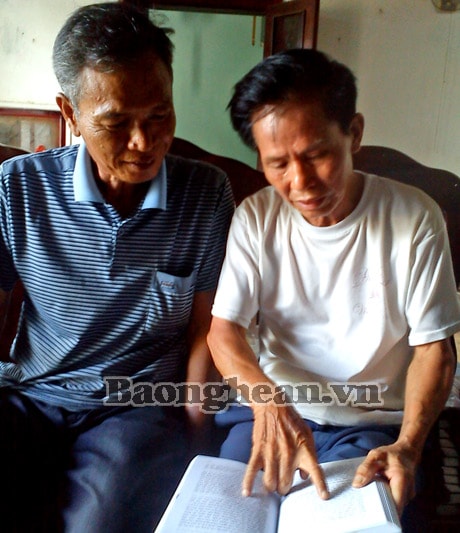
Veterans Ngo Tri Bao and Luong Luyen review the memoirs of the "No-Number" convoy.
After nearly a night adrift on the waves, Ngo Tri Bao managed to swim ashore at dawn the next day. As soon as he set foot on land, he heard the roar of airplanes in his ears. The enemy's loudspeakers relentlessly blared out: "Communist soldiers of North Vietnam, you are surrounded. Return quickly to the national cause to have beautiful wives, intelligent children, and plenty of food and clothing…"
“At that time, I only had an AK rifle and more than twenty bullets, and I was quite panicked. My first thought was to hide in a secluded place and then figure things out later, because the river mouth leading to the mainland was completely surrounded, and the coastline was blocked by a platoon of frogmen conducting a search.”
After hiding for almost a whole day, and listening until nightfall when things began to quiet down, he followed the coastline searching for traces of a base and discovered nearly a dozen South Vietnamese soldiers hanging in hammocks. Suspecting they had been ambushed, he opened fire, and then heard groans and curses from the South Vietnamese soldiers in the night. However, he was already wounded in the back and had to struggle to make his way back into the deep forest. He was exhausted from hunger, fatigue, and blood loss. “I was so hungry I couldn’t stand it, so I caught a crab, peeled it, rinsed it in saltwater, and devoured it greedily, oblivious to the smell. Unexpectedly, after consuming some of the seafood, I felt much better. I regained my confidence and continued on.”
After this battle, due to injuries, he had to be transferred to another unit, but he remained in the U Minh Ha region until the complete liberation of South Vietnam. Upon returning, bearing the scars of war, he still worked diligently to raise his three children, provide for their education, and build a family. Occasionally, he would visit his old comrade, Luong Luyen, to reminisce about the old days. Their conversations covered topics like business ventures, arranging marriages for their children, family matters, and village life... and each time they recalled the past, both were filled with emotion. Memories of the Ho Chi Minh Trail on the sea and the "numberless" ships helped them become stronger, forgetting the hardships of everyday life...
From the "Ghost Battle" to a Peacetime Victory
Upon arriving at Squadron 137 of the 1st Naval Region Command, Lieutenant Colonel Vu Xuan Tinh – the company's political officer – led me to the Ho Chi Minh Room – the unit's traditional room. The most prominent feature is a portrait of President Ho Chi Minh, followed by images documenting the formation and development of the Vietnamese Navy.
Lieutenant Colonel Vu Xuan Tinh specifically highlighted a black-and-white photograph depicting a rudimentary ship with its guns proudly pointed toward a modern American fleet. This was one of three ships directly commanded by Battalion Commanders Le Duy Khoai and Nguyen Xuan Bot of Battalion 135 that participated in the battle against the Americans after the incident on the night of July 31, 1964, when the US sent the USS Maddox to encroach upon the waters of North Vietnam.
The battle took place under unequal conditions, with the US on one side possessing a modern, elite fleet and air support, and the Vietnamese Navy on the other with rudimentary weapons. However, after two days of fierce fighting, we drove the USS Maddox out of our waters, shot down one aircraft, and damaged another. This battle was later dubbed the "ghost battle" by the American press because they could not explain why the US, the aggressor, became bogged down in that conflict.
Defeated, two days later the US government fabricated the "Gulf of Tonkin incident"... unexpectedly launching an attack codenamed "Operation Pierce Arrow," targeting most of our naval bases along the northern coast from Song Gianh Port (Quang Binh); Cua Hoi, Vinh, Ben Thuy (Nghe An); Lach Truong (Thanh Hoa) to Bai Chay (Quang Ninh), but once again they failed. The victories on August 2nd and 5th marked the beginning of a glorious chapter in the history of the Vietnamese Navy's fighting and victories, affirming our determination and will to fight, to be determined to fight, and to know how to fight the Americans. August 5th is also chosen as the traditional day of the Vietnamese Navy.
Continuing the glorious tradition of the Vietnamese Navy, Squadron 137 was established on May 6, 2005, to carry out two key tasks: combat readiness, patrolling, and reconnaissance in conjunction with other forces managing and protecting the sovereignty of the southern part of the Gulf of Tonkin; and flood prevention, search and rescue on rivers and at sea. Lieutenant Mai Van Son (Quynh Yen, Quynh Luu) recounted: "Typhoon No. 5 unexpectedly struck Tan Ky in 2005."
At that time, the unit was newly established, and most of the soldiers in the squadron had just been transferred from other units. He himself had also just transferred from the Hai Phong Naval Special Forces Unit. But he and the soldiers in the squadron immediately went to the eye of the storm, participating in rescue and relief efforts for 12 communes in the district. He also participated in search and rescue operations for fishing boats from Thanh Hoa province, and in repelling foreign survey vessels...
For these men, the voyages, the struggles against the waves and storms, full of danger, not only signify self-sacrifice for the peace and safety of the Fatherland and its people, but also represent invaluable experiences unique to the naval forces. Perhaps these experiences are what create the value, the so-called "soldierly spirit," unique to the soldiers of Uncle Ho's army, whether they are currently serving or have retired.
Therefore, the story of Thoại's intention to learn electronics before his discharge, and Quân's return to Quảng Bình to continue his unfinished studies... continues to unfold year after year with the discharge of soldiers after completing their military service. Most of them, upon returning to their localities, become positive and exemplary individuals in all fields, whether in Party, government, and mass organization work, or in cultural, social, business, and production activities. As Thoại firmly believes, "Two years wearing the naval uniform, being trained in a harsh and disciplined environment, I feel I have matured a great deal. After studying and participating in many training and combat exercises, I feel I have a responsibility to become a leading 'soldier' in the cause of protecting and building the Fatherland, no matter where I am or in what field."
Lieutenant Colonel Vu Xuan Tinh said: "Nearly 70% of the squadron's members are from other provinces, but because of the special nature of our mission, we can only return home once a year. Living far from family, wives, and children, the longing for home arises every time we are on patrol at sea. At those times, looking back at the mainland, we see how sacred and integral our S-shaped land is; we deeply understand the truth: A meaningful life is one of sacrifice and selflessness for the peace of the people and the territorial integrity of our beloved Vietnam."
Bidding farewell to the officers and soldiers of Squadron 137, the words in the letter from young Lieutenant Pham Quang Giap to his mother were deeply etched in my memory: “Mother, our country is so vast and wide, so many mothers still stand at the gate waiting for their sons every evening, but how many leave and return? They leave forever for our beloved Fatherland. Peace has come, but perhaps you are still the same now! I leave carrying your love, my father’s perseverance and courage, the support of my village, and the gratitude I owe to my teachers as my baggage for my military life. My homeland is my source of strength; with a firm grip on my rifle, I am ready to fight, accepting sacrifice to defend this land and continue the legacy of those who have fallen before me…”
My Ha


