
Continuing the history of the village
(Baonghean) - The alternating rain and sunshine create a lively atmosphere, hinting at the beginning of spring, bringing a sense of peaceful joy that stretches along the newly developed rural roads. At this time of year, returning to Thanh Chi, one feels the warmth of simple, rustic village life and the enduring historical narrative of the village, like a heroic epic...
Every time I return to this small, heroic village, I seek out Mrs. Le Thi Khoa, who is now very close to her centenary. Her age and sharp mind seem to have made her an expert on the village's history, and for many years, almost every visiting group from afar has asked to visit her for advice. Mrs. Le Thi Khoa, leaning on her worn-out bamboo cane, sat and chatted with us over a cup of tea at the end of the day. Old people often reminisce about the past, and for Mrs. Khoa, it always leads back to the significant events of her life. “In 1930, I was just over 10 years old. The village was very poor, but the people were united and protected each other. Every evening, following the streams, ‘our people’ would sneak back to people’s houses to eat, rest, and talk secretly. A short time later, I heard the adults whispering that a branch of the Communist Party of Vietnam had been established,” Mrs. Le Thi Khoa recounted her memories.
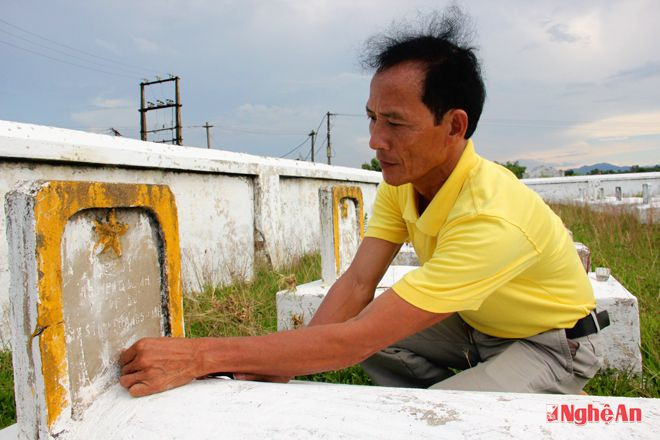 |
| Mr. Tran Duc Khieng takes care of the graves in the cemetery. |
I read the story my grandfather told me in the book "History of the Party Committee and People of Thanh Chi Commune, 1930-2010". The history records: After the district Party committee officials came to assess the situation, establish contact, and conduct propaganda to instill revolutionary ideals, on June 9, 1930, the first Party branch was established in Thanh Chi. The ancestral temple of Mr. Co San in Lien Tri hamlet was chosen as the venue for the founding ceremony and the admission of the first five Party members... A few months later, the branch's meetings successively admitted seven more new members. Thus, in 1930, the Thanh Chi Party branch had 12 members. The mark of the activities and leadership of this first branch is clearly evident in the milestones of struggle and development in Thanh Chi commune, and was enthusiastically received by the people. However, not long after, a tragic event occurred, marking a change in the methods of revolutionary struggle on a large scale for the people of the commune.
Regarding that tragic event, here are the authentic and precious memories of Mrs. Le Thi Khoa: “I remember it was October 6th. That morning, I went to the Ro wharf to bathe, but there was no water; that year there was a severe drought. While I was walking, our group (the protesters) arrived and swept me away. From above, they told the people to line up in pairs for the soldiers to give a signal. Unbeknownst to them, after they lined up in pairs, they took out their guns and started shooting. Countless people died that day, from Con Gay to the temple gate; many people fled into the ditches...”
Connecting the memories of Mrs. Le Thi Khoa with the events of October 6, 1930, as recorded in "The History of the People's Party Committee of Thanh Chi Commune, 1930-2010," I would like to humbly and simply record here the tragic and heroic event that remains etched in the memories of generations of people in Thanh Chi commune as something unforgettable: The event originated in Bau hamlet, Ngoc Lam village. At dawn on August 15th of the year Canh Ngo, which is October 6th, 1930 in the Gregorian calendar, the Foreign Legion soldiers from Thanh Qua outpost raided Bau hamlet, stormed into the house of Mr. Nguyen Viet Man, arrested him, and stole some of his property. The sound of drums and gongs sounded the alarm, and the whole village gathered at Mr. Man's house to surround the soldiers. Shortly afterwards, under threat of weapons, the soldiers broke through the encirclement and brazenly abducted Mr. Nguyen Viet Man, much to the outrage of the people in the villages of Ngoc Lam, Thanh Qua, Chi Ne, and others.
From this event, the people of Vo Liet, Bich Hao, and Cat Ngan communes were ignited with hatred and patriotism. Under the leadership of the Communist Party branch and the Red Self-Defense Force, thousands of people rose up in protest against the soldiers' outrageous actions and made several demands to the Thanh Qua outpost commanders. It was from this point that the soldiers hatched a plot, urging the protesters to stop near the O Ro bridge to listen to the high-ranking official's instructions. When the shouting subsided, from the mountain, the soldiers used mortars to unleash a bloody massacre on the protesters. On the morning of October 6, 1930, 142 people perished, including 32 sons of Thanh Chi commune.
This large-scale protest, led by the Party branch, marked the first turning point in the struggle in Thanh Chi and is considered the event that ignited the smoldering embers of the 1930-1931 Nghe Tinh Soviet Uprising. Mrs. Le Thi Khoa is one of the few surviving witnesses of that fateful October 6th, 85 years ago. Time, age, and the burdens of making a living have faded many things from her mind, but that morning, the rumbling sound of the mortars and the simple figures in brown trousers and cloth shirts who fell, will forever remain unforgettable. Among those who fell were many valiant Party members, her loved ones, and countless villagers who had never known a day of joy under the oppressive and exploitative colonial regime.
Nearly a century has passed, and we cannot know what those 142 people from this resilient Soviet land were thinking that morning, before the massive demonstration and the courageous sacrifice. Perhaps it was the arduous task of carrying water during a severe drought? Or perhaps it was the sight of stunted sweet potatoes and cassava plants in the fields to warm their children's stomachs? Or perhaps it was the indomitable will and patriotism, forged over years, waiting for the opportunity to erupt fiercely, overcoming poverty and oppression? Throughout the arduous journey back to his memories, Mr. Khoa could not hold back his emotions. His dry, wrinkled hands slowly wiped away the tears that had been carefully gathered on his aged face, as if he had cried until his voice was dry countless times when thinking about that painful day in the past. He said: "It's better not to mention it, but how could the people here forget? From here to the village temple (Thanh Qua temple) is just a short distance; the temple is gone, but the land remains. Just look at it and remember."
After that tragic morning, the soldiers at Thanh Quả outpost continued firing their guns until late afternoon. As dusk fell, Party members from the Thanh Quả - Chi Nê branch led the way, followed by relatives and villagers from neighboring hamlets, secretly making their way to the fields to search for the bodies of those who had fallen. The image of the vast green fields stained crimson with death, the stench of decay mingled with the silent anguish of those who directly gathered and searched for fragments of bodies, turning over faces buried in the soil of their homeland. All of this created a lasting haunting, forging a will to move forward and a sense of gratitude, even for generations to come who only know about the event through the stories of their predecessors.
Mr. Tran Duc Khieng, a cultural officer of Thanh Chi commune, is a son deeply attached to his homeland. His uncle, Tran Duc Doc, was a martyr – Secretary of the Thanh Qua – Chi Ne Party Branch, one of those who sacrificed their lives on the morning of October 6, 1930. He always carries within him a deep concern for honoring the past. He said that, like many generations of descendants in Thanh Chi, the village's history permeated his childhood through the stories told by his grandmother and mother, and became even more compelling when fate led him to take on the role of cultural officer of the commune. He led me to the village field from years ago, now transformed into the Thanh Chi Commune Martyrs' Cemetery – the resting place of 32 sons of the commune who fell on that fateful morning of 1930. The cemetery was built in 1961 on the site of the former Thanh Qua village communal house, using local government funds. We stood in the windy village fields, with the gentle brown earth on one side awaiting the new planting season, and on the other, the rising smoke of incense rising from the graves of fallen comrades and fellow villagers, filling our hearts with overwhelming emotions. Khieng thoughtfully recounted: “I am a descendant of the Tran Duc family. My great-grandfather was the patriotic scholar Tran Tan – the leader of the Giap Tuat uprising in the late 19th century against the French colonialists and the Nguyen dynasty. My uncle was Tran Duc Doc – one of the leaders of the demonstration on October 6, 1930. My uncle's grave lies here, beside his comrades, on the land where he was born and raised…”
Eighty-five years, almost a full lifespan. In those years, many things might be forgotten, but for the people of Thanh Chi commune, that heroic past, the sacrifice of those indomitable Party members who "led the way," will forever remain unforgettable. This unwavering loyalty is partly due to the determination of the commune's Party committee and government. As Mr. Nguyen Duy Minh, Secretary of the Thanh Chi Commune Party Committee, shared, "We don't wait for major holidays or festivals; we skillfully incorporate this content into Party committee and branch meetings, or even village and hamlet meetings. This could involve launching fundraising campaigns to support the families of fallen soldiers facing difficulties, or helping lonely Party members' families... We believe that all these small actions contribute to warming the hearts of those who fell, and also serve to engrave a glorious historical symbol of our homeland for future generations to know and remember."
And with the desire to commemorate that symbol, the Party Committee and the government of Thanh Chi commune are developing a plan to upgrade the commune's Martyrs' Cemetery, so that its grandeur is worthy of the historical significance of these heroic people. "If internal resources are insufficient, we will rely on external support. We cannot be indifferent to spiritual matters of remembrance!" Mr. Nguyen Duy Minh affirmed. He added that, following the principle of "the state and the people working together," in addition to awaiting support from higher levels and the heartfelt contributions of local people, the commune is planning to mobilize social resources from Thanh Chi's children who have left their hometown to work and prosper, possibly starting with the "association" of Thanh Chi's children in Hanoi. "As a child of Thanh Chi, no one is unaware of the events of October 6, 1930. Paying tribute to those who fell for today's peace is something that should be done, something that needs to be done," Mr. Nguyen Duy Minh asserted.
For decades, this gratitude has stemmed from the warm incense offered during holidays and festivals. I bid farewell to this heroic land, carrying with me the sparkling memories and the belief of Mr. Tran Duc Khieng: “On the night of the War Invalids and Martyrs Day, July 27, 2014, we lit candles around the cemetery. Perhaps a thousand people from Thanh Chi returned to this field that night, standing in circles, both inside and outside, intently commemorating the martyrs of our homeland. At that moment, I knew for sure that, even though nearly a century has passed with so many changes, ultimately, the true historical values will surely endure through time…!”
Phuong Chi


