
Supporting students to go to school.
(Baonghean) - To share the difficulties faced by ethnic minority students, since the 2013-2014 school year, ethnic boarding schools in Ky Son district have simultaneously implemented the provision of meals and accommodation for students. This activity is an important support for students in border areas to attend school.
As the poorest district in the country, Ky Son still faces many difficulties in economic development and improving the lives of its people. Due to the customs and traditions of the ethnic minorities and the complex terrain, the villages are scattered and separated by rivers and mountains. In this situation, students from the Thai, Mong, and Khmu ethnic groups bear a heavy burden of worries about food and accommodation on their journey to pursue their education. Most ethnic minority students live far from school and cannot travel to and from school daily, so they have to stay with local people. Others build makeshift shelters around the school, bringing their own food to cook and live in rented rooms. This significantly affects their health and the quality of their learning. In fact, due to these difficulties, many students have dropped out of school midway…
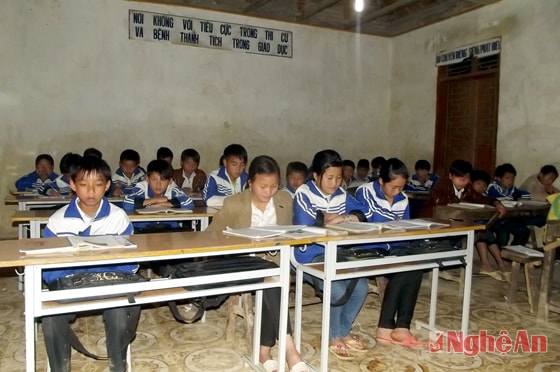 |
| A classroom at Huoi Tu Ethnic Boarding Junior High School. |
Now, the children's journey to school has become less difficult and arduous thanks to the State's support, which provides each child with 460,000 VND and 15 kg of rice per month. In the context of a difficult economic situation and a high poverty rate of 52.79%, this State support is invaluable. To implement the State's policy, all levels and sectors in the district have actively participated, carrying out the implementation and achieving encouraging results, positively changing the awareness of all segments of the population regarding caring for their children's education. To date, the entire district has 18 schools (17 secondary and junior high schools with 3,519 students, accounting for 98.7%, and 1 primary school with 14 students) that have been provided with stable accommodation and meals under the boarding school program.
Initially, many schools were unfamiliar with the process and felt uncertain, but with the close guidance of the Department of Education and Training, they overcame difficulties and built kitchens and dormitories for the students. At Bac Ly and Nam Can boarding schools, although the kitchens are still temporary and cooking utensils are lacking, the teachers have made efforts to organize meals for the students. The schools face challenges such as being far from the center, far from water sources, and having scarce and expensive food. Meanwhile, many markets, such as Muong Long and Huoi Tu markets, only operate twice a month. Therefore, during rainy and windy periods, sometimes for almost a week, the students have to rely on dried food. Despite these difficulties, "All for our beloved students," the school's staff and teachers dedicate their love and responsibility to the children. The teaching staff has focused on disseminating information, explaining thoroughly to parents the benefits and importance of their children's meals, accommodation, and education at school. In some schools, teachers and staff had to arrange for extra accommodation for the students in their offices. Undeterred by the difficulties, the teachers also spent time with the students, going to the forest to collect wood to build beds for the children to sleep on, gathering firewood for fuel, and helping the students improve the soil to grow vegetables, thereby increasing the quality of the students' meals.
To ensure that students' meals are palatable, some schools have hired local cooks because they understand the customs and tastes of the students. Food is sourced from reliable suppliers, ensuring hygiene and nutritional standards, and students are consistently provided with three meals a day. The centralized cooking system for boarding students is strictly managed by the school, with supervision and inspection from local authorities and parents. In addition, schools assign one teacher specifically for boarding students, and assign a team of teachers to supervise the boarding classes, assist students with their meals and daily activities, especially during nighttime study. Furthermore, schools have developed daily schedules for students, provided tutoring for weak students, and managed students' self-study time outside of regular school hours and in the evenings.
According to assessments, since the implementation of school lunch programs, the educational activities in schools have improved, overcoming the problem of students dropping out or asking to go home for food; students have more time for studying, improving the quality of their studies and extracurricular activities... Some schools have effectively advised on the construction of facilities and the organization of school lunch programs for students, typical examples include: Bao Thang Ethnic Boarding Junior High School, Nam Tip Ethnic Boarding Junior High School, Muong Long Ethnic Boarding Junior High School, Na Ngoi Ethnic Boarding Junior High School…
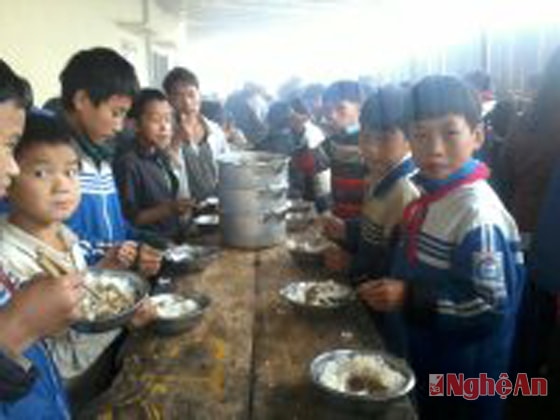 |
| The cafeteria for students of Huoi Tu Ethnic Boarding Junior High School (Ky Son). |
Visiting Huoi Tu Ethnic Boarding Junior High School, which has the highest number of boarding students in the district with 311, one can truly appreciate the efforts of the teachers and students there. The temporary shelters and kitchens made of bamboo and thatch within the school grounds are no longer present as in previous years; instead, the students' living quarters are neater, cleaner, and more organized. The students have developed a strong sense of collective responsibility and punctuality in their daily routines. Vu Ba Binh, a student in class 9D, shared, “I am an orphan, having lost both my parents. My home is in Huoi Kha village, Huoi Tu commune, 7 km from the school. Before, to get to school, I had to wake up at 5 am to be on time. Some days, when it rained and the roads were muddy, I was late for school and came home hungry and tired, so I just wanted to quit. Now, I get to eat and live at school, and receive attentive care and guidance from the teachers, so my health and academic results have improved a lot. I consider the school my second home…”
Mr. Nguyen Hong Hoa, Head of the Education and Training Department of Ky Son District, added: “Since implementing the boarding school model, we have seen parents become more enthusiastic, making it easier to encourage students to attend school. The students themselves, thanks to better care, learning and playing in a safe and healthy environment, have become more confident and active in life. As a result, the quality of education at boarding schools has improved significantly, the number of good and excellent students has increased, and the percentage of weak students has decreased from 6.92% to 5.12%. The number of students dropping out has decreased from 0.62% to 0.52%…”
Besides that, there are still many concerns. Currently, schools with boarding students are facing difficulties in terms of facilities, dormitory rooms, beds, dining halls, kitchens, and equipment. While investments are being made, they are still not commensurate with the number of students. In the future, in addition to investment from the State budget, the joint efforts of philanthropists, businesses, and the entire community are urgently needed to make the boarding school model effective, contributing positively to helping students in mountainous areas pursue their educational dreams, and simultaneously improving the quality of human resource training for the border district of Ky Son…
Tran Van Duc
Ky Son District Party Committee


