
Continue to share responsibility.
(Baonghean) - Nearly 10 years have passed since the first households in the Ban Ve Hydropower resettlement area moved to their new homes, giving up their land for the hydropower project. Overcoming all difficulties and obstacles, the lives of the people have gradually stabilized and adapted. However, shortcomings such as lack of arable land, lack of clean water, and deteriorating transportation infrastructure are major obstacles for the resettled people, especially given that the government's food assistance quota only has 7 months left.
| RELATED NEWS |
|---|
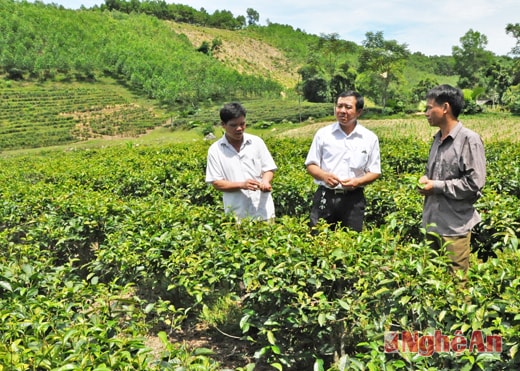 |
| The tea garden of Mr. Vi Văn Tuyền (Ngọc Lâm commune - Thanh Chương district) yields high returns. |
Life in a new land
Returning to the Bản Vẽ Hydropower resettlement area in Ngọc Lâm and Thanh Sơn communes (Thanh Chương district) in early July, during the hot season, one still sees an endless expanse of green from cassava, paper pulp trees, tea plants, and bamboo shoots. This demonstrates the fruits of the hard work and production that the people have put in since moving to their new homes. They have gradually adapted to new ways of doing business; this is the result of the decisive joint efforts of the investor, all levels of government, and local authorities; and the striving of nearly 2,300 households, with over 11,000 resettled people.
In Ta Xieng village, Ngoc Lam commune, we had the opportunity to visit the family of Mr. Vi Thanh Tuyen, one of the dynamic households implementing a comprehensive economic model combining trading, tea cultivation, and buffalo and cattle farming effectively. Visiting his nearly 1,000 m2 tea garden, just over four years old, under the scorching sun, his tea plants were still lush and green. Mr. Tuyen said: "We harvest tea twice a month for Truong Thinh Tea Company, earning 12-14 million VND per year from tea cultivation – a significant source of income for my family's livelihood." Next to Mr. Tuyen's house, also thanks to the support from Program 135/CP for tea cultivation, Mr. Luong Van Ty's family also grows tea and has a stable monthly income of over 1 million VND. Not only have they become familiar with industrial tea cultivation, care, and harvesting methods, but some resettled households, whose hands were once rough, have now skillfully cultivated tender young tea plants through training.
Visiting the nearly 200-square-meter covered tea seedling nursery of brothers Vi Van Hoa and Vi Van Nghi, one can witness the villagers' ability to work and adapt quickly to new farming methods in this new land. Under the canopy, nearly 15,000 healthy green tea seedlings are being prepared for the new planting of industrial tea plantations according to Thanh Chuong district's plan. Village head Vi Van Nghi not only guides his brother Vi Van Hoa but also encourages nearly 10 households in Ta Xieng village to boldly establish nurseries to produce tea seedlings in preparation for the new planting plan. Village head Nghi said: "Learning from the first tea planting under Program 135/CP, where we were unfamiliar with the techniques and lacked a reliable source of seedlings, the results were not very good. Now, with the new tea planting under the industrial tea project, the households in the village have grasped the basic techniques and will ensure successful planting. Tea will become an effective crop for poverty alleviation in Ta Xieng village." Currently, the nearly 114 hectares of tea plantations that the people acquired through Program 135/CP are becoming a sustainable source of income, accumulating technical experience to enable them to implement the industrial tea planting project in the resettlement area on 543 hectares, which has been approved by the Provincial People's Committee.
Leaving Ta Xieng village, we arrived at Kim Kien village, Ngoc Lam commune, the earliest village to be relocated to the resettlement area. Although they don't directly cultivate tea, the lives of the villagers have stabilized, and the families' business plans are quite clear. Using a loan from the Social Policy Bank for poor households, Mr. Luong Van Hoai and Ms. Lo Thi Da invested in buffalo farming. Applying their practical experience in buffalo farming from their old hometown to the new conditions, their initial buffalo has given birth to two calves. In addition to buffalo farming, the family also reclaimed 5 sao (approximately 0.5 hectares) of land and planted bamboo shoots, thus stabilizing their family's economy. Thanks to flexible capital management, Mr. Hoai repaid his 10 million dong loan ahead of schedule. Next door, Ms. Quy Thi Nguyet borrowed nearly 30 million dong for her son to work abroad, and this has been very effective. The money her son sends home monthly not only contributes to improving the family's life and building a house, but also repays the bank loan. According to the consolidated report of the District Social Policy Bank, the outstanding loan balance for the two resettlement communes has exceeded 12.5 billion VND. Basically, the people have accessed loan programs and used the capital effectively, with very low overdue debt.
The old village is desolate.
Unlike the "vibrancy in the new land," in some outlying villages such as Ta Xieng, Kim Lien, Nhan Pha, and Lap, Kim Hong village in Ngoc Lam commune remains desolate and full of difficulties. The bridge connecting the only road from Ta Xieng village to Kim Hong village was cut into three sections by heavy rains caused by Typhoon No. 8 last year, and has been impassable for nearly a year. To reconnect the road to the outside world, the commune and village have built a makeshift bridge with steel gabions underneath, but just one rainstorm is enough to cut off the road again, completely isolating Kim Hong village. The road access is difficult, but even more heartbreaking is the sight of scattered remnants of houses that returned to their old homes – only the foundations and walls remain, now crumbling, with grass growing all over the yards and gardens.
The house of the Chuong Van Hoanh family, sold in 2011, has been dismantled for its wood, leaving only a crumbling kitchen wall. Next door, the house of the Vi Van Dien family has been bought and sold multiple times, and now it's locked and bolted shut... Originally, Kim Hong village had 101 households, but 36 of them sold their houses and returned to their old hometowns. With a somber expression, Party branch secretary Luong Thi Liem said: "Since the villagers sold their houses and returned to their old hometowns, only the Vi Van Nhan family has returned. Before that, the Party branch also encouraged the households to stay; at first, they said they would only return to farm, but then they secretly sold their houses, and only then did the Party branch and village committee find out. Even within the Party branch, out of 14 members, two—Chuong Van Hoanh and Quang Van Tuyen—did not set a good example and still sold their houses and returned to their old hometowns."
According to Mr. Lo Huy Hung, Vice Chairman of the Ngoc Lam Commune People's Committee, the reason some villagers returned to their old homes was due to difficulties in making a living and unfamiliarity with the new location. In Kim Hong village, the land had already been cleared by earlier settlers, leaving no land for production. Another reason was the incitement of people to return; initially, they only returned to farm, but later sold their houses and moved back permanently. The district, commune, and village authorities have also formed several teams to go to the reservoir area to persuade the households to return, but without success.
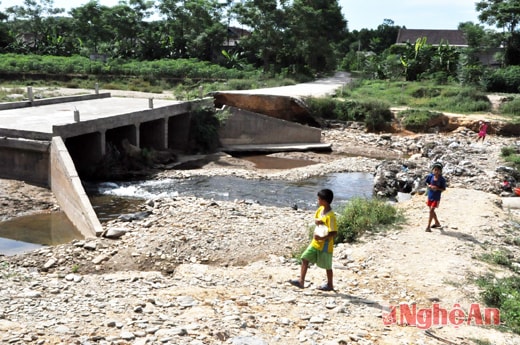 |
| The bridge is damaged, forcing residents of Kim Hong village to take a detour, which is very dangerous when it rains. |
Thirty-six households from Kim Hong village, out of a total of 46 households in the entire resettlement area of the two communes of the Ban Ve Hydropower Plant, returned to their old homes in the reservoir area, hoping for a brighter and less arduous life. However, the reality is quite the opposite. During our trip to the areas where these people returned, we witnessed the potential for unpredictable social consequences. This issue was highlighted in a series of articles about the post-resettlement situation of the Ban Ve Hydropower Plant, "The Dark Corner in the Heart of the Reservoir," published in the Nghe An newspaper at the end of 2012. Here, the displaced households live precariously in makeshift huts along the Sop Xuan, Ca Muc, and Tang streams, in a state of "anarchy," without any management or affiliation with any village or commune. While adults are affected, the high rates of illiteracy among the children and the resulting illnesses are very worrying. This is the biggest problem of the project and requires a thorough and swift solution.
We need to continue sharing responsibilities.
The Ban Ve Hydropower Resettlement Project is a large-scale project, both in terms of total investment and the relocation of the largest number of households and people in the province to date. The complex terrain, the long distances between the resettlement areas, and the differences in production practices and cultural characteristics between the old and new settlements meant that it took time for the residents to adapt. Initially, there were shortcomings and inconsistencies in planning, house design, technical infrastructure, and production infrastructure, leading to intense conflicts between the resettled households and the investor at times. However, with the investor's high level of attention and responsibility, along with the decisive leadership and intervention of Thanh Chuong district and the relocated communes, after nearly 10 years in their new homes, the residents are now generally settled and living peacefully.
Upon arriving at the resettlement area, one noteworthy and commendable achievement is that after the resettlement of the local people, and despite numerous reports from various levels of government and the press regarding the serious deterioration of their housing and its impact on their "stable living conditions," Ban Ve Hydropower Joint Stock Company is currently providing financial support for the repair of 779 houses (Thanh Son: 354 houses, Ngoc Lam: 425 houses) under a two-phase support mechanism: in the first phase, households contribute 50% of the cost, nearly 5 billion VND, for self-repair, and upon completion and proper procedures, the remaining 50% is paid. This solution has fundamentally addressed the housing deterioration issues that the local people had raised and requested.
Currently, to stabilize the lives of the local people, the investor (Ban Ve Hydropower Joint Stock Company) must first complete the necessary procedures to issue land use right certificates, creating a legal basis for the people to invest and confidently engage in long-term production. At this point, the investor has not yet completed the necessary documents and paperwork to coordinate with the District People's Committee to issue land use right certificates, which is a significant delay. Because land use rights have not yet been granted, many households are still uneasy, clinging to the idea of living in temporary conditions, and lacking the basis to mortgage or secure loans from banks to expand production. At the same time, it is necessary to continue paying attention to and supporting farmers in investing in production, because out of nearly 200 hectares of agricultural land, including more than 90 hectares that the Project Management Board reclaimed and handed over to the two communes to distribute to the people, only 35 hectares have started production. However, erosion, leaching, and especially the lack of water for production are causing great difficulties, leading to low productivity.
Mr. Phan Dinh Ha, Vice Chairman of the Thanh Chuong District People's Committee, suggested that the Provincial People's Committee should consider applying a more flexible mechanism so that people can receive the same level of financial support for tea cultivation as stipulated in Decision 09/2012 for high-altitude mountainous districts. This would facilitate the implementation of the project to plant 543 hectares of industrial tea in two communes, which has already been approved by the Provincial People's Committee. Currently, the 114 hectares of tea plantations already cultivated under Program 135 are proving very effective, demonstrating that tea is well-suited to this region and is becoming a stable source of income, supporting households in poverty alleviation. At the same time, consideration should be given to allocating funds for the recovery of the old forest land to provide additional land for households lacking production land, as stipulated in the project. Regarding the severely damaged infrastructure affecting travel and trade between villages as well as within the resettlement area, especially the bridge connecting Ta Xieng village to Kim Hong village and the bridge on the road from Kim Lien village to Cha Luan and Sop Phe villages, which collapsed nearly a year ago, funding needs to be allocated for repair and restoration to ensure safety as the rainy and stormy season approaches.
To ensure the stable and sustainable lives of the people in the two resettlement areas, the efforts of the investor, the province, and the district are commendable and appreciated. However, there are still some outstanding issues and obstacles that urgently need to be addressed with the high sense of responsibility and dedication of the local authorities, the investor, and relevant levels and sectors. Effective solutions are needed to definitively resolve the issue of resettled people returning to their old homes, avoiding any unfortunate consequences that may occur.
Huu Nghia - Thanh Duy


