
Finding solutions to poverty alleviation for the Khơ Mú people.
(Baonghean.vn) -Currently, with 67%, Ky Son district remains the leading district in the province in terms of poverty rate. The high poverty rate stems from many causes, including the mentality of dependence and reliance among ethnic minorities, especially the Khmu people.
According to statistics, the Khơ Mú ethnic group accounts for over 34% of the population of Kỳ Sơn district (ranking second, after the Hmong). Some communes, such as Bảo Nam, Bảo Thắng, and Bắc Lý, have 100% Khơ Mú inhabitants; others have a large Khơ Mú population, such as Keng Đu, Mường Típ, Mường Ải, Tà Cạ, and NaLoi. Their houses are makeshift, their children are neglected, and their fields are barren... Compared to other ethnic groups living in the area, the Khơ Mú people face the most difficult living conditions. Analyzing the reasons, many believe that the Khơ Mú still heavily rely on a nomadic lifestyle, living entirely dependent on nature, with low levels of agricultural production and a lack of awareness to overcome poverty.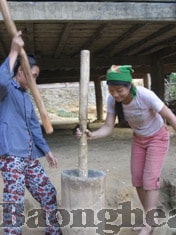
The lives of the Khmu people in Ky Son are still full of hardships.
Let me share two stories below to help you easily visualize the way the Khmu people think and do things. The first story was recounted by a leader of Ky Son district. For a long time, maintaining the wet rice farming model in Bac Ly commune had not been very effective, so the district decided to experiment with peanut cultivation. When Ky Son district officials came to inspect and evaluate the harvest, they asked a woman harvesting peanuts: "Do you think peanut cultivation is more effective than rice cultivation?" The woman replied: "Much more effective!" "Can you explain in more detail how it's more effective?" - an official asked. Unexpectedly, the farmer innocently replied: "Peanuts can be shelled and eaten right away. But rice has to be harvested, carried home to dry, then pounded, sifted, and winnowed before it can be eaten" (!).
The second story was recounted by Mr. Ho Sy Can, an officer from the Nam Can Border Guard Post who was seconded to serve as Deputy Secretary of the Party Committee of Ta Ca Commune. Mr. Can advised and directly supervised the implementation of a pig farming model for several Khmu ethnic households. The families received piglets and feed on a regular basis. One day, while inspecting a household, he was delighted to see the pigs clean, plump, and well-fed. However, upon returning some time later, he found the pigs noticeably thinner. Mr. Can decided to investigate the cause. It turned out that when the feed supply was sufficient, the family fed the pigs continuously, several times a day, whenever they squealed. As a result, the pigs grew rapidly and became very thin. But when the feed ran out, and before the scheduled replenishment, the pigs were only fed crushed plants, and their care became erratic, causing them to become emaciated.
According to Mr. Ho Sy Can, the most important thing to help the Khmu people gradually escape poverty is to change their mindset. Currently, he is planning to study and research the Khmu people's identity to find solutions to help them change their mindset and overcome their dependent mentality, but this work is facing many difficulties. A Khmu friend, currently the head of a district-level department in Ky Son, shared that the Khmu people need increased guidance on science and technology to apply to production, increasing productivity and output. At the same time, opportunities should be created for their children to pursue higher education and provide employment to motivate the Khmu people to "break through" and improve their lives.
Liem Trinh


