
Learn about Nghe Tinh folk singing.
In terms of origin, the folk song style of Nghe Tinh province stems from two forms of folk music: the "ví" singing style and the "giặm" singing style. The "ví" singing style has many forms such as "ví phường vải" (cloth-making folk song), "ví phường cấy" (rice-planting folk song), "ví phường nón" (hat-making folk song), "ví phường quảt" (harvesting folk song), "ví phường đan" (weaving folk song), "ví phường củi" (firewood-burning folk song), etc., but "ví phường vải" is the most distinctive.
| RELATED NEWS |
|---|
Like other folk songs, the "ví phường vải" (also called "hát phường vải") is a self-sufficient form of performing arts in Nghe Tinh, deeply lyrical in nature. "Hát giặm," on the other hand, is a narrative form using rhyming verses to discuss, philosophize, describe scenery, express emotions, spread propaganda, satire, etc. According to Ninh Viet Giao, "hát giặm" is not as widespread throughout Nghe An as "hát ví," mainly thriving in the southern districts of Nghe Tinh, including Can Loc, Thach Ha, Cam Xuyen, and Ky Anh (Ha Tinh). However, if we only consider the popular "ví phường vải" form, its main areas include Quynh Luu, Dien Chau, Yen Thanh, Do Luong, Thanh Chuong, and Nam Dan (Nghe An), with Nam Dan being mentioned most frequently: "Thanh Chuong is the land of plowing and tilling / Nam Duong (Dan) is where cotton is grown and people sing all night." Despite some differences, both "hát ví" and "hát giặm" are expressions of the heart, conveyed through simple performances, unpretentious melodies, and the unique language of many generations of working people in Nghe Tinh. Therefore, the name and the studies can be grouped together as Nghe Tinh folk songs.
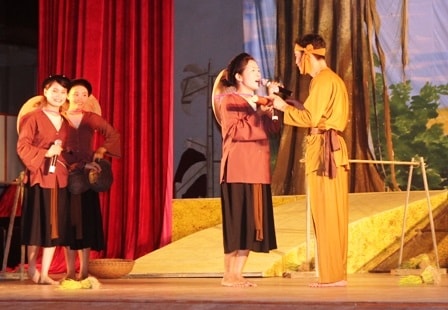 |
| Performing folk songs and dances on a large stage. |
2.1. It can be said that the language of Ví Giặm folk songs possesses characteristics of Vietnamese poetic language. Therefore, it not only serves a purely communicative function but also an communicative-aesthetic function. This is manifested in many aspects, but in this article, we will only consider some typical aspects.
2.1.1. Ví giặm folk songs widely use common vocabulary, many of which are refined, smooth, and subtle, reflecting the poetic thoughts and feelings of the young men and women of Nghe Tinh. For example, this is a way of expressing and measuring feelings: "Hong Son is towering, how many layers high / Lam Giang is how many fathoms wide, so is my heart" (Fabrication Song). Furthermore, the words in many Ví giặm songs are rich in imagery, highly symbolic, and distinctly "poetic." For example: "Stones have moss because the water is still / Mountains have white peaks because of the falling dew"; "Leaving home, I instruct the country and the mountains / I instruct them that the word 'husband and wife' is a perfect and complete word," etc. (Fabrication Song); or: "Mother stops and stands still / Afraid of the setting sun, the fading flowers / Afraid of the strong wind, the single rain / For this fate, I am troubled / For this destiny, I am troubled..." (Ví giặm folk song).
2.1.2. Nghe Tinh folk songs effectively utilize rhetorical devices such as similes, metaphors, personification, allegory, exaggeration, etc. These rhetorical devices are constructed based on associative relationships, reflecting the unique way of thinking and aesthetic sensibilities of the people of Nghe Tinh. Regarding similes, folk songs mainly use "open-ended" comparisons (with almost complete comparison formulas), using very familiar objects in daily life but creating subtle associations. For example: "Her skin is like a young banana shoot / Her waist is as slender as a wasp" (Fabrication Song); Or: "Her belly is as round as a jar of pickled vegetables / As fat as a Lao buffalo" (Folk Song).
In Nghe Tinh folk songs, metaphor is the most frequently used rhetorical device. Folk authors use metaphors to convey their feelings and intentions. In many cases, this artistic device creates vivid and subtle expressions of things that are difficult to say or express. For example: "The phoenix is very foolish and not wise / It doesn't perch on Tam Thai Mountain but instead lands on a mound of wildflowers" (Folk Song); Or: "The bees come and go many times / The butterflies come and go many times / Leaving the willow tree with its body / My heart aches with sorrow" (Folk Song),...
Personification is also used in folk songs to describe landscapes, weather information, or express human emotions. For example, the personification in the folk song "Rú Bờng hasn't put on his hat yet / Rú Bể hasn't worn his raincoat yet" indicates that it hasn't rained yet (Rú Bờng, meaning Côn Bằng, Thạch Hà, is not yet covered by clouds; Rú Bể, meaning Nam Giới, Thạch Hà, is not yet surrounded by clouds). Or: "The garden of persimmons and pink plums / Plums and apricots intertwine, tangerines and oranges" (from the folk song "Phường Vải") simultaneously expresses the close and affectionate bond between young men and women, and introduces a garden of seven types of fruit: persimmon, persimmon, plum, apricot, tangerine, pomelo, and orange (personification combined with wordplay). It's truly surprising and delightful.
Exaggeration (also known as hyperbole or allegory) – a rhetorical device that creates a strong impression by multiplying the attributes of things and phenomena – also appears frequently in Nghe Tinh folk songs. For example: "Even if someone gouges out my eyes or cuts off my hands, I will still follow this path with you" (Folk Song); "We have sworn an oath, to live and die together, through the deep sea and high mountains, even if a sword is at our heads, we must be prepared to move forward" (Folk Song). Such expressions convey a high level of determination in a couple's love.
The rhetorical devices constructed through the associative relationships typical of Nghe Tinh mentioned above have given the folk songs a profound meaning, a haunting second layer of meaning that invites the recipient's imagination.
2.1.3. One of the characteristics that makes Nghe Tinh folk songs so appealing is the profound and poignant nature of their melodies. The melodies of folk songs are primarily formed through rhyme and rhythm. Regarding rhyme, since most folk songs are composed in the six-eight meter (folk songs) or five-word meter (folk songs), the lines are always linked together by rhyming at specific points. This is the internal rhyme in folk songs. For example: "When will Hong Linh's stones wear away / When will Hoanh Son's clouds cover it, my heart will still remember you," etc. This is the end rhyme in folk songs. For example: "Even if the sea dries up and the stones wear away / My heart is iron and my soul is pure / When will it fade / When will it fade away,..." The rhyming in folk songs is mostly a main rhyme (completely consistent in terms of tone, final sound, and main sound), thus maximizing the harmonic function of the rhyme.
In many cases, even the syllables within the verse rhyme with each other, enhancing the rhythm of the folk song. For example: "Passing by, I hear your cry / Hearing from afar, I want to take you home"; besides the rhyming pair in "cheo/deo", there are also rhyming syllables: "qua/xa", "nhe/ve", "cheo/keo/deo". Or: "A pair of red-lacquered chopsticks / Picking up a red ash / Putting it into a golden container / Coming from a distant village / Wishing to have a phoenix perched across the dragon." This combined folk song, in addition to rhyming syllables according to poetic principles (son/hon, vang/lang/ngang), also has a series of rhyming syllables: "dua/tro/do/bo/vo/cho", "coi/day/ngai", "lang/rang/gang", "yeu/duc/cap/chanting", creating a heartfelt and poignant melody, thereby revealing the content of the folk song.
The musicality of Ví Giặm is also formed by the pauses (temporal breaks) in each line and each song. In Nghệ Tĩnh Ví Giặm, the pauses not only serve to delineate the components of the lines and sentences but also maintain musicality, thereby increasing the expressive power of meaning and contributing to the expression of the content of the Ví Giặm verses. Therefore, in addition to organizing the rhythm according to the poetics of the genre (even rhythm 2/2/2 and 2/2/2/2 in six-eight verse, 3/2 rhythm in five-word verse), the pauses in Nghệ Tĩnh Ví Giặm are not always smooth and gentle but vary diversely according to the inspiration of the lyrical subject, thus creating complex rhythms. For example: Don't/ gamble/ gamble/ gamble/ Don't/ drink/ drink/ tea/ tea/ Don't/ invite friends/ invite friends/ Don't/ listen to what people say/ Don't/ listen to what people say (Ví Giặm singing). In a five-line stanza, each line has a different rhythm: 1/1/1/1/1 (lines 1 and 2), 1/2/2 (line 3), 1/4 (lines 4 and 5). Or: One/ is fate/ is debt// Two/ is because of mother/ because of teacher// Three/ is because of someone's destiny// For this fate, I am troubled// For this destiny, I am troubled (Folk song). These examples show us that the rhythm in folk songs is rough and diverse, just like the difficult life of the laborers in Nghe Tinh.
2.2. Language, with its most important function as a tool for expression, reflects the behavior of different communities. Furthermore, the cultural landscape within each community is quite diverse across different regions and localities. Of course, the division between cultural regions and dialects does not completely coincide, but if we rely on F. de Saussure's assertion: "The customs of a people influence their language, and on the other hand, to a considerable extent, language makes up the people" [6], then it can be inferred that local languages carry within them the local cultural identity of each residential area. Because the folk songs are composed and performed in the local language (i.e., the Nghe Tinh dialect), below, we continue to demonstrate the beauty of folk songs through the linguistic means of the Nghe Tinh dialect.
2.2.1. In daily communication, people from Nghe An use the Nghe An accent, meaning they use a phonetic form with semantic value that is completely different from other regions. Therefore, the Nghe Tinh dialect has a purely local vocabulary. These local "specialties" appear frequently in folk songs and chants, becoming unique means of expression that create a deep impression on the recipient. Examining folk song texts, it is easy to see that the most useful vocabulary is pronouns. People from Nghe An use pronouns and forms of address in a very diverse and unique way. Like other regions, in folk songs and chants, first and foremost, personal pronouns are used according to person and number such as: tui (I), tau (you), mi (you/you), han (he/she), meng/meng (myself), choa (I/you), bay/bay (you/her), nau (you), etc.
For example: "If you lose your teeth (or your possessions), then I'll accept it / If I make you accept it / I'm not your son (or your father)." In this folk song, "choa" is used in the first person, plural. In communication, "choa" often corresponds to "bay" (you) or "bay" (you). Furthermore, people from Nghe An use this monosyllabic word to form other words based on a certain semantic structure, such as "bây choa" (a group of people), "bọn choa" (a group of people), "nhà choa" (a family), etc. These words are then used in response to express a resolute attitude: "Bây choa eats a bowl of rice / Like serving a bowl of blood / What kind of blood is this, so foul-smelling blood? / Damn the invaders, you won't have a good life!" (Folk song). The way people use terms of address in folk songs like this demonstrates that the people of Nghe An are accustomed to enduring hardship but not humiliation, and that their courage is accompanied by stubbornness, their honesty by brutality, and their resourcefulness by recklessness (Dinh Gia Khanh, 1995), or rather, the stubbornness of Nghe Tinh as many people have observed.
In folk songs, terms of address within kinship and family relationships such as "ông" (grandfather), "bà" (grandmother), "cha" (father), "mẹ" (mother), "chú" (uncle), "bụ" (grandfather/aunt), "dì" (aunt), "o" (aunt), "anh" (brother/sister), "em" (younger sibling), etc., appear frequently. Among these words, the word "mự" is the most unique. In folk songs, the word "mự" is used to address the following roles: 1/ the wife of an uncle, equivalent to "thím" (Northern Vietnam); 2/ the wife of an uncle, equivalent to "mợ" (Northern Vietnam); 3/ an older woman (around 40 to 50); 4/ a young girl. For example: "Trốc cúi bằng ống giang/ Lạ lung chi hỡi mự" (Folk song), the word "mự" refers to an older woman. Or: Before, you said you loved me / I kept my betel nuts in the room / My rice was kept in the field / Pigs grunted in the sty / Money tied with string in the chest / A bed already prepared in the room / Now you say you don't love me /… Why are you so unfaithful, ma'am? / Why are you so unfaithful, ma'am? (Singing in the style of a folk song); the word "mự" refers to a girl who betrays her promise. Because in some Nghe An families, children who are childless call their parents "cụ mự" (grandparents), the way of addressing "mự" (referring to a girl) in the folk song above expresses a truly close and intimate feeling that seemed certain but ultimately did not turn out as desired.
It's hard to find a place quite like Nghe Tinh, where the forms of address include terms like "anh nho" (young scholar), "anh học" (scholar), "anh nhiêu" (mandarin), "chú xạ" (master), "anh hoe" (young man), "anh cu" (young man), "anh đị" (young man), "anh cháu" (grandchild), "anh chắt" (great-grandchild), etc. Of course, just as there are "anh cháu," "anh chắt," "anh cu," "anh đị," etc., there are also "ả cháu," "ả chắt," "ả cu," "ả đị," etc.; each term has a distinct meaning. For example: "Climbing the mountain pass until you sweat / Borrowing a red scarf from the master to wipe your rosy cheeks" (Folk song). Or: "Brother Thắng laments / Because of the granddaughter / Mother Túc cries out / Because of the village and the neighborhood" (Folk song), etc. Most interestingly, the word "mệ" (grandmother) is phonetically equivalent to "mẹ" (mother) in standard Vietnamese, but in the combinations "mệ mi," "mệ chắt," "mệ cu," "mệ đị," etc., these are the ways Nghe Tinh men address their wives. For example: "Think again, my dear/ Don't nag and complain/ It's because the teacher oriented the house/ My wife and I are not lazy/ We are not lazy today" (Folk song). From the ways of using pronouns as presented, it is evident that the colloquial nature is quite strongly expressed in the folk songs of Nghe Tinh.
The colloquial nature of Nghe Tinh folk songs is also revealed through the use of local vocabulary. Besides the dense use of local variations that are phonetically similar and semantically similar (in initial sound, rhyme, and tone), there are also words that exist only in the local area. These include words like "nhút," "nham," "lớ,"... (referring to local products), "nắng cưởi," "mù nam,"... (referring to weather); "chóp hiệu," "nhà mại," "nón chế," "đám dận,"... (rituals), etc. For example: "Nhút Thanh Chương is also sweet / It doesn't cost much" (Folk Song). Or: "Only the scorching sun and the misty south / A hundred storms will dry up / A thousand storms will wither" (Folk Song). "Nhút" is a dish made from unripe jackfruit. "Nắng cưởi" means scorching sun; "mù nam" means foggy and hot, dry winds. Furthermore, a series of very ancient Vietnamese words are used in folk songs such as chiềng (to present/present), mần (to do), dức lác (to scold/scold), dóng (to place), dứt lắc (to break off), chợm (to be happy), sương (to carry), tráo (to go back), đòn noi (plank), trấp (to be busy/busy), trác (to take), nheo (to tease/tease), tróng (noose), van (to call), ngăm (to threaten), ràn (pen), xùt (low-lying area in a field), chỉn (to point), răng giừ (when), răng ấy (how much), nỏ (not), rứa hè (that's how it is), vô kể (many), bựa ni/bựa rày (today),…
For example: The sky is making a thunderstorm/ The brown yam is heavy, the boat cannot cross (Folk song). Or: My house and door are floating away/ If you don't look at it, then so be it/ Someone has already asked for my field/ I'll take your buffalo today/ I'll take your cow today (Folk song), etc. The archaic nature of the folk songs is also reflected in a series of reduplicated words from the Nghe Tinh dialect, such as "lọng khọng" (very tall), "lộ mộ" (sparse), "xóng nóng" (lingering), "trăn triu" (stingy), "khăn khắn" (anxious), "hởn hởn" (fresh and thriving), "hoang đàng" (lazy), "thúc thích" (slowly), "chờm chợ" (coming and going), "thiu thiu" (small, very small), "lúc ngúc" (slow gait), "ngạ nghề" (full and satisfied), "ngao ngán/ngơ ngơn" (very much), "lật lưỡng lật lờ" (uncertain), etc. For example: "Just came to visit for a meal / Rice, wine, and meat, hungry and satisfied / Given a cake to take home / I thought that was enough to make me happy" (Folk song). Or: "Beautiful bamboo grows in the world / Young bamboo shoots are cheerful and thriving, waiting for talented people" (Folk song), etc. It can be said that local reduplicated words are the semantic highlights of folk songs and proverbs.
2.2.2. Another distinctive feature of Nghe Tinh folk songs is the use of simple yet unique wordplay. Besides effectively utilizing Vietnamese wordplay, many folk songs use the Nghe Tinh dialect for wordplay. The most common form of wordplay is homophones. For example: "Greetings, young man / Those who are in summer are in winter, aren't they?" This folk song contains two local words: "ha," a variant of "ha," and "rahe," corresponding to "the auspicious one" in standard Vietnamese. Because of the element "he" (understood as summer), "ha" is both like "ha" (in Vietnamese) and "ha" in summer. There is also synonymy, established on the basis of homophones. For example: "Remember this when you leave / Come to my house again tomorrow night." We have: "thiệt" is a variant of "thật" but is homonymous with "lưỡi" (tongue); "nha" is a variant of "nhé" but is homonymous with "nha" (tooth); "răng" corresponds to "sao" (pronoun) but is homonymous with "răng" (a body part), is an adverb (indicating continuation), and is also a variant of "lưỡi" (tongue). This leads to synonymous pairs: "thiệt/ lại" (tongue), "nha/ răng". Or: "The pigsty is lower than the chicken coop / I'll put up a little, I ask you what you're up to." In this call-and-response section of the folk song, "thỉ" is a variant of "tí" (a little), but "thỉ" also means "pig"; "kê" means "to put," but "kê" also means "chicken," resulting in synonymous pairs: "lợn/thỉ," "gà/kê."
There are also very elaborate forms of wordplay such as wordplay – homophones – synonyms. For example, in the call-and-response segment, the woman sings: "He plucks horse grass and sits at the head of the gate / The one who shoots the deer sits at the base of the young tree." In pronunciation, people from Nghe An often use local variations in parts of the syllable (tone, rhyme, and initial sound). Therefore, in the above proverb, "cựa ngọ" corresponds to "gateway," and "con nây" corresponds to "deer." And only by using the local pronunciation can "young tree" be a wordplay on "con nây"; especially, "cựa ngọ" is a wordplay on "horse grass," leading to: "ngọ" corresponds to "gateway" and is a homophone of "ngọ" (horse) (year of the horse), so that "ngọ"/"ngọ" is a pair of synonyms. If the above sentence were pronounced according to standard Vietnamese: "He plucks horse grass and sits at the head of the gate / The one who shoots the deer sits at the base of the young tree," it would lose all its surprise and charm. The examples of wordplay in Nghe An folk songs allow us to affirm that the people of Nghe An are not lacking in vocabulary. Their wordplay intentionally utilizes readily available, everyday elements from the local language to reveal their intelligence and erudition.
3. Language is the repository and expression of national cultural characteristics. Language itself is the bridge, the means of expanding interaction and exchanging cultural understanding between different communities; language is the address of culture. This is reflected not only in the language of each ethnic group and community, but also in different regions, areas, and dialects. It can be said that the Nghe Tinh folk songs encompass the unique characteristics of the way of thinking, aesthetic views, moral principles, interpersonal relationships, attitudes towards good and evil, etc., of a geographical and ethnic region known as Nghe An. Our article examines the beauty of Nghe Tinh folk songs from a linguistic perspective, thereby highlighting the unique cultural and linguistic features of the Nghe Tinh region. As natives of Nghe An province, studying the folk songs and chants is, first and foremost, an expression of responsibility, an attitude, and a deep respect for the traditional heritage left by our ancestors. It contributes to the preservation and conservation of this folk culture – precious gems that are easily forgotten. We hope that the collection and preservation of this intangible cultural value will be more thorough and done better to safeguard the cultural identity of the people of Nghe An.
According to DancaNgheTinh


