
Rediscovering the past
(Baonghean) - The beauty of a city, besides its spacious surroundings and modern, scientific architecture, needs to have ancient touches that reflect the passage of time. Vinh City is undergoing rapid development, with many new urban areas and high-rise buildings springing up; however, the dizzying pace of construction is causing the old features to fade into memory…
(Baonghean) - The beauty of a city, besides its spacious surroundings and modern, scientific architecture, needs to have ancient touches that reflect the passage of time. Vinh City is undergoing rapid development, with many new urban areas and high-rise buildings springing up; however, the dizzying pace of construction is causing the old features to fade into memory…
My childhood friend, who had just returned from Russia after nearly 20 years away, exclaimed, "Vinh has changed so much in such a short time, it's unbelievable. It's truly a miraculous development." After strolling around the city for a while, he sighed, "Vinh is so new now, everything is so new that it's impossible to find images or memories from the past; the only way is to search through my memories." Then my friend shared, "I've had the opportunity to visit many cities in Europe, including some of the most beautiful cities in the world, such as Venice, Paris, Amsterdam, Prague, Moscow,..."
Each city has its own unique architectural style, reflecting its geographical location. All of them combine modern elements with the preservation of ancient beauty, deeply marked by cultural and historical significance. In terms of development and modernity, they certainly surpass us. However, the impressions of these cities seem to remain unchanged over time. It's like a person's face; over the years, wrinkles may appear and they may age, but the fundamental features remain the same. That is what creates the cultural depth and enduring beauty of a city.”
Although considered a relatively young city, Vinh has actually gone through thousands of years of history and countless changes to become a first-class urban center as it is today. From the day Vinh officially became a city in the country, on October 20, 1898, when King Thanh Thai issued a decree establishing the Vinh urban center, more than 100 years have passed. Since then, Vinh has suffered severe damage many times, especially during the war against the US, when the entire city was devastated by bombs. After peace was restored, it had to be rebuilt from the ruins. Many historical relics were severely damaged but still retain their original traces, such as the Vinh Citadel, Diec Pagoda, Vinh Confucian Temple, Hong Son Temple, etc.
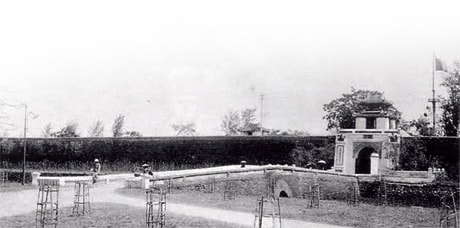 |
| The ancient Vinh Citadel gate in 1929. Photo: Tran Dinh Quan (Archive). |
In 1974, with the assistance of experts from the German Democratic Republic, Vinh City was re-planned on a large scale and in a scientific manner for the first time. With a far-sighted vision, the Vinh City plan designed by German experts placed particular emphasis on preserving ancient historical sites and landmarks that had left their mark over time. Among these, the Vinh Citadel was proposed to be restored to its original form to serve as a cultural and environmental highlight for the city.
Architect Tran Anh Sinh, Head of Planning Department 1 of the Nghe An Institute of Architectural and Construction Planning, said: “Back then, the population of Vinh City was sparse, but German experts planned very wide traffic routes. Thanks to such scientific calculations and long-term vision, Vinh is now the city with the most spacious and well-maintained roads in the country. Although the population of Vinh City has now reached nearly half a million people, there is no traffic congestion like in many other cities. In particular, when surveying the planning of Vinh City, the German experts carefully considered many factors. In addition to cultural, social, and economic factors, they also scientifically calculated physical and climatic issues.”
According to the original design by German experts in 1974, they calculated that Nghe An province is affected by very hot Lao winds in the summer. Therefore, Vinh City was planned in a "hand-shaped" model, developing towards the north to receive the cool, humid air currents when the Lao winds blow from the southwest across the Lam River. In addition, the city needed green spaces and lakes to regulate the climate in each area. Thus, the central area of Vinh City (shaped like a palm) comprises the wards of Le Mao, Quang Trung, Hung Binh, Le Loi, Truong Thi, etc. The main "fingers" are the roads radiating northward, such as National Highway 1A, Nguyen Van Cu Street, Ha Huy Tap Street, and Le Nin Boulevard. Along both sides of these "finger-shaped" roads are commercial streets, while the areas interspersed between the "fingers" are green spaces, parks, lakes, and villas with gardens. With this concept, as the population grows, Vinh will not be limited by land area but can continue to gradually expand outwards along the "fingers" and the city's ring road, while still ensuring the environmental and climatic factors as originally designed.
From the early 1990s to the present, the rapid development of Vinh City, coupled with the arbitrary actions of many citizens and even some state management agencies, has led to serious violations of urban planning regulations. The Vinh Ancient Citadel Park project, approved long ago, has yet to be implemented due to the excessive and chaotic construction of houses by residents. Many plots of land and lakes in other areas, originally designated as green spaces to regulate the climate and create a pleasant urban landscape, have also been encroached upon and allocated to organizations, individuals, and businesses.
Many areas were planned as villa and garden neighborhoods, creating spacious living spaces that would harmonize with the city, but instead, they were divided into plots for sale, resulting in cramped and suffocating concrete houses built close together. Numerous real estate projects sprung up with designs that maximized land use for profit without ensuring social welfare issues such as parking spaces and recreational areas. This left residents feeling trapped within four walls, constantly encountering traffic upon stepping outside their doors. The elderly and children could only sit on upper floors, looking out the windows at the bustling streets, unable to find a place to play or relax. The dizzying pace of construction is causing the city to become completely concreted, and its traditional cultural features are gradually being buried in the past.
In recent years, efforts to preserve and restore historical relics have begun to receive attention, but they are still too limited. Apart from Hong Son Temple, which has been preserved relatively intact compared to its original state, most others are ruins. Diec Pagoda, the largest and most famous ancient pagoda in the region, now only has its gate remaining, its entire vast grounds encroached upon for commercial purposes; Vinh Confucian Temple, a symbol of Nghe An's culture of learning for generations, has been razed to the ground, and despite years of planning for its restoration, it has yet to be implemented; Vinh Ancient Citadel, a unique architectural landmark and a highlight of the city, has yet to be developed after three planning adjustments…
“Recently, the Provincial People's Committee hired Japanese experts to revise the Vinh City master plan towards 2030 and with a vision to 2050. According to this plan, which has been approved by the Government and recently announced, the Japanese experts still based their work on the design previously created by German experts, of course expanding the area significantly due to societal development needs. However, one problem is that the Japanese architects mainly focused on infrastructure development rather than prioritizing the preservation of cultural buildings. Furthermore, according to this plan, many items require very large investments that our current resources cannot meet,” said architect Tran Anh Sinh.
To rediscover the charm of old Vinh, perhaps the only option now is to look to precious historical photographs, such as a photograph of Vinh Citadel taken in the early 20th century by a Frenchman. In this photograph, the citadel still retains its entire six-sided wall perimeter, surrounded by a river as beautiful as a plum blossom. Looking at this picture, one might wonder how valuable it would be if we could restore the citadel to its original form and build cleaner, more orderly neighborhoods around it. Or consider the photograph of Vinh Confucius Temple taken in 1929 by Tran Dinh Quan, which looks truly magnificent, with its two-tiered main hall, a wide courtyard in front, and symmetrical side wings – a beautiful symbol of learning in Nghe An province. How wonderful it would be if it could be restored sooner. Furthermore, characteristic images of old Vinh can also be found in photographs such as the Ben Thuy ferry with its bustling trading port; and the Truong Thi railway factory, a symbol of the industrial development of that era. Guest Street (a street frequented by Chinese, Indian, and French people) symbolizes the trade and interaction between Nghe An province and foreign countries…
Although architectural structures, temples, pagodas, houses, and even bricks, no matter how durable, cannot last forever, their images can be preserved if people know how to maintain and preserve them. Looking at old photographs of many architectural landmarks in Ho Chi Minh City from decades ago, even over 100 years ago, such as Notre Dame Cathedral, Turtle Lake, Ben Thanh Market, Binh Tay Market, the City Theatre, Nha Rong Wharf, the Western District Palace (currently the headquarters of the Ho Chi Minh City People's Committee), the Telegraph Office (now the Ho Chi Minh City Post Office)... they still retain their original charm.
"The imprint of time lies in the profound cultural features, in preserving the memories and recollections of the city's inhabitants, and that's what truly attracts tourists, not the newly built high-rises," my friend who returned from Russia for Tet shared...
Hoang Hao - My Ha


