Find the optimal solution.
(Baonghean) - Relocating and resettling residents in areas prone to natural disasters and landslides is one of the urgent issues aimed at protecting lives and property; more importantly, it helps people stabilize their lives. However, implementing this policy in our province still faces some difficulties and obstacles that need to be overcome…
(Baonghean) - Relocating and resettling residents in areas prone to natural disasters and landslides is one of the urgent issues aimed at protecting lives and property; more importantly, it helps people stabilize their lives. However, implementing this policy in our province still faces some difficulties and obstacles that need to be overcome…
Our province is located in a region frequently affected by natural disasters such as storms, floods, flash floods, and landslides. Therefore, from 2006 to 2015 (up to 2020), the central government allocated over 2,400 billion VND for 25 relocation projects to resettle 30,722 households in 95 communes across 9 districts. To date, 8 projects have been completed, 13 projects have been allocated funding for implementation (4 projects have not yet received funding); 1,706 households have been relocated, including 990 households relocated under concentrated projects and 716 households relocated through integrated, mixed-use projects away from areas prone to natural disasters, floods, and dangerous landslides. It can be said that this support has helped people avoid and mitigate the calamities caused by natural disasters, especially creating conditions for people in areas at risk of natural disasters and landslides to live stable lives.
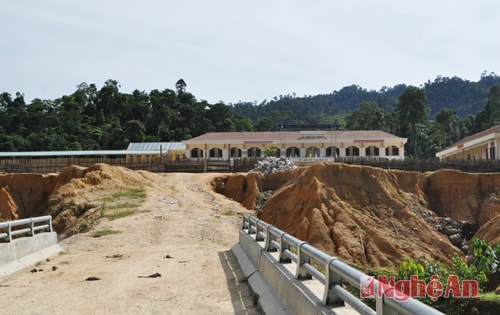 |
| Landslide in front of Dong Van Secondary School - a resettlement site for the Hua Na Hydropower Plant, Que Phong. |
However, the implementation of Government Decision 193 in Nghe An still faces some shortcomings and obstacles. The allocation of funds is too small and fragmented, leading to extremely slow progress. Decision 193 was issued in 2006, but some projects, such as those in Keng Du commune (Ky Son district) or Lang Khe commune (Con Cuong district), were only approved in 2011 and allocated funds in 2013. Even now, they are only at the land leveling stage and have not yet relocated a single household. In some places, even after approval and allocation, the funding is very limited. The resettlement project in Khe Linh, Keng Du commune, has a budget of 47.736 billion VND, but only 4 billion VND has been disbursed, reaching only 8.4%. Several other projects in Ky Son district, although approved in 2011, have only recently received funding and are beginning implementation. Additionally, two projects have been approved but lack funding. Similarly, the resettlement project in Pieng Puc village, Lang Khe commune, Con Cuong district, with a budget of 63.577 billion VND, received only 13.2 billion VND between 2011 and 2013, reaching 20%. The Binh Chuan resettlement area project, with a budget of 26 billion VND, has only received 15.8 billion VND to date. Due to insufficient funding, only enough funds have been allocated for road construction and land leveling in the resettlement area; no other projects have been completed.
Mr. Nguyen Dinh Thanh, Head of the Economic Development and Resettlement Board of Con Cuong District, said: "When people learned about the project, which offered better living conditions, water sources, and production opportunities than their previous location, they were very happy and eagerly awaited its completion. However, after the land leveling was completed, the project had to be halted due to a lack of funds, causing people to lose faith. Currently, because their old homes are unsafe, the people and the district hope that the government will allocate funds to bring electricity to the resettlement area so that people can live there temporarily."
The situation in Ky Son and Con Cuong is also the general situation of the province. Although the central government has shown concern by allocating 2,408.3 billion VND as mentioned above, in reality, from 2006 to 2013 only 315.44 billion VND was allocated, including 235 billion VND from the central budget and 80.44 billion VND from the local budget, reaching only 11%. Due to limited funding, the progress of projects is very slow, with the average volume only reaching 10%, and to date only 1,706 households have been relocated, achieving 7.8% of the need.
Upon investigation, it is encouraging and fortunate that although the rate of relocation of people from dangerous areas is not high, there have been no casualties or property damage in these locations. However, natural disasters in mountainous areas are not uncommon, exemplified by the historic flood in Muong Xen town (Ky Son district) in 2011; or the flash flood in Nam Giai (Que Phong district) in 2007, which caused very heavy damage. Statistics from the Provincial Steering Committee for Flood and Storm Prevention and Control show that from 2006 to the present, the province has experienced 288 natural disasters, storms, and floods, resulting in 245 deaths, nearly 2,000 houses destroyed or damaged, and estimated material property damage exceeding 11 trillion VND. These serve as cautionary lessons for the people to proactively prevent and mitigate disasters.
Upon investigation, relocating each household from disaster-prone and landslide-prone areas through concentrated projects requires a significant investment, averaging 500-700 million VND per household. Some projects, such as the one in Lang Khe, cost 63.57 billion VND, relocating 56 households; and the project in Keng Du, cost 47.73 billion VND, relocating 50 households, averaging around 1 billion VND per household. This doesn't even include the emergency flood and flash flood evacuation project for residents along the riverbanks in Ky Son, with a budget of 380 billion VND, relocating 450 households, which some consider unfeasible.
The reason for the high investment cost of concentrated resettlement projects is that they are located in extremely difficult areas. A typical example is the project in Keng Du commune; after traveling 73 km from Muong Xen town to the commune center, residents still have to walk more than 7 km to reach the resettlement area. A representative from the Ky Son District People's Committee frankly stated: One of the requirements for concentrated resettlement areas is a water source for residents' daily needs. Because a more distant location had to be found, in addition to essential community infrastructure, access roads had to be built, thus increasing the total investment cost. This doesn't even take into account the high labor and transportation costs due to the remote location, leading to increased material prices…
Mr. Bui Tram, Chairman of the Ky Son District People's Committee, stated: The State needs to be decisive and prioritize allocating sufficient resources to approved projects to ensure their timely implementation; on the other hand, priority should be given to resettlement through mixed relocation and relocation plans, and funding should not be allocated to unapproved projects, instead integrating them with the new rural development program. Given the extremely limited budget, to ensure the safety of the people, the province and districts have, in recent times, integrated funding through hydropower resettlement projects and permanent settlement programs, thus successfully relocating a relatively large number of households. Practical experience has shown that, with a relatively small budget, averaging 20 million VND per household, the mixed-use model has been the fastest way to relocate people to new homes, meeting urgent needs. Examples include the mixed-use residential projects in Ta Ca, Huu Kiem, and My Ly communes (Ky Son district) and Cam Lam and Binh Chuan communes (Con Cuong district). These experiences should be replicated, provided the locality has available land, neighbors are willing to donate land, and the financial support for house construction is sufficient. However, for poor households, it is very difficult to provide a better living environment than their previous one.
Given the above situation, on the one hand, while continuing to petition the Central Government to promptly supplement funding for Nghe An to implement approved projects on schedule, the province is reviewing areas frequently affected by natural disasters and landslides. Areas that no longer pose a risk will be removed from the plan, while resources will be allocated to support local authorities in relocating residents using integrated and mixed-use plans. According to Decision 1776/2012/QD-TTg supplementing Decision 193/TTg, from 2013, if residents in disaster-prone areas are relocated using a mixed-use plan, each household will receive 50 million VND; of which 20 million VND goes to the family and 30 million VND goes to the commune where infrastructure is built (the province has not yet balanced the resources, so this has not been implemented). On the other hand, the province is also reviewing projects, prioritizing urgent relocation projects. Projects that have already been implemented will receive focused funding to complete them, while projects that have not yet been implemented will not receive funding.
Text and photos:Nguyen Hai