
Finding a market for organic vegetables.
Safe vegetables are a top concern for homemakers today. In fact, for many years, the Ministry of Agriculture and Rural Development has been directing some vegetable production areas towards VietGAP standards to increase the area of safe vegetables. However, to date, vegetables grown according to these standards are still struggling to find their place in the market.
Farmers don't like growing organic vegetables.
According to the Vietnam Academy of Agricultural Sciences, the total area for vegetable cultivation nationwide is 823.7 thousand hectares, yielding a total production of 14 million tons per year. Approximately 85% of vegetable production is consumed domestically, and 15% is exported. However, the area of certified VietGAP-certified clean vegetable cultivation only reaches 14,500 hectares. The number of vegetable samples on the market found to have pesticide residues exceeding the permitted limits accounts for 5-7% of the total production.
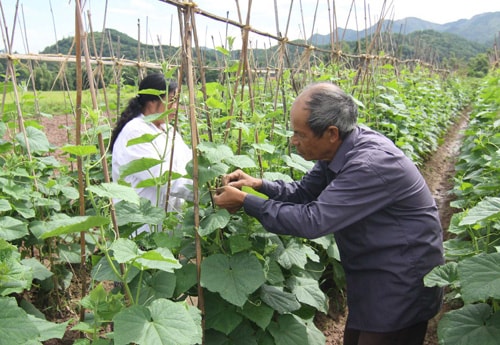 |
| A model of growing baby cucumbers according to VietGAP standards in Gia Cat commune, Loc Binh district, Lang Son province. Photo: Vu Sinh – VNA |
In reality, the demand for safe vegetables is huge, but expanding the cultivated area still faces many difficulties. According to Mr. Nguyen Van Minh, Deputy Chairman of the Van Duc Agricultural Service Cooperative (Gia Lam district, Hanoi), the VietGAP-standard vegetable production model has not yet attracted farmers. The reason is that this production method requires strict technical requirements: ensuring origin, keeping field diaries from planting and caring for the crops to harvesting. Meanwhile, the selling price is not higher than other vegetables on the market.
"To grow vegetables according to VietGAP standards, farmers have to invest more effort and the costs are 10-15% higher compared to growing vegetables using conventional methods, however, the selling price is not higher," Mr. Nguyen Van Minh affirmed.
Similarly, Mr. Dang Ba Thang, Chairman of Dai Lan Cooperative (Thanh Tri District, Hanoi), said that because farmers are not enthusiastic about growing clean vegetables, after nearly 4 years, the area of vegetable cultivation according to VietGAP standards has only reached about 20 hectares, accounting for a very small percentage compared to the area of conventional vegetable cultivation. In fact, many households have abandoned growing safe vegetables and returned to growing them using conventional methods. Finding markets for clean vegetable products remains very difficult. Farmers mainly sell their products through traditional channels such as wholesale markets and stores.
Links to identify clean vegetables
The demand for safe vegetables is very high, but it is difficult to distinguish between safe, quality-tested vegetables and ordinary vegetables. Furthermore, due to overlapping management responsibilities, the vegetable market in Hanoi and some other major cities often lacks control over the origin and quality of vegetables.
Vegetable production according to VietGAP standards must meet 4 criteria:
+ Criteria for production techniques that meet standards.
+ Food safety criteria include measures to ensure there are no chemical, bacterial, or physical contaminants during harvesting.
+ Criteria regarding a working environment suitable for the labor capacity of farmers. + Criteria regarding the origin of products from production to consumption.
(Source: Ministry of Agriculture and Rural Development)
According to Ms. Nguyen Thi Xuan Thu, Deputy Minister of Agriculture and Rural Development, many clean vegetable production models fail because the products are not recognized by consumers and the distribution network is not widespread enough.
“There needs to be a way to identify and distinguish safe vegetables from other types of vegetables to build consumer trust. Many countries have established a system of standards to recognize safe vegetable programs and disseminate this certification program to consumers. This is a necessary step to help consumers increase their awareness of safe products,” Ms. Thu commented. Although production according to VietGAP standards still faces many difficulties, it is a solution to improve the quality of vegetable products, protect the environment… to meet the increasingly high demands of consumers, thereby increasing added value and the efficiency of agricultural production.
According to Ms. Nguyen Thi Kim Oanh, Head of the Transaction Department (Hanoi Safe Vegetable and Food Exchange), to develop vegetable production according to VietGAP standards, in addition to investing in production, more attention needs to be paid to addressing the market for clean vegetables through organizing a distribution network. Support from the State is needed to establish a market for VietGAP-certified vegetables and fruits.
"To effectively organize the production and consumption of vegetables according to VietGAP standards, there must be close cooperation between the State, farmers, scientists, and businesses," proposed Ms. Nguyen Thi Tan Loc, M.Sc., from the Institute of Vegetable and Fruit Research.
According to the News


