
Rediscovering Identity
(Baonghean) - Con Cuong is one of the localities recognized for its many efforts in preserving and promoting ethnic cultural identity, including the preservation of folk songs and the "revival" of traditional stilt house architecture of the Thai people.
The "source of the stream" flows on forever.everywhere...
We were in Cang village, Mon Son commune, on the night of a cultural and artistic exchange between the villagers and a team of volunteer students from several universities in Hanoi. The village and surrounding mountains echoed with the sounds of traditional music; the lively sounds of the xòe dance, the sạp dance, and the khắc luống and tăng bu dances; the resonant sounds of gongs, cymbals, flutes, and pipes... At the end of the exchange, everyone joined hands to dance in a circle, enthusiastically enjoying the captivating lam vông dance.
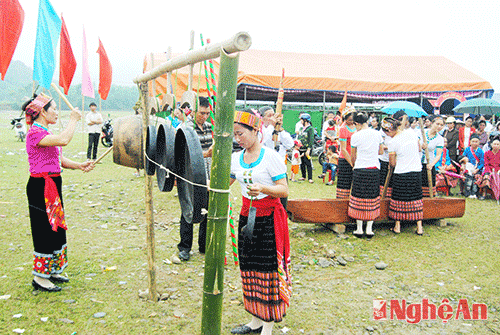 |
| The Folk Song and Musical Instrument Club of Cang village (Mon Son commune, Con Cuong district) performs at the Mon Son - Luc Da Festival. Photo: Cong Kien. |
Mr. Luong Van Nghiep, the head of the Cang Village Folk Song and Musical Instrument Club and a prominent artisan, stated that the club was established in 2010 with 13 initial members, and now has 37 members. The club also serves as a traditional music teaching center, where artisans act as instructors, passing on knowledge and experience to younger generations, fostering continuity and connection between generations in preserving and promoting the valuable musical heritage of their ancestors. In recent years, the Cang Village Folk Song and Musical Instrument Club has become a key player in the local cultural and artistic movement, participating in festivals and exchanges at both the district and provincial levels. Recently, the club was selected by the Provincial Cultural and Sports Center as a model example in the preservation and promotion of traditional folk music. Hopefully, this will be an opportunity for the club to capitalize on its strengths, overcome difficulties, and move towards sustainable existence and development.
In a conversation with Ms. Vi Thi Mo, the head of the Nua Village Folk Song and Instrument Club (Yen Khe commune), she stated that this club was the first of its kind established in Con Cuong district (in 2008), serving as a model for other localities in the district to learn from and replicate. Despite the difficulties in its operations, a major advantage is that since 2011, Nua Village has been recognized by UNESCO as a community tourism destination, thus receiving encouragement and attention from various levels and sectors. In particular, the Pu Mat National Park Management Board has provided 2.5 million VND to support training, costume purchases, and props. Whenever tourist groups need cultural exchange and want to learn about local culture, they are often referred to Nua Village. This provides the club with some additional funding for its activities and opportunities for performances. Established in 2007, the Khe Rạn Folk Song and Instrumental Club currently has 23 members.
When it was first established, the club's members were mainly elderly people, but now many younger generations have joined. The Bong Khe commune leadership provided 20 million VND to purchase musical instruments. Each member voluntarily contributes 100,000 VND per year to fund its activities. Recently, when families in the area hold weddings or housewarming parties, the club is often invited to perform, and the money earned is added to the club's operating fund. Currently, some children of the villagers have graduated from cultural and artistic schools, and talented students with a passion for traditional music are participating in the club's activities, thus fostering a connection between generations. After 7 years of operation, the club has truly become a core of the commune's cultural and artistic movement, with some members participating in the Con Cuong District Amateur Arts Troupe at provincial-level festivals and competitions.
Speaking with us, Mr. Vi Van Kim, Director of the Culture and Sports Center of Con Cuong District, affirmed: “The Thai ethnic group accounts for about 70% of the district's population, so the establishment of Thai folk song and traditional musical instrument clubs is extremely welcome. The number of 15 clubs reflects the efforts of local authorities and the cultural sector. These clubs have made important contributions to the preservation of ethnic musical identity, especially in the timely collection of folk songs and ancient folk dances from elders, rekindling the passion of artisans.”
The architectural "revival".stilt house
Stilt houses are a cultural "specialty" of the Thai ethnic group. For a time, Con Cuong also experienced a "loss" of stilt houses, like many other localities. Fortunately, recently, there has been a movement among the people in the district to restore this traditional stilt house architecture...
Khe Ran village (Bong Khe commune – Con Cuong district) has 158 households, with 105 stilt houses. These ancient stilt houses nestle on the hillside, under the palm trees, creating a picturesque scene in this village along the Lam River. On the right bank, across the river, is Con Cuong town, currently undergoing transformation into a "mountain town." This small, purely Thai village stands out as a charming highlight beside the highland town. Village head Ha Van Inh explains: "Before, Khe Ran village was called Ken village, and people were only accustomed to living in stilt houses. New houses have only been built about twenty years ago. Most people in the village grew up in stilt houses. There was a time in the 1980s and 90s when many families in the village favored modern styles, selling their stilt houses and building brick houses. So, the stilt houses were transported by car to the lowlands. After five or ten years living in brick houses, the villagers realized they were no longer suitable for their community's lifestyle." Many people want to rebuild their stilt houses, but unfortunately, wood in the forest is scarce. To get wood for building a house, they have to go deep into the forest or buy it from elsewhere, costing hundreds of millions of dong.
Recently, in Khe Ran village, stilt house architecture is experiencing a revival. Lacking wood, the villagers have chosen to build stilt houses using concrete pillars. Even the beams and rafters are made of concrete, with only a few components like purlins and rafters made of wood. The readily available concrete building materials make the cost affordable for many households in the village. Each completed concrete stilt house costs approximately 100 million VND. This is a considerable sum, but many households have chosen to borrow from the Social Policy Bank or the District Agricultural Bank to finance the construction. It seems that "concretization" is becoming a way for stilt houses to be revived. In Khe Ran village, immediately after the spring harvest, the villagers actively rebuilt their stilt houses. Currently, more than 10 households in the village are constructing concrete stilt houses. Village head Ha Van Inh added: "The demand for stilt houses among the people remains very high. It won't be long before all the houses in the village will be able to build stilt houses." However, this year the village only allowed 10 households to participate. According to the village regulations, when a family builds a new house, each household must contribute at least 3 days of labor. If too many houses are being built, the villagers will have to help more, which will affect overall production. Currently, dozens of wooden houses in the village are being renovated. Wooden houses are easy to assemble and disassemble, so most of the components can be replaced or repaired. Renovating old stilt houses not only saves families money but also contributes to preserving traditional houses, which are becoming increasingly rare in villages where almost 100% of households live in stilt houses. Mr. Ha Van Hong recently renovated his house, which is nearly 40 years old. The house retains its original architecture; the owner only raised the level and repainted the wooden structures. Mr. Hong said: "I'm originally from the Thai ethnic group, and I'm very proud of my stilt house. This house has been a part of my life since childhood, so I decided to renovate it rather than build a new one."
In Chi Khe commune, the movement to restore traditional stilt houses has been booming in many villages over the past few years. Especially in 2011 and 2012, in purely Thai villages like Nam Dinh, Son Khe, and Tong Chai, dozens of stilt houses were rebuilt, with many people choosing concrete structures. Commenting on the concrete stilt houses in Con Cuong, Mr. Hoang Van Thuyen, a resident of Tri Le commune, Van Quan district (Lang Son province), said during a visit: “This is a commendable approach that other places should learn from. Even though they are made of concrete, the traditional stilt house architecture is preserved. This method can also help protect the forest because building a traditional stilt house consumes a lot of wood.” The only concern is that the stilt house restoration movement in Con Cuong is happening spontaneously. The importance of promoting the role of stilt houses has only been mentioned in a tourism development plan approved in 2013.
It is known that in 2013, the People's Committee of Con Cuong district issued the Project "Preservation, preservation and promotion of the cultural identity of the Thai ethnic group in the period 2013 - 2017 with consideration to 2020"; the total estimated budget was approximately 7 billion VND, of which 300 million VND was allocated for teaching the crafting and use of traditional musical instruments; 300 million VND for collecting, preserving, and storing artifacts, musical instruments, tools, and jewelry; 300 million VND for establishing folk song and traditional musical instrument clubs; and 1.5 billion VND for restoring some traditional stilt houses. Thus, this will be a significant source of funding to help the clubs operate in an organized and increasingly effective manner, and will also serve as a driving force to further promote the revival of traditional stilt houses of the Thai people.
Tuong Anh - Huu Vi