
Long-term strategy for seafood exports
(Baonghean)Despite its potential advantages, the province's seafood exports are facing numerous challenges. Export turnover is small, unsustainable, and to date, no sufficiently strong solution has been implemented to give this product a significant boost.
Nghe An is considered a province with significant potential in the marine economy, boasting an 82 km long coastline, a sea area of 4,230 square nautical miles, and six estuaries along the coast (Cua Hoi, Cua Lo, Van, Thoi, Quen, and Con). Additionally, the coastal area has 3,500 hectares of brackish water suitable for aquaculture. However, seafood export revenue currently falls short of the province's status as a "key export item" and its potential; there is also a lack of strong linkage between production, processing, and the market.
According to compiled data from the Department of Industry and Trade, in 2013, seafood export turnover reached 22 million USD. In 2014, the turnover of this commodity decreased sharply, reaching only 10 million USD. In the first five months of 2015, seafood export turnover in the province reached nearly 7 million USD (with more than 4,000 tons of production), of which Xuri Viet Trung Seafood Processing Company Limited accounted for nearly 6 million USD, with the remainder handled by Phuong Mai Enterprise (Hoang Mai).
According to Mr. Vo Minh Tuan, Deputy Head of the Import-Export Management Department of the Department of Industry and Trade, favorable natural conditions for fishing and aquaculture, and relatively high and stable global market demand are advantages for the province's seafood exports. However, in reality, the export value of this commodity is very modest and unstable; the products are monotonous. The quality management system and investment in packaging, trademark registration, and origin of goods are still weak. Most processed products have low economic value, and there are no high-value items or brands in the domestic and export markets.
Van Phan Seafood Joint Stock Company in Dien Ngoc, Dien Chau district, with its established Van Phan fish sauce brand, sells approximately 2 million liters of fish sauce annually. However, the lack of diverse packaging designs makes exporting a challenge. In 2012, for the first time in Nghe An province, a shipment of 1,800 liters of Van Phan fish sauce was exported to Malaysia, but this "feat" has yet to be repeated.
Mr. Vo Van Dai, the company director, said that besides the domestic market, they are focusing on exports, but it is not easy. To export fish sauce to foreign markets, in addition to strict requirements regarding hygiene and food safety, the fish sauce must be delicious, fragrant, of high quality, and have the required protein content. Therefore, to meet market demands, the company is currently investing around 500 million VND to install a packaging line.
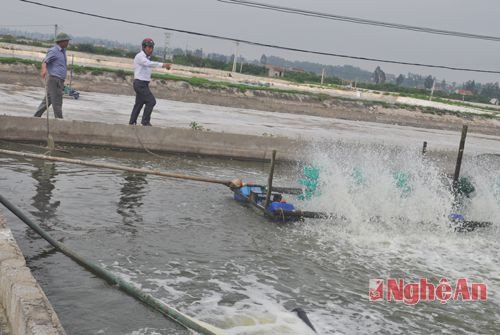 |
| Despite having a relatively large area for brackish water aquaculture, the farmed products are not yet included in the province's annual export list. |
In reality, the province's seafood products have not yet been exported to EU, US, and Japanese markets because these markets have strict requirements for controlling chemical residues, food safety and hygiene, and preservation techniques. Meanwhile, seafood businesses are mostly small enterprises with weak machinery and equipment for production, processing, and preservation. Consequently, the number of businesses participating in official seafood exports in Nghe An is very small; currently, only two companies, Xuri Viet Trung Seafood Processing Company Limited and Phuong Mai Company Limited, have export shipments.
Previously, the province had two large-scale frozen seafood processing companies: Nghe An Seafood Import-Export Joint Stock Company II, with a capacity of 8-10 tons of products per day, meeting the standards for export to demanding markets such as the EU and the US; and Nghe An Seafood Import-Export Joint Stock Company with a capacity of 5-6 tons per day. However, Nghe An Seafood Import-Export Joint Stock Company II has now been dissolved, and Nghe An Seafood Import-Export Joint Stock Company II is operating in difficult circumstances.
At the end of 2013, Royal Foods Group of Thailand commenced construction of a canned fish processing plant (Royal Foods Nghe An) with two production lines capable of processing over 100 tons of fish per day. The province's seafood exports are pinning their hopes on this project, but currently the investor is only implementing the construction items according to the investment registration, and no products have yet been released to the market.
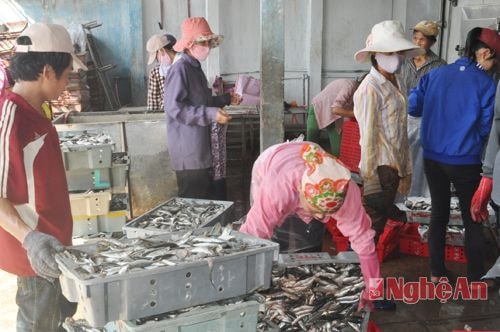 |
| Fishermen in Cua Lo prepare their goods for export to China. |
According to feedback from businesses, the province's seafood raw material supply is fragmented and insufficient to meet large orders; the types of seafood exported through official channels are also limited. Regarding this issue, Mr. Le Thai, Director of Xuri Viet Trung Processing and Packaging Co., Ltd., shared: The company's product is fishmeal exported to the Chinese market. In the first five months of this year, the company's export turnover reached 6 million USD. In 2014, the turnover reached 10 million USD, and the goal is to reach 15 million USD this year. However, the current difficulty is the lack of raw materials for processing and export. The main raw materials are various types of fish such as herring, anchovies, and spotted fish, but at many times, there isn't enough locally available for processing, so we have to collect them from Quang Binh and Ha Tinh provinces. "The output isn't difficult; we can sell everything, but the problem is the lack of raw materials. For example, we are currently having to stop production because we don't have any fish," Mr. Thai said.
Mr. Nguyen Trong Hung, Director of the Nghe An Trade Promotion Center, said: Businesses complain about a lack of orders, but when orders do come in, they cannot fulfill them. We have participated in trade promotion activities to Malaysia and Singapore, and all the businesses we connected with were uninterested, citing reasons such as insufficient supply, inadequate quantity, and inability to meet preservation requirements. There is a lack of businesses in the province that have developed systematic export strategies; most only purchase goods when orders are received, rather than proactively surveying market demand to guide long-term business strategies. Furthermore, businesses in the province have not yet met the requirements of large markets, so the province's official exports mainly consist of fishmeal for livestock feed. A significant amount of seafood, mostly specialties (white pomfret, shrimp, crab, etc.), is exported through unofficial channels.
Currently, regional raw material planning for the processing industry of agricultural, forestry, and aquatic products has been developed and approved. The province has also adopted a policy of focusing investment on a number of export products through several export-oriented programs and projects such as tilapia farming, shrimp farming, and tilapia farming, but these products are still absent from the province's export list. The majority of the export value achieved in the first five months of 2015 was fishmeal; Nghệ An's seafood is currently only exported to a few markets such as China, Laos, and Malaysia.
Over the years, aquaculture has become a highly profitable industry per unit area, attracting many people to participate in farming and production in coastal districts and towns. The quality and efficiency of aquaculture and fisheries are increasing; farming methods and species are becoming more diverse. Total annual seafood production has grown considerably, but export revenue remains low. According to the plan, in 2015, exports of 1,500 tons of various seafood products were targeted, achieving a revenue of 15 million USD. This is not an unattainable goal, but to fully utilize the potential advantages and sustainably develop the seafood processing industry requires a comprehensive solution from farming, fishing to source raw materials, processing and food safety, market research, and strong collaboration between managers, businesses, and farmers. The industry and trade sector, and the fisheries sector, must consider the long-term perspective. Clearly identify specific seafood export groups, so that development plans and strategies can be focused and investments made, avoiding a scattered and fragmented approach.
Thu Huyen


