
The spirit of the people of Nghe An
(Baonghean) - Nghe An province is praised by people all over the country as a region of picturesque landscapes. This beauty leaves a deep impression on anyone who has ever visited this land of "green mountains and blue waters like a painted picture." Many talented individuals have been born here, bringing glory to their homeland and country. And this very land of "Lao winds and white sands" is also the cradle of the famous folk songs and melodies that have resonated throughout the world, ever since Nghe Tinh folk songs were recognized by UNESCO as a Representative Intangible Cultural Heritage of Humanity.
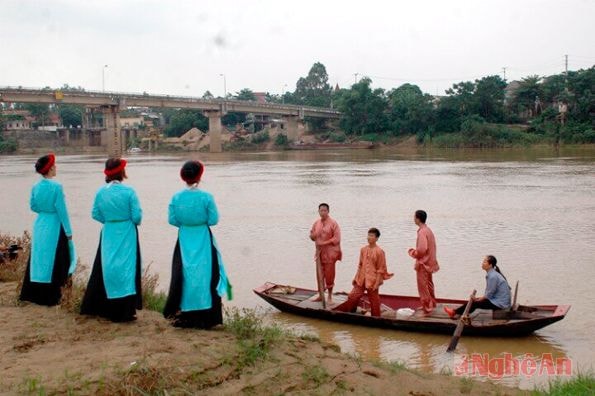 |
| Folk singing on the Lam River. Photo: Xuan Tam |
The beautiful land gives rise to the beautiful folk songs.
On the S-shaped strip of land that is Vietnam, Nghe An province lies at the crossroads between the two ends of the country. This land, constantly battered by the hot, dry winds of Laos and covered in white sand, boasts a picturesque landscape of mountains and rivers. Amidst the endless mountain ranges, the sea, and the fertile, alluvial rivers, folk songs and melodies rise alongside the activities of production. Remarkably, wherever the Lam River flows, the people live peacefully, with lush green cornfields and mulberry plantations. And there, villages specializing in weaving, silk spinning, cotton cultivation, and bustling trade on the docks and boats emerge. This setting further infuses the folk songs and melodies with warmth and charm.
In the folk songs of Nghe An province, we can easily encounter images of moonlit nights, young women spinning silk, weaving cloth, and confiding in young men with sincere, heartfelt, and simple songs: “There are plenty of jasmine and plum blossoms, yet you prefer out-of-season sweet potato flowers? Sweet potato flowers endure sun and rain, while jasmine and plum blossoms wither before noon” or “Salt remains salty even after three years, ginger remains spicy even after nine months. Our love is deep and our bond strong, even if we are far apart, thirty-six thousand days will not separate us.” And on the Lam River, a young woman from Nghe An, wearing a conical hat and brown áo dài, rows a boat while singing melancholic songs: “Who knows whether the Lam River's water is clear or muddy? Only then will one know whether life is shameful or glorious. My boat goes up the rapids and down the waterfalls, the land and water represent our meaning and our love, my dear…”
What makes the "ví" and "giặm" folk songs unique compared to other folk singing activities in different regions is that this call-and-response singing style originated in labor and production, yet it attracted the active participation of intellectuals, scholars, and patriotic intellectuals such as Nguyen Du, Nguyen Cong Tru, Nguyen Huy Quynh, Dinh Viet Than, Phan Boi Chau, and Vuong Thuc Quy… The great poet Nguyen Du was famous for his exchange with a girl from the Truong Luu weaving village when he accidentally tripped and fell in front of her house: “Come here to sing and make friends / Why bow and worship in front of the house? - What strange land is this / It doesn't like standing, but it lets you lie down…” Or the exchange between Phan Van San (the top scholar, also known as Phan Boi Chau) and a girl from the Nam Dan weaving village: “Give me a handful of roasted corn / Where did it grow? I'll burn incense and invite you home. - Where the sun never dries / And the rain never wets, it grows immediately…”
The power supply flows continuously.
The roots of Nghe Tinh folk songs, particularly the Ví and Giặm styles, stem from the working life of the people. Perhaps that is why they possess such enduring vitality throughout the ages. The image of farmers with muddy feet and hands, working year-round in the fields stretching as far as the eye can see, leisurely leading their buffaloes back to the barn in the hazy evening smoke…; in the evening, sitting together over a warm, fragrant cup of green tea, chatting, the men smoking tobacco, the women spinning silk and weaving until late at night… These folk melodies originated from there. Initially, they were just simple, call-and-response songs, close to everyday life. Later, they were performed by the people themselves on occasions like birthday celebrations at the beginning of the year, village festivals… Then, over time, folk songs became the main theme of cultural exchanges and arts festivals. Especially the "Village of Sen" movement, which for decades has become a widespread movement among the people from the commune to the district, province, and has spread to many other localities nationwide.
Mr. Nguyen Yet Niem, Chairman of the Hong Son Folk Song Club (Quynh Luu) - the club that won first prize at the first Folk Song and Music Club Festival in 2011 - said: “From a burning passion, every Sunday evening, our club holds regular meetings. Year-round, rain or shine, we meet regularly. Those elderly who can't come themselves are driven by their children or grandchildren. The members come from diverse backgrounds: some are vendors at the market, some work diligently in the fields, some are retired officials… but they all share a passion for the folk songs of our homeland.”
 |
 |
 |
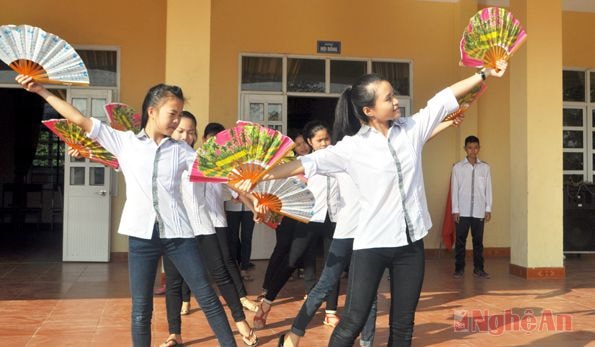 |
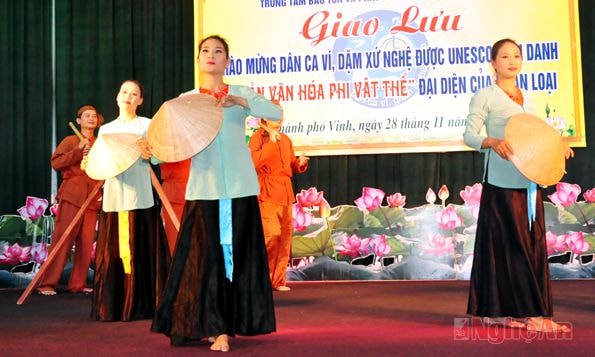
| Some images of the Ví and Giặm folk songs. Photo: PV |
Currently, Nghe An province has 80 active folk song clubs in 15 districts, towns, and cities along the Lam River and in the plains (excluding the high mountainous districts: Tuong Duong, Ky Son, Quy Chau, Quy Hop, and Que Phong). Some clubs have a long tradition of activity. Districts with a relatively large number of Nghe An folk song clubs include Dien Chau, Do Luong, Nghi Loc, and Thanh Chuong...
Through the activities of these clubs, folk songs are nurtured by the burning passion of honest, hardworking people. There, we easily find elderly men and women with white hair still teaching their children and grandchildren songs passed down through generations. Although their voices may no longer be clear and melodious, it is these elders who have "ignited the flame" in today's youth. A prime example is Mr. Dinh Nhat Tan (Dien Thai - Dien Chau), who not only initiated the Dien Thai Folk Song Club – one of the strongest clubs in Dien Chau district today – but his passion for folk songs has also attracted all three of his children to participate.
Furthermore, composing songs using elements of the Ví and Giặm folk songs is also a way to continue and make folk music show its strong vitality and charm in a new context. “Immersed in folk songs / The Ví and Giặm folk songs make our lives more vibrant / Life is a purification of the impure / More than 60 springs have passed / Oh life, so many storms / Nestled in folk songs, I express my feelings” (excerpt from a composition by artisan Chu Văn Tỵ (70 years old), Deputy Chairman of the Cát Văn Folk Song Club - Thanh Chương, who has composed more than 50 folk songs to serve the mass art movement, contributing to preserving and promoting the traditional values of Nghệ Tĩnh Ví and Giặm folk songs).
Passing on folk songs to the younger generation is the most important task in preserving and promoting the folk song heritage of Ví and Giặm. We still vividly remember the image of the two brothers, Nguyen Thanh Cong (8th grade student) and Nguyen Quoc Bao (6th grade student) from Lang Sen Secondary School - Kim Lien - Nam Dan, who, after school, would take the opportunity to visit the home of folk artist Tran Van Tu (83 years old this year) to chat and learn new folk melodies. Each time, Mr. Tu felt happier. In his small house in Sen 1 hamlet (Kim Lien - Nam Dan), the clear, cheerful voices of the children, along with his warm and lingering singing, resonated, creating a peaceful atmosphere amidst the vibrant flow of modern life. Mr. Tu said: “At any time, the children or anyone who comes to learn folk songs, I am ready to teach them, whether it's noon, afternoon, or evening… I feel happy because tomorrow, the children will bring the songs and melodies to everyone.”
People's Artist Hong Luu - Deputy Director of the Center for Preservation and Promotion of Nghe An Folk Song Heritage - a person deeply devoted to folk songs and who achieved fame from the folk songs of her homeland, affirmed: "Nghe An folk songs have been and are still enjoying a strong vitality in the community, becoming an indispensable spiritual nourishment for many people - that is something to be happy about. Because UNESCO's recognition of Nghe Tinh folk songs as a representative intangible cultural heritage of humanity is also to 'nurture' folk songs so that they can endure and develop sustainably within the nation and for humanity."
Thanh Thuy
| RELATED NEWS |
|---|


